
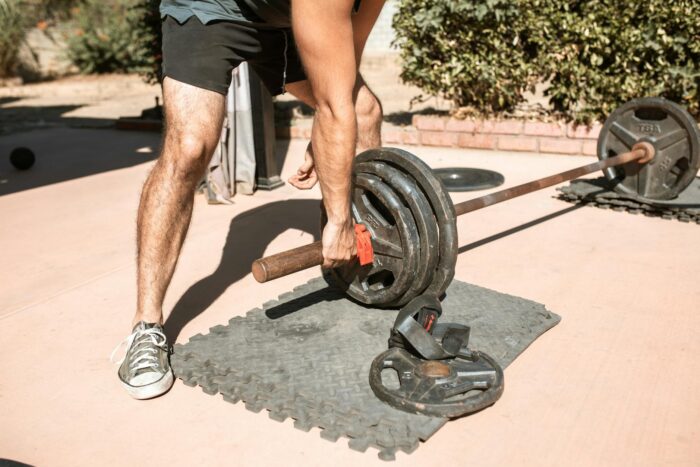
Barbell rows and compound exercises
The barbell row is one of those exercises that shows well why the old pull/push/squat split works. Pick a big movement for your plan and you work your back, arms, core and nervous system all at once.
Below are two simple examples of how to fit compound exercises into your week. The idea isn’t to do as many exercises as possible, but to choose the ones that give the biggest return.
Why do barbell rows belong in your plan?
The pull/push/squat split is simple. One day you pull, the next you push and on the third you train your legs. It keeps the plan easy to follow and gives every big movement group its own place.
The barbell row belongs on pull day. Deadlifts, pull-ups and other back-focused movements fit well into the same day. Honestly, for a beginner this split is often clearer than a long list of individual muscles.
One important detail: the deadlift is a hip extension exercise, but in practice it is often placed on pull day in a three-day split like this. The reason is simple. The deadlift loads your back, legs and the whole posterior chain at once.
Barbell rows on pull day
The first example shows the general logic. Each training day has its own emphasis, and the exercises don’t compete with each other too much.
Example 1
- Monday: deadlift, Romanian deadlift with dumbbells, pull-ups, seated row with a barbell or dumbbells.
- Wednesday: bench press, standing barbell press, dips on parallel bars, standing dumbbell lateral raise.
- Friday: squat, barbell clean, lunges, leg press.
The picture here is fairly clear. Monday is for pulling, Wednesday for pushing, and Friday is a lower-body day with an emphasis on the quadriceps. This rhythm works well when you want to keep your plan simple but not too easy.
Example 2
The second example is more specific. It also lists sets and repetitions, so it’s easier to track your training load.
- Monday – pull: deadlift 5 x 5, weighted underhand-grip pull-up 3 x 8, bent-over barbell row 5 x 5, standing dumbbell hammer curl 3 x 8.
- Wednesday – push: bench press 3 x 5, incline barbell press 3 x 5, seated dumbbell press 5 x 5, weighted dips on parallel bars 3 x 8.
- Friday – legs: squat 5 x 5, straight-leg deadlift 3 x 5, lunges 3 x 8, seated leg extensions 3 x 10, abdominal crunches: 3 x 15.
As you can see, some days also include a smaller, less fundamental exercise for the triceps, biceps or the front of the thigh. These aren’t the core of the plan. They support the bigger picture.
Barbell rows and saving time
The big value of compound exercises is time. Take the bench press, for example. When the barbell moves down to your chest, the upper arm moves away from the body’s midline and the elbow joint flexes. When the barbell is pressed back up, the opposite movement happens.
A simple movement? It looks that way. In reality, a great many muscles work at once. Different parts of the pectoral muscle, the middle and front of the deltoid and, strongly, the triceps all take part in the press. One exercise loads several large muscle groups.
The same principle applies to pulling. During a barbell row, the biceps isn’t the only muscle at work. Your back, the area around the shoulder blades, your grip, your core and the whole posture-holding system all work too. That’s why one big exercise gives back more than a long string of tiny isolation exercises.
Strength, muscle mass and the Pareto principle
Why do compound exercises build strength? Because these are movements where you can use heavy weight and many muscles at once. In a pull-up the whole upper body works, biceps included. In a biceps curl, mostly just the biceps does the main work.
Even more important is coordination. When you train the squat, the muscles involved in it learn to work together. You can do leg extensions, leg curls, calf raises and lower-back exercises separately, but that doesn’t automatically mean a strong squat. A good squatter’s edge often comes from coordination and the nervous system.
The logic is the same for muscle mass. There’s a big difference between a movement that works two muscles at once and one that works twelve. The more large muscles you can load sensibly at the same time, the better the overall payoff of your training.
The Pareto principle, or the 80/20 rule, fits well here. In training, put simply: 80% of the training results you achieve come from just 20% of all the exercises you do. Find that 20% and put it first.
It’s pretty clear that the squat, pulls and presses in their variations are the twenty percent that is actually responsible for 80% of our results. Do them properly.
Finally, a word about the Pareto principle. The 19th-century economist and sociologist Wilfredo Pareto noticed that the world is not evenly distributed. The Pareto principle states that 20% of your priorities produce 80% of your results, provided you devote your main focus, time and resources to that 20%.
- Time: 20% of our time produces 80% of our results.
- Advice: 20% of people demand 80% of the time.
- Production: 20% of output yields 80% of the profit.
- Work: 20% of our work gives 80% of our satisfaction.
- Speech: 20% of what we say accounts for 80% of its impact.
- Donations: 20% of people give 80% of the money.
- Management: 20% of people make 80% of the decisions.
- Books: 20% of books contain 80% of their value.
- Company: 20% of people are responsible for 80% of the success.
- Picnic: 20% of people eat 80% of the food.
FAQ
Are barbell rows suitable for beginners?
Yes, as long as your technique is under control and the weight doesn’t make your back fall apart. Start easy, keep your torso solid and don’t turn the exercise into a snatch.
Do you have to deadlift on pull days too?
You don’t have to, but it fits in well there. If the deadlift makes recovery too hard, choose an easier variation or reduce the volume.
What is the main idea behind this program?
The main idea is to put the exercises that deliver the most results first: the squat, pulls and presses. Accessory exercises come afterward.
Author: Janar Rückenberg
Come and train! ArtGym




