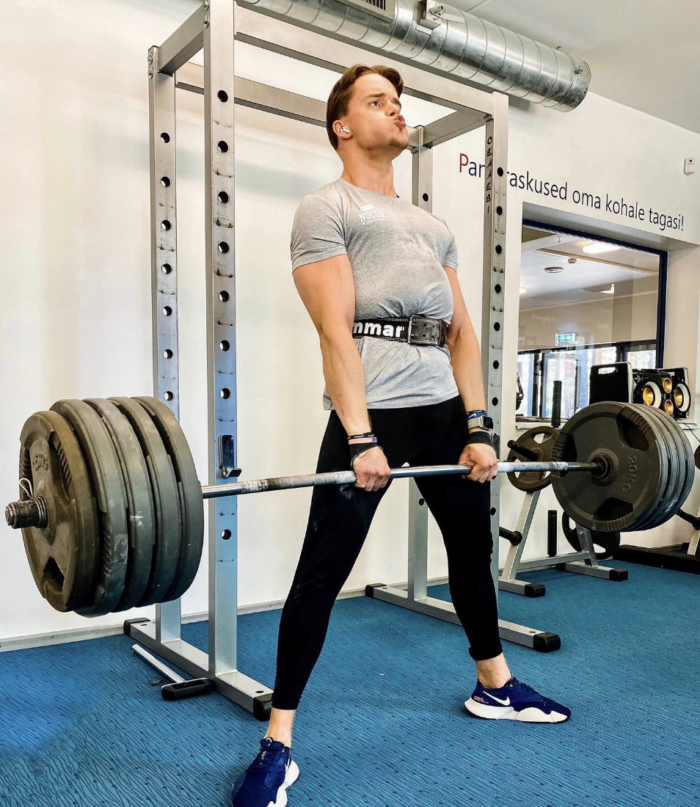
Sumo deadlift: the Finnish technique
The sumo deadlift takes center stage here because it was the variation that helped many Finnish deadlifters achieve their best results. There is no magic formula. It comes down to positioning, hip drive, a strong back, abs, grip and years of hard work.
Sumo deadlift technique starts with the setup
Veli Kumpuniemi has said that if there is even half an inch between his legs and the barbell at the start of a deadlift, he will not complete the lift. That sounds unforgiving, but in the deadlift, the starting position can be the key to the entire lift. Half a step out of position and the barbell drifts away from your body. Your lower back then has to do the work your hips should have done.
For conventional deadlifters, the back does much of the work. Finnish sumo deadlifters, however, fell broadly into two camps. Raimo Välineva and Hannu Malinen, the 1988 IPF world champion, relied heavily on hip drive. Raimo Välineva was even credited with inventing a sumo style that maximized the hips’ contribution at the start of the lift.
If you have tried both deadlift styles, the difference can be surprisingly large. Ari Virtanen, Jarmo Virtanen’s younger brother, had one of the cleanest deadlift techniques seen in Finnish lifting circles. Once he got the weight off the floor, he usually completed the lift. Ari’s best conventional deadlift was 260 kg, while his best sumo deadlift was 307.5 kg, achieved at the 1991 World Championships.
Pirjo Savola, who held the European record in the 56 kg weight class with a lift of 202.5 kg, could deadlift 165 kg conventionally. These numbers make a simple point: technique is more than cosmetic. The right style can change how effectively your body transfers strength to the barbell.
How to make the sumo deadlift work
Veli Kumpuniemi, Janne Toivanen and Aarre Käpylä were sumo deadlifters with strong backs. What stood out was that they straightened and locked their legs first, then brought their backs fully upright. Aarre Käpylä, for example, performed 10 reps with 300 kg using a conventional stance, but his hips still did much of the work, and his legs were practically straight during the lift.
Jarmo Virtanen, an 8-time IPF world champion, used a similar approach. People often spoke of him as though he had been blessed with the ideal build for deadlifting. In reality, that explanation was too simple. He too had technical details to improve, and he was an incredibly hard worker. Bone lengths can help, but anatomy alone does not lift the barbell.
On one occasion, Jarmo demonstrated the difference between deadlifting with relaxed shoulders and with tense, raised shoulders. When he pulled sumo with his shoulders lowered and relaxed, his range of motion was approximately 30 cm shorter than when pulling conventionally with an arched back. That is a substantial difference in a deadlift. The shorter the distance and the better the barbell’s position, the less strength goes to waste.
Many good deadlifters have recommended mastering the conventional deadlift before moving on to sumo. The reason is simple: the conventional deadlift teaches you sound body mechanics in relation to the barbell. Reijo Kiviranta, Kullervo Lampela and others emphasized two points. First, your knees should be over the barbell in the starting position. This brings your hips closer to the barbell and gives you more favorable leverage. Second, you could turn your feet out slightly. This helps with lockout and allows larger deadlifters to engage their hip muscles more effectively.
Foundational strength, work capacity and recovery
Old-school deadlifters often had a solid foundation of general fitness. Many did heavy manual work. Many also had a background in Olympic weightlifting. That gave them a foundation in the gym that you cannot buy in a month or fake with a single training program.
Today, many powerlifters are physically active only during training. That is not necessarily wrong, but general work capacity still has to come from somewhere. Moderate aerobic exercise, core training and mobility work can help your body tolerate the training load. Janne Toivanen trained his abs and obliques in the mornings six times a week and sometimes added aerobic exercise and stretching to his deadlift workouts for the lower back. His program would have been too demanding for many people, but it suited him. He was able to recover from it.
Ismo Lappi trained in a similar way. His high activity level kept his body fat percentage lower, and his recovery remained good. This does not mean that every deadlifter should copy that volume. The point is that just one heavy deadlift day a week may not prepare your whole body for a big lift.
Finland’s strongmen offer telling examples. At the time, 5 6 of their strongmen were deadlifting at least 365 kg or more. The competition season was long, and strength training during that period mainly supported recovery or maintained strength. Meanwhile, carrying and dragging various objects, lifting stones, flipping tires and lifting cars continually worked the same muscles needed for a strong deadlift.
In September 1998, Jukka Laine deadlifted 365 kg despite having trained the deadlift itself only twice over the summer. He competed frequently in strongman and also entered a few powerlifting competitions. Jouko Ahola’s deadlift stayed at the same level even when he rarely trained it. Before competitions, he completed a short, dedicated deadlift training cycle, most recently bringing his lift up to 387.5 kg. Janne Virtanen and Juha Räsänen have both officially deadlifted 362.5 kg, with a training best of 380 kg.
The sumo deadlift needs assistance work
Many Finnish deadlifters did a lot of assistance exercises. Two muscle groups received particular attention: the upper back, especially the lats, and the abs. This makes sense. Your back keeps the barbell close to your body, and your abs keep your torso stable. If either gives way, your position breaks down.
Veli Kumpuniemi was often known for his raw strength. The reason was clear. He could do 5–6 pull-ups with 90 kg of added weight, bent-over barbell rows with 180 kg, and 8–10 one-arm bent-over dumbbell rows with an 85 kg dumbbell. For him, this was routine assistance work, not a goal in its own right.
Weighted pull-ups were fairly common among Finnish deadlifters. They varied their grips and attachments on pulldowns. Ano Turtiainen did a lot of cable pulldowns, used different attachments, and sometimes added rows and chest-supported bent-over barbell rows. The old-school lifters also did plenty of shrugs.
The strong deadlifters of the late seventies and the eighties did a lot of weighted sit-ups at different angles to train their abs. They worked their obliques with barbell or dumbbell side bends. They also did one-handed deadlifts. Later, leg raises, machine crunches and other abdominal exercises became more common. Ab wheel rollouts also became popular, with many lifters doing them from their knees with a weight plate on their back. This placed more of the load on the abs and less on the hip flexors.
The lower back was trained directly mainly through the main lifts: squats and deadlifts. Back extensions were used too, of course, often with added weight. Rauno Rinne did plenty of these and deadlifted 362.5 kg at a body weight of 100 kg. The old-school lifters also did a lot of good mornings, usually after squats, for sets of 5–10 repetitions. The exercise fell out of favor for a while but later made a comeback.
Ano Turtiainen pulled a solid 318 kg at a WPO competition. In preparation for competitions, he used resistance bands on his deadlifts and always did a couple of sets with chains as well. This kind of work teaches you to accelerate the barbell and maintain tension throughout the movement.
Jarmo Virtanen and lessons in deadlifting
Jarmo Virtanen was considered one of Europe’s best powerlifters. He was a very good deadlifter and a strong squatter. His background explains a lot. In his youth, he trained in both powerlifting and Olympic weightlifting, played football and did physical work. He had a high level of all-around fitness.
As a 9-time IPF world champion, he used plenty of variations. He did front squats and back squats, with high and low barbell positions and different stance widths. He deadlifted both conventional and sumo. He thought he had probably done slightly more conventional deadlifting overall, counting both training and competition. Sometimes he also used a very wide snatch grip.
One of his variations was the sumo deadlift from 3 cm platforms. He sometimes went very heavy on this lift. His best result in this variation was 315 kg. He also did conventional deadlift sets in which he paused just before setting the barbell down, keeping the weight off the floor. This meant he began the next repetition already under static tension. The aim was to develop static strength and endurance.
When Jarmo used the sumo style, he performed every repetition as if it were the first. In his view, bouncing the barbell was a complete waste, especially in sumo. He developed speed and explosiveness with high pulls. Translator’s note: see www.youtube.com.
His technique was particularly clean in the eighties, before a hip injury affected it. Squatting played a major role in developing his technique. He sometimes used a very wide stance, occasionally on a Smith machine, and tried to squat as upright as possible. He also practiced his technique without weights in front of a mirror on almost every training day.
He did a lot of abdominal assistance work, but never good mornings. He felt they made him stiff and tight. Staying relaxed was important to him, especially in his upper body. This was intended to help him find positions that gave him favorable leverage in the squat and deadlift. Jarmo did not usually lift to his maximum in the gym, and his training lifts mostly stayed below 300 kg. In competition, however, he was a different man.
In 1988, he lifted 358 kg 2 times. On the first attempt, he pulled the weight up but lowered it before the signal. He also injured his arm on that attempt. He came back and tried the same weight again with a torn arm muscle. The weight came up again, but his grip slipped before the down signal and the barbell fell.
A year earlier, he competed in the 75 kg class in Norway. He made 307.5 kg on his opening attempt. He then went straight for a world record of 332.5 kg and lifted that too. He attempted 340.5 kg twice, but his grip let him down and he could not complete the lift at 340.5 kg. His grip was a persistent problem.
Before his grip problem finally improved, he injured the outer head of his quadriceps. The scars remained for a long time. His grip improved in the nineties, and if he could have combined it with his injury-free technique from the eighties, Jarmo would probably have lifted even more. He certainly had 370–375 kg in him. With a deadlift like that, a 900 kg total would have been comfortably within reach.
FAQ: the sumo deadlift and the Finnish school
Is the sumo deadlift right for everyone?
Not necessarily. Some people are better suited to the conventional style, others to sumo. It comes down to hip mobility, body proportions, back strength and how well you can maintain tension in the starting position.
Why did the Finns do so much accessory work?
Because a big deadlift takes more than a strong lower back. Your upper back, abs, hips, grip and overall work capacity all need to work together. Pull-ups, abdominal work, hyperextensions and different deadlift variations helped build that complete package.
What is the biggest lesson from Jarmo Virtanen?
A simple truth: technique and work capacity must go hand in hand. Jarmo was talented, but he did not rely on talent alone. He practiced his positioning, used variations, kept his whole body strong and was exceptionally tough in competition.
We have had many great deadlifters, and we have had—and still have—Jarmo Virtanen. Reijo Kiviranta, the 1981 world champion in the 110 kg body weight class, put it well: whoever lifts the most has also trained the hardest. There are no secrets, just sheer determination and hard work. If you want to be among the best, you have to take the deadlift seriously.
Finnish Deadlift Secrets Sakari Selkäinaho
Translated by: Janar Rückenberg
Come train with us! ArtGym