Coaches answer: does the front squat win?
Coaches argue about the squat for good reason: the back squat and the front squat load the legs differently, and mistakes show up in different ways. If your goal is stronger legs, better technique and a lower risk of injury, it pays to understand what each variation actually does.
Why are coaches talking about the front squat?
The question is simple: should you drop the regular back squat? Many gym coaches have recommended giving up the conventional squat and replacing it with the front squat, because it’s harder to cheat your technique there. The claim sounds logical. With the bar in front, the body can’t pitch forward as freely or bring the back into the lift.
Charles Poliquin pointed out that the front squat is especially common in sports where lower-body strength and power are directly tied to results. Alpine skiing, bobsled and speed skating are examples. In these sports, strong legs aren’t just a nice extra. They can decide how fast an athlete covers the distance or gets out of the start.
That’s exactly why the front squat works well for testing some athletes. It shows fairly directly how strong the front of the thigh is and how well the athlete can hold position. In a regular squat, part of the work can shift more to the hips and back, especially if the body tips forward.
Is the front squat really the more honest test?
Honestly, yes, often it is. There’s not much room for tricks in the front squat. If the load is in front and your position breaks down, the exercise signals it immediately. The bar starts rolling off your shoulders, the elbows drop and the lift becomes unstable. With heavier weight, this can quickly turn dangerous.
In the regular squat the picture is more forgiving. If the lifter leans the torso forward, they can sometimes increase the load, because the back and hips contribute more. That doesn’t mean the back squat is bad. It simply means it measures a slightly different kind of strength and gives the body more ways to get the weight up somehow.
Poliquin’s point here was quite specific: in the front squat, you can’t so easily shift the work away from the quadriceps with any significant weight. If you try, you pay for it immediately with your position. That is why some coaches consider the front squat a more accurate and adequate yardstick.
Coaches shouldn’t write off the regular squat
Here comes the important part: the regular back squat shouldn’t be forgotten entirely. One exercise doesn’t cover all of leg training. Poliquin said he uses many different squat variations himself and that there are over seventy ways to squat. Saying that one is enough for good legs would be like claiming that all you need to build a house is a hammer.
The comparison holds. The front squat teaches a more upright posture, demands a strong core and gets the front of the thigh working properly. The back squat often allows heavier loads, involves the hips and the posterior chain more, and is a staple exercise of strength training for many people. Both have their place.
If you train in the gym for general fitness, muscle mass or athletic performance, the choice doesn’t have to be one or the other. It makes more sense to ask: what goal is today’s workout serving? If you need clean, controlled work for the front of the thigh, the front squat fits well. If the aim is to build overall squat strength, the back squat isn’t going anywhere.
How to do the front squat and what to watch for
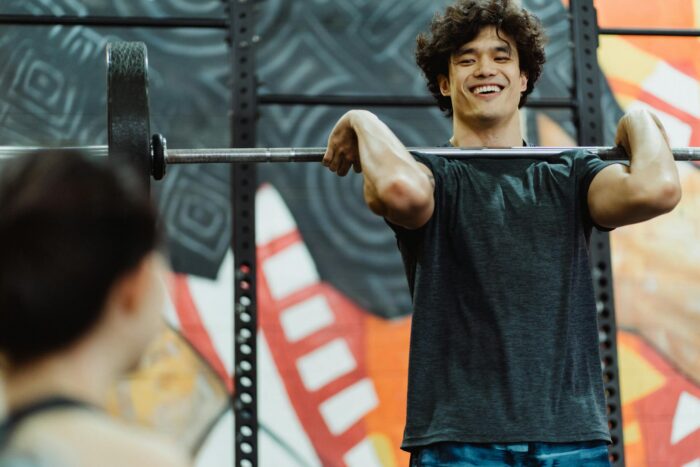
Poliquin preferred the weightlifters’ front squat position over the bodybuilders’ classic version with the arms crossed on the bar. In the weightlifters’ position, the bar rests on the shoulders, the elbows are high and the upper body stays more upright. It isn’t comfortable for everyone at first, because the wrists and shoulders have to move well enough.
His practical limit was clear: he never recommended going over 6 repetitions in the front squat. The reason wasn’t a magic number but technique. Experience showed that around that point the lifter starts to lose position. The body pitches forward, the back rounds into marked kyphosis and the exercise becomes risky for injury.
If you do sets of six, the training volume can still be high. The original example mentioned 5–10 working sets. An even tougher example was a 107 kg powerlifter who front squatted 240 kg. Poliquin called it the best front squat he had ever seen with his own eyes: a clean performance, not the version American college football players do.
The strongest front squatters he had seen squatted 3.3 times their body weight. About the athlete who front squatted that same 240 kg, he added that the man did 10 sets of six of front squats in the morning and 10 sets of ten of regular back squats in the evening. That is not a plan for the average lifter but an example of a very high level.
Coaches and the squat: what should the average lifter take away?
A simple truth: the front squat isn’t automatically better than the regular squat. It’s different. It forces you to stay upright more honestly, exposes technical errors quickly and works well for assessing an athlete’s leg strength. At the same time, it doesn’t cover all the goals the back squat can serve.
If the front squat feels foreign to your shoulders or wrists, start light. Keep your elbows high, your chest up and the movement under control. When your position breaks down, the set is over. The goal isn’t to grind out a rep at any cost, but to perform reps that build your legs without hurting your body.
Apply the same sober logic to the back squat. If your torso pitches forward every time and the load shifts onto your back rather than your legs, the problem isn’t the exercise but the execution, the weight or your mobility. Sometimes lowering the weight helps more than hunting for a new exercise.
FAQ
Is the front squat safer for beginners?
It can be more honest, because poor positioning shows up quickly. Still, safety depends on technique, mobility and the weight you choose. A beginner should start with a light bar or a practice stick.
Should you drop the back squat from your program?
No, you don’t have to. If your technique is under control and the exercise suits your body, the back squat is still a strong foundational exercise. The front squat can complement it, not necessarily replace it.
Why aren’t long sets recommended in the front squat?
In longer sets, your upper body tires from holding its position. Once your elbows drop and your back collapses forward, the lift quickly becomes risky. That’s why Poliquin set the limit at 6 reps.
The questions are answered by Charles Poliquin. The article comes from www.T-Nation.com, from the column “With one of the world’s premier strength coaches!”
Translator’s note: Going forward, I intend to bring you more practical and informative answers and ideas from this column.
Translated by Janar Rückenberg
Come and train! ArtGym