Squatting in Inna Terasmaa’s heavy training session
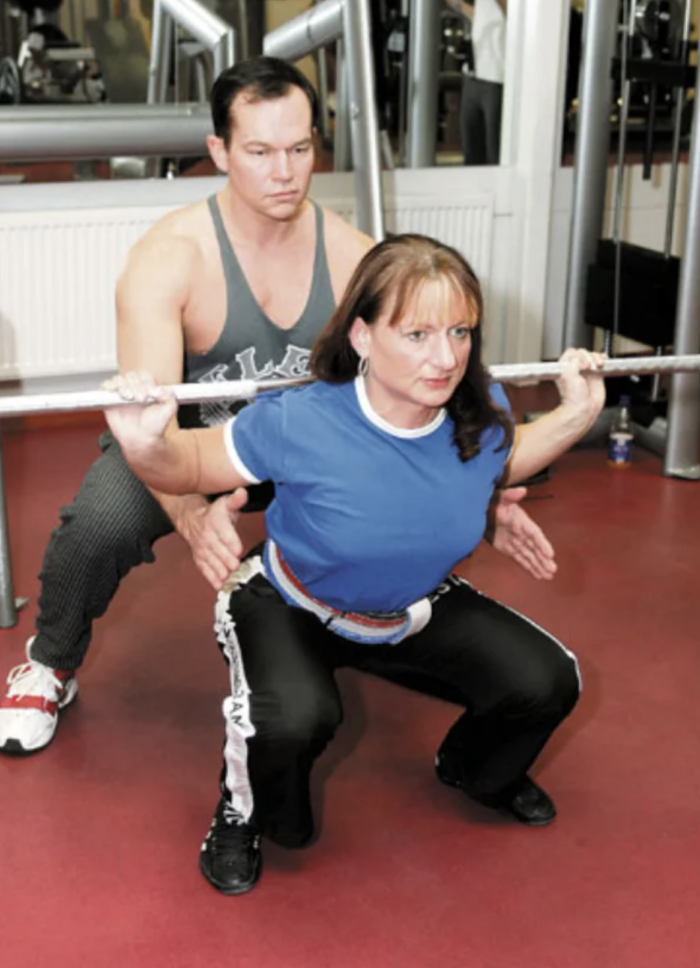
Squatting is the centerpiece of the whole day in Inna Terasmaa‘s training: the weight climbs, the reps drop and every detail counts. Let’s look at how a serious powerlifting squat workout went at the Arctic Sport club in Tartu, led by Marko Terasmaa.
Why squatting matters so much in powerlifting
After the Tegijate workout with Kaido Leesmann, the forum made one thing clear: readers wanted to read more about powerlifting. No sooner said than done. We turned to Marko Terasmaa, coach of Inna Terasmaa, a former bodybuilder and fitness competitor who has won top titles countless times and is now Estonia’s most successful powerlifter.
One Thursday afternoon we headed for Tartu. Inna was already focused in the Arctic Sport gym. The first impression was simple: a very powerful woman. Her arms stood out immediately, surely close to 40cm. In the corner of the gym sat a large sports bag: several squat suits, a T-shirt to wear under the suit, a lifting belt, knee wraps. To a layperson, it’s a world of its own.

Squatting: from the warm-up to a 170kg attempt
The main workout consisted of squats. First came warm-up sets with lighter weights. 50 kg went on the barbell and 10-12 squats were done with it. After that the weights climbed and the reps went down. The point of a warm-up isn’t to exhaust the muscle but to get the body ready for the working sets.
Marko also explained the principle of the full squat. In competition, a squat counts as completed when, on the way down, the top surface of the thigh at the hip joint is lower than the top surface of the knees. This is not a half-hearted dip but a truly deep, controlled movement.
The next weights were 80kg and 110kg. Then the knee wraps came into play. Not at full tightness yet, but enough to feel their effect. Honestly, it’s uncomfortable. Your legs feel like they’re in a vise and walking becomes clumsy because the knees don’t bend freely.
A belt was added too, to reduce the risk of injury. At 130 kg the rep count dropped to three. Inna was in the middle of her immediate pre-competition training, so the weights were heavy and the reps few. In competition, what counts is the max, not how many times you can work with the same weight.
At 140 kg two reps were done and the wraps were already tied very tight. With 150 kg on the barbell, a squat suit went on that supports the body and hips. A Fitness TV video was supposed to show in more detail how it all looked. Since we were there too, Inna tried a weight she had never tried before: 170kg. The squat succeeded.
Accessory exercises after a heavy squat workout
Once the squats were done, the workout moved on to accessory exercises. This part resembled bodybuilding more. The goal was no longer to chase a record but to work the leg muscles calmly through to the end.

Seated leg extensions
The rep count was 10-15. The point of the exercise was to work the muscle thoroughly. 3-4 sets were done, going by feel. It’s a simple movement, but after heavy squatting the front of the thigh quickly makes itself known.
Lying leg curls
This exercise worked the back of the leg. You lie on the machine and curl your legs. The weights are lighter, but the work is necessary, especially for those who want to squat heavy weights. Strong hamstrings help keep the movement stable.
Hip adduction on the machine
Hip adduction supports squatting because powerlifters often use a stance wider than average. That puts the inner thigh muscles to a lot of work. If they fall behind, technique starts to break down under heavy weight.
Squatting and preparation according to Marko Terasmaa
According to coach Marko Terasmaa, preparation for the World Championships began a week after the spring Estonian Powerlifting Championships, where Inna became overall champion for the fourth year in a row. At the start, the training load was cut back and work began on reinforcing the foundation.
Workouts were done with longer sets, 8-12 reps. Three basic exercises came first: squat, bench press and deadlift. Accessory exercises went to the back muscles, upper arm muscles and forearm muscles. Calf and abdominal training weren’t left out either.
On average, training took place three times a week. Large muscle groups were trained on different days and enough time was left for recovery. Usually there were 48 hours between workouts, and the same muscle group came up once a week. Later came a mass phase, in which the weights increased and the rep count dropped to 6-10 reps.
By the time of writing, preparation was in the strength phase. Sets were shorter, the weights climbed and the goal was to develop maximal strength. The whole period also included an aerobic session of about 1 hour 1-2x a week to keep the “engine” running.
Nutrition and competition weight
Inna Terasmaa’s diet was precise. Meal 1: 3 egg whites, 1 of them with the yolk, porridge made from 75g of dry ingredient, 1 tbsp of jam and 15-20g of nuts or 15-20g of oil. The gap between meals was 2.5-3 hours.
Meal 2: 100g of meat or chicken (raw weight), 50g of dry pasta, 100g of fresh salad and ketchup for flavor. The gap was 1-1.5 hours. Meal 3: 100g of meat, chicken, red meat or turkey (raw weight), 75g of dry rice, 100g of fresh salad and either unflavored yogurt or ketchup. The gap was 1 hour.
After the workout came meal 4: a Tai Kane WGPD shake with 50g of powder or Tai Kane DR7, in both cases with Tai Kane glutamine and Tai Kane creatine citrate added. The gap was 1 hour. Meal 5 was 100g of meat or chicken (raw weight), 50g of rice or pasta, 100g of fresh salad and Felix yogurt mayonnaise.
Each week, 1-2 days of good and better food in moderate amounts were allowed. This helped avoid constant “head hunger” during the long preparation. At the same time, the competition body weight had to stay at up to 67.5 kg, so there was no room to go wild with food. The Estonian delegation travelled to Stavanger, Norway, on 5-11 November.
FAQ
Does a full squat simply mean a deep squat?
In powerlifting, the full squat has a clear standard: the top surface of the thigh at the hip joint must be lower than the top of the knees. Only then is the squat deep enough under competition rules.
Why are knee wraps and a squat suit used?
They support the joints, torso and hips under very heavy weights. You do need to know how to use them, though. As Inna’s workout showed, wrapping the knees and getting the suit on is almost a workout in itself.
Is squatting alone enough for strong legs?
No. The squat is the main lift, but you also add exercises for the quads, hamstrings, inner thighs, calves and abs. Balanced musculature helps you move better under heavy weight.
Author: Joker
Come and train! ArtGym