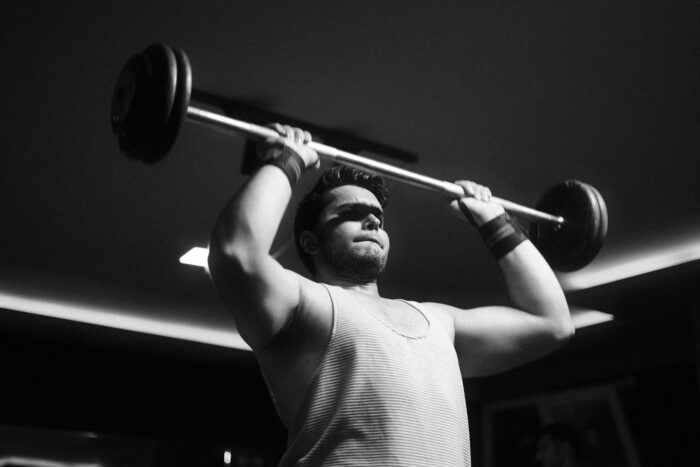
Question for the coach: how to break through a plateau
The question for the coach is a simple one: what do you do when the standing press just won’t move anymore? If the same weight stays stuck in front of you for 5 workouts in a row, it doesn’t always mean you’ve run out of strength. Most often, your body has simply adapted to exactly the strain you give it.
Why does the question for the coach come up in the first place?
Almost every lifter reaches a point sooner or later where progress stalls. For a while everything moves well: the weights go up, the reps come and your shoulders feel stronger. Then you hit a wall.
The original question was about the standing press. The exercise was part of a shoulder training session and was done as a pyramid with 5 different weights, 12-6 reps. For the last five workouts, the lifter got stuck at one weight. Even on days when there seemed to be plenty of energy, they couldn’t get past it.
A plateau like this isn’t strange. It’s common in training. Tom Prince, the 1997 NPC international champion, explained it very simply: the body doesn’t develop in a straight line. Growth comes in waves, not at exactly the same pace every week.
Think of a child growing. Nobody grows an even 2.54 cm a month until they reach adult height. Growth comes in spurts. Strength and muscle work the same way. Some periods bring a quick jump, others hold you in place.
Question for the coach: what does a plateau really tell you?
A plateau doesn’t always mean a bad training program. Often it means the program has become too familiar. If you’ve done the same exercise the whole time, with the same rhythm, the same number of sets and the same rep range, your body already knows what to expect.
The original example was the standing press, 5 sets of 6-12 reps. That can be good work. But once your body has adapted to it, pressing the same thing even harder may no longer help.
A simple truth: sometimes you don’t need more willpower, but a different stimulus. Your shoulder muscles, nervous system and technique get a new signal when you change the angle, the equipment, the rep count or the feel of the exercise.
How do you get past a training plateau in practice?
The first step isn’t to overhaul your whole training. Start with one change. If the problem is the standing press, swap it for a different overhead press variation for a while.
Change the exercise, not the goal
If you’re stuck on the standing press, try the seated dumbbell press. Dumbbells force each side to work separately and can expose a small imbalance that you don’t feel as clearly with a barbell.
Another option is the seated barbell press from behind the neck. It demands good mobility and control, so it isn’t for everyone. If your shoulders or neck complain, choose a different variation.
You can also try the seated press on a Smith machine or a shoulder press machine. These variations reduce the balancing demand and let you focus more on the work your shoulders are doing.
Change the rep count
If you’ve stayed in the 12-6 range for a long time, do it differently for a while. One way is to extend your reps to at least 15. That gives the muscle a longer time working and changes how the training load feels entirely.
Another way is to move toward shorter sets and focus on strength. Here your technique has to be clean. There’s no point adding weight if every rep turns into a half rep or your lower back starts doing the work.
Question for the coach and variety in training
Variety doesn’t mean training randomly. It means giving your body a new task while keeping the direction the same. If your goal is a stronger overhead press, still choose exercises that are close to the shoulders and the pressing movement.
You can change several things: the exercise, the number of sets, the rep count, the tempo, the rest breaks or the order of the workout. Changing everything at once isn’t smart. Then you can no longer tell what actually helped.
A good rule of thumb is to hold a change for 3-6 weeks and watch what happens. If your shoulders feel better, your reps improve and your motivation comes back, you’re on the right track.
Honestly, the mental side matters just as much here. The same exercise, the same weight and the same frustration can take the joy out of training. A new variation freshens up your head, even if the muscle is still working toward the same goal.
FAQ
Does a plateau mean the training program is bad?
Not necessarily. A plateau can come even with a good program once your body has adapted to it. Before changing the whole program, change one important part, such as the exercise or the rep range.
Should you drop the standing press completely?
Not necessarily. Take it out for a while or do it with a lighter load. Later you can bring the exercise back and see whether new progress comes more easily.
When should you ask a coach for help?
If the same problem repeats for several weeks, your technique breaks down or your shoulder starts to hurt, it makes sense to have a coach check your movement. Sometimes a small technical fix is worth more than a new list of exercises.
Come and try a session with a coach at ArtGym!
Author: Muscle&Fitness, translated by K.Reial
Source: WHO – physical activity.
Come and train! ArtGym