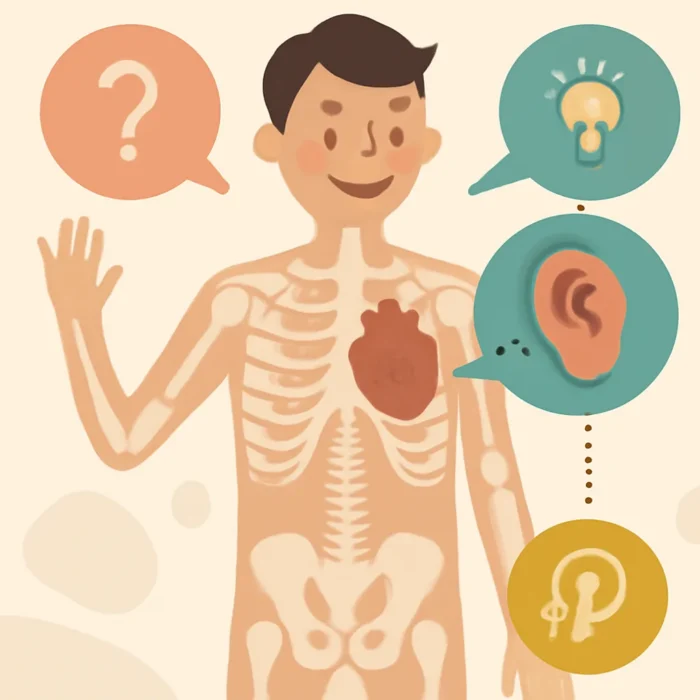
Body trivia: the smallest bone in the human body
Human body trivia often starts with something tiny: the smallest bone in the human body is in the ear, but that is far from the only surprise your body has in store. Here is a selection of facts, organized and rewritten for clarity, that will make you look at the brain, bones, muscles and senses a little differently.
What makes body trivia so fascinating?
The human body has always fascinated me. How does it work? Why do we yawn? Why does tickling get out of hand so quickly? And how can such a tiny body part be so vital to life?
That curiosity led me to Dr. Stephen Juan’s book “The Odd Body.” Juan is an anthropologist, a researcher who studies behavioral habits and a professor at the University of Sydney. His book looks for answers to questions that seem both ordinary and strange.
Below is a selection of facts about the human body. Some are amusing, some practical, and some simply raise an eyebrow. A few older claims deserve a cautious reading, but the overall message remains the same: the human body is full of clever, strange and sometimes remarkably powerful solutions.
The body and brain: a little power station in your head
The brain is the body’s control center. One person’s brain produces more electrical impulses each day than all the mobile phones in the world combined. If you could concentrate and harness your brain’s power, you could use it to light a ten-watt bulb.
When you touch something, information about that contact travels to your brain at 124 miles per hour. An average human brain contains 100 billion nerve cells. Women’s brains are, on average, 12% smaller than men’s, but that number alone says nothing about a person’s intelligence, abilities or thinking.
On an average day, the human brain produces around 70000 different thoughts. Honestly, on some days it feels like even more, especially when it is well past bedtime.
Eyes, nose, ears and mouth
Human eyes are not truly jet black. Eye color can range from very pale blue to dark brown, but completely black eyes are not normally found in humans. The eye can distinguish 10 million different colors, and you use around a quarter of your brain’s capacity to control your eyes.
It is almost impossible to keep your eyes open while sneezing. Particles expelled from your mouth during a sneeze can travel at 100 miles per hour. When you laugh, you release small puffs of air that travel at 70 miles per hour.
Smell is a sense closely linked to memory. A single scent can instantly bring back memories of an old home, school cafeteria soup or a summer training camp. The average lifespan of a tongue papilla is 7–10 days. By the age of sixty, most people have lost around half of their tongue papillae.
The average speaker releases around 300 microscopic droplets of saliva from their mouth per minute. That is about 2.5 droplets per word. The average mouth produces 851.76 ml (1.8 pints or 3.6 cups) of saliva a day. Your nose and ears grow as you grow, but your eyes stay roughly the same size as they were in childhood.
Bones: the body’s smallest bone and its largest supports
If you ask what the smallest bone in the human body is, the answer takes you inside the ear. That is where the auditory ossicles are found: tiny bones whose job is to transmit sound. Compared with the body’s large bones, this delicate mechanism seems almost unbelievable.
Tooth enamel is the hardest substance produced by the human body. The index finger is the most sensitive finger. The strongest bone in the human body is the femur, or thighbone. The jawbone has been considered the hardest bone. The knee joints are among the joints most prone to injury.
A newborn’s kneecap is not yet like an adult’s. An older text stated that the knee’s joint capsule only forms between the ages of 2–6; claims like this are best read as historical trivia rather than medical advice.
The distance from your wrist to your elbow is approximately the same as the length of your foot. At birth, you have 300 bones. Some fuse as you grow, leaving you with 206 bones as an adult. The human hand consists of 27 bones, the entire leg consists of 31 bones, and the skull consists of 29 different bones.
The femur, or thighbone, is the longest bone in the human body, measuring around a quarter of your total height. It has been said that if a femur is positioned perfectly upright and a load is applied directly to it, it can remain intact even under a weight of 1600–1800 kg. Most human bones are ¾ water. The human skeleton renews itself completely roughly every seven years.
Muscles, blood and metabolism
Your body is more than bones and skin. Muscles produce movement, blood vessels keep tissues functioning, and the heart pumps to keep the whole system running. If all your blood vessels were untangled and measured, their combined length would be 60 thousand miles, stretching around the Earth 2.5 times.
Blood travels through the entire network of blood vessels in a healthy person’s body in 60 seconds. The human heart beats an average of 70 times per minute. Over an average lifetime, that adds up to 3 billion beats. The pressure generated by a heartbeat is great enough to squirt blood 30 feet (about a meter). Over an average lifetime, the heart pumps 40 million gallons of blood.
The liver is the largest gland and the largest internal organ in the human body. The right lung takes in more air than the left because the left side has to leave room for the heart. Human bone marrow produces 3 million blood cells every second, and just as many are destroyed every second. The stomach produces a new lining every two weeks. Stomach acid is strong enough to break down a fingernail.
Blood is noticeably thicker and more viscous than fresh water, but has roughly the same viscosity as seawater. All the urine produced worldwide in one day would be enough to flow over Niagara Falls for about 20 minutes. The heat an average person gives off in a day could bring 8 gallons of cold water to a boil.
If it were possible to compress the spaces between all the atoms that make up the human body, you would become small enough to walk through the eye of a needle. This is a good illustration of how much empty space there is in matter, even though we do not notice it in everyday life.
There is an old claim about muscles: every pound (about 450 grams) of muscle you gain burns an extra 50 kcal per day. Gaining 5 pounds (2.25 kg) of new muscle would therefore burn a total of 250 kcal per day. Treat this as a simplified illustration, rather than an accurate calculation of your own calorie expenditure.
Muscles are made up of muscle fibers. Each muscle fiber is thinner than a human hair, yet can pull a weight 1000 times its own mass. People who have not engaged in regular physical activity by age 65 may lose around 80% of their muscle strength. The human body has more than 650 muscles.
A muscle uses only 20–30% of the energy available from ATP for movement and contraction; the rest dissipates as heat. No two muscles in the body have exactly the same function. If a muscle becomes paralyzed, movement in that part of the body will inevitably be affected.
In simple terms, movement such as walking or running is a process in which the body repeatedly moves out of balance and regains it. You cannot lose fat from just one specific part of your body. Fat mobilization occurs throughout the body, while strength training can strengthen the particular muscle an exercise targets.
The human body contains about 60,000 miles of blood vessels. Their job goes beyond delivering oxygen to tissues and removing waste products. Blood vessels also help keep the body’s internal environment stable. Carrying 11 kg of excess body weight creates around 5 miles of additional blood vessels through which the heart has to pump blood.
As you may know, the heart relaxes and rests between beats. Over an average lifetime, the human heart spends about 20 years at rest. If you were standing upright and your veins had no valves, all your blood would flow into your lower body and legs.
Body trivia: skin, hair and nails
Skin is more than just a covering. It is an extensive protective layer that changes along with us. Your belly button gets larger or smaller as your body weight rises or falls. By around age 70, you will have shed about 47 kg of skin.
Eating plenty of carrots can give your skin a slightly browner or more orange hue. A 1 square inch area of skin on your hand contains around 600 pain receptors, 9000 nerve endings, 36 heat receptors and 76 pressure receptors.
According to an old piece of trivia, the length of a finger indicates how quickly its nail grows. The middle fingernail grows fastest, and the thumbnail slowest. Fingernails grow almost four times faster than toenails.
Hair grows fastest in the morning. If human hair were braided into a rope as thick as a nylon rope, it could lift a locomotive. The translator noted in the original text that this might even be plausible, since Germans once used human hair to make rope and cord specifically for its strength.
The old text also claimed that more intelligent people’s hair contains more zinc and copper. Such associations should be interpreted cautiously. What is known, however, is that men lose around 40 hairs per day and women around 70 hairs.
The original text made a blunt statement about cellulite: there is no such thing as cellulite. More precisely, this means that the visible dimpling of the skin results from the structure of the underlying fat and connective tissue. The fat in these areas is not inherently different from fat elsewhere in the body. Training, being physically active and reducing excess fat may also make the skin look smoother.
FAQ: body facts at a glance
What is the smallest bone in the human body?
The smallest bone in the human body is in the ear. It is one of the auditory ossicles and helps transmit sound vibrations. Small in size does not mean small in importance.
Can you lose body fat from one area?
In practice, no. Abdominal exercises strengthen your abdominal muscles, but your body uses fat more broadly. Physical activity, strength training and nutrition work together.
Why do facts about the body sometimes seem unbelievable?
Because much of what the human body does happens out of sight. We notice the result, rather than the entire process. That is exactly why it is good to read these facts with curiosity, but also with a healthy dose of critical thinking.
Compiled and translated from various materials and websites by Janar Rückenberg
Author: Janar Rückenberg
Come work out! ArtGym