
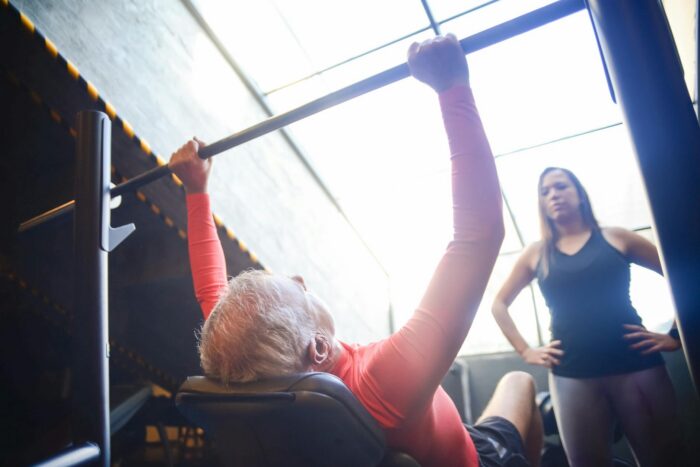
Prioritize your chest: a training program that works
Your chest is the focus of this program: the goal is to build chest muscle mass and improve your bench press. Below is a practical split that alternates heavier weeks of structured training with more flexible, higher-volume weeks. The idea is to choose a rhythm that suits you and stick to it, rather than trying to do everything at once.
Why make your chest a priority?
If your chest development is lagging, simply adding a couple of sets of pec deck flyes at the end of your usual workout generally won’t be enough. Your chest needs a dedicated place in your weekly schedule, sufficient training frequency and a variety of rep ranges. The same applies to pressing: if you’re making no progress with the barbell, you need to look at your training load, rest periods, exercise order and recovery.
The simple truth is that muscle mass and strength often go hand in hand. For many people, improvements in the bench press come with chest muscle growth. The relationship isn’t always linear, but it exists. That’s why this program puts structured pressing first, followed by accessory exercises that give your chest volume, a stretch and a final burn.
A week with four training days gives your chest two dedicated sessions. A week with three training days offers a change of pace, with more room to train by feel. I wouldn’t treat it as an easy week, but as a different kind of stimulus. Honestly, it can be a pretty tough week.
How do you fit chest training into your week?
The basic approach is simple: choose one four-day split and follow it for 1 or 2 consecutive weeks. Then slot in one week in which you train only 3 days. After that, return to the four-day schedule. This gives your chest frequent training without keeping your body locked into the same routine.
Four-day split options
Train four days a week

Mon – Chest, shoulders, triceps
Tue – Thighs, calves, abs
Wed - Rest
Thu - Chest, triceps
Fri – Back, traps, biceps
Sat - Rest
Sun – Rest

Mon – Chest, shoulders, triceps
Tue – Rest
Wed - Thighs, calves, abs
Thu - Chest, triceps
Fri – Rest
Sat - Back, traps, biceps
Sun – Rest

Mon – Chest, shoulders, triceps
Tue – Rest
Wed - Thighs, calves, abs
Thu - Rest
Fri – Chest, triceps
Sat - Back, traps, biceps
Sun – Rest

Mon – Rest
Tue – Chest, shoulders, triceps
Wed - Thighs, calves, abs
Thu - Rest
Fri – Chest, triceps
Sat - Back, traps, biceps
Sun – Rest

Mon – Chest, shoulders, triceps
Tue – Rest
Wed - Thighs, calves, abs
Thu - Rest
Fri – Chest, triceps
Sat - Rest
Sun – Back, traps, biceps

Mon – Rest
Tue – Chest, shoulders, triceps
Wed - Rest
Thu - Thighs, calves, abs
Fri – Rest
Sat - Chest, triceps
Sun – Back, traps, biceps
Choose one of these. Not all of them. If work, family or school forces you to rearrange your week, move the days around while keeping the structure intact: train your chest 2 times a week, give your legs and back their own days, and keep your rest days.
The three-day week
Train three days a week

Mon – Chest, shoulders, triceps
Tue – Rest
Wed - Thighs, calves, abs
Thu - Rest
Fri – Back, traps, biceps
Sat - Rest
Sun – Rest
The three-day week takes a more traditional bodybuilding approach. Here, your pressing doesn’t have to follow a strict system. You can add more chest volume, more pump work and something you wouldn’t do in a regular week. Training volume for this week can be 25 – 50 sets, but that doesn’t mean flinging weights around. You still need to perform the exercises with control.
During the four-day week, a good approach is to follow a structured system for your first chest exercise: 5 x 5, the Russian system or another program. This is the foundation of the day’s workout. The second exercise could fall within the 6 – 10 rep range, averaging 8. The third exercise could be in the 10 – 15 rep range, going up to 20 reps if needed. Take adequate rest between sets in the structured program, allowing 2 – 2.5 minutes if needed. Rest periods for the other exercises can be 1.15 – 1.30.
Aim for a total training volume of around 25 working sets during the four-day week. That’s enough to give your chest a solid training load without pushing your shoulders and triceps to their limits every week.
A practical sample program for your chest
The example below covers one four-day training week. Perform the exercises in the order shown, because the sequence is deliberate. The priority work comes first, followed by extra volume, with the smaller muscles last.
Program breakdown

Mon – Chest, shoulders, triceps
Tue – Rest
Wed - Thighs, calves, abs
Thu - Chest, triceps
Fri – Rest
Sat - Back, traps, biceps
Sun – Rest
Mon – Chest, shoulders, triceps
- Bench press: 5 x 5, the Russian system or another program.
- Decline dumbbell flyes – 3 x 6 – 10.
- Pec deck flyes – 3 x 12 – 15.
- Bent-over barbell row with a wide overhand grip to target the rear delts + bent-over dumbbell raises – 3 x 8 – 10.
- Standing dumbbell lateral raises – 2 – 3 x 10 – 12.
- Floor skull crushers for triceps – 6 x 4/5 x 5/4 x 6.
- Cable pushdowns 3 x (3 x 8): perform three sets of eight, resting 15 – 20 seconds between each set of eight. Complete three of these groups of three sets, resting 1.5 minutes between groups.
- Dumbbell flyes – 5 x 5, resting 20 seconds after each set of five. Choose your weight wisely, as you should reach failure by the end.
Wed – Thighs, calves, abs
- Squat: follow a progression scheme of your choice.
- Leg press – 3 – 4 x 8.
- Barbell hack squat – 2 x 10 – 12.
- Seated leg extension – 5 x 10, resting 20 seconds between sets of ten.
- Leg curl – 4 x 6 – 8.
- Standing calf raise on the hack squat machine – 6 x 6/5 x 7/5 x 8/4 x 9/4 x 10. Move on to the next set and rep scheme each workout, keeping the weight the same. Once you reach the end of the sequence, increase the weight.
- Abs – 4 sets.
Thu – Chest, triceps
- Bench press: 5 x 5, the Russian system or another program.
- Incline dumbbell fly – 3 x 6 – 10.
- Cable crossover – 3 x 20.
- Triceps dip on parallel bars – 5 x 4/4 x 5/3 x 6.
- Barbell floor press for triceps – 4 x 6 – 8.
- Bench press – 2 x to failure, using the weight from your third set of 5 x 5. If you are following the Russian system, choose a weight that takes you to failure at 8 – 12 reps and do 2 sets.
- Cable triceps pushdown – 5 x 5, resting 20 seconds after every five reps. Use a slightly lighter weight so you can get through the extended set.
Sat – Back, traps, biceps
- Wide neutral-grip pull-up – 6 x 4/5 x 5/4 x 6.
- Bent-over dumbbell row or landmine row – 3 x 6 – 8.
- Seated row 3 x 8 + 3 x 8 + 3 x 8. Rest 15 – 20 seconds after every eight reps and 1.5 – 2 minutes after each group of three sets.
- Overhand-grip pull-up – 2 x to failure with bodyweight.
- Barbell or dumbbell shrug – 2 – 3 x (3 x 5). Do 5 reps, 5 reps, 5 reps, resting 20 seconds after every five reps and 1.5 minutes after each group of three sets.
- Standing barbell curl – 5 x 5/4 x 6.
- Seated dumbbell curl, supinating your hands by rotating them outward as you lift – 2 – 3 x (4 x 5). Do 5, 5, 5, 5, resting 20 seconds after every five reps.
Does that sound like a long session? Your workouts should actually take no more than 70 minutes, provided your rest periods do not drag on and your phone does not dictate the workout. If the sets in your progression scheme require more focus, give them the time they need. Keep a steady working pace on the accessory exercises.
Chest training and ideas for a shock week
During the three-day training week, you can give your chest something completely different. The program does not have to look pretty on paper. It can be dense, hard, uncomfortable work that wakes your body up. What is actually happening? You are giving the muscle a stimulus it does not get during a normal week on your progression scheme.
- Choose a rep range and train your chest using presses only: 30, 40 or 50 sets in the 5 – 10 rep range.
- Combine the bench press and fly in a superset. For example, do 10 of these supersets: finish your presses, then go straight into flyes.
- Use the contrast method for flyes or presses. For example: 120 kg – 6x; 140 kg – 3x; 120 kg – 6x, 140 kg – 3x, and so on.
- Do five tri-sets: dumbbell flyes for 10 reps on an incline bench, 10 reps on a flat bench and 10 reps on a decline bench.
- Do dumbbell flyes: 10 x 10, using the same weight throughout.
- Try a chest circuit: bench press, incline fly, pec deck fly. Complete the circuit five times.
- Try sets of twenty reps. For example, do dumbbell flyes for 3 x 20, resting 30 seconds between sets, and complete 3 of these groups of three twenty-rep sets.
- Use negatives and timed sets in your chest exercises.
- Do 100 reps of presses or flyes in a workout. Choose a weight you think you could manage for, say, 20 x 5.
- See how many reps you can press with 100 kg in 30 minutes. Rest as much as you like, but aim to complete as many reps as possible in the allotted time.
- Twenty-ones, or 21s, for your chest: press from the bottom to the top for 7 reps, from the midpoint to the top for 7 reps, then finish with 7 full reps.
- Use set and rep schemes: 5 x 5, 6 x 6, 7 x 7, 8 x 8, 10 x 10. These work for both presses and flyes.
- Do a regular chest workout, but with high volume—for example, 40 working sets.
- Do your chest workout in reverse order.
- Complete your chest workout twice in a row in the same session, using the same weights.
- Do pec deck flyes for 10 x 10, with 60-second rest periods and with 30-second rest periods.
In a week like this, your shoulders and triceps need less work. If your chest has already taken a pounding, your shoulders and triceps don’t need to play the hero that same day. Sometimes it’s fine to skip them altogether. Your chest is the priority, not ticking off every muscle on a chart.
FAQ: chest training and your training program
Can I train my chest 2 times a week?
Yes, if you keep training volume and recovery under control. The idea here is to give your chest two distinct workouts, with rest days and training for other muscle groups in between.
Is 5 x 5 better for strength or size?
5 x 5 works well for both. It provides enough heavy work to improve your pressing strength and creates a foundation you can build on by adding volume through accessory exercises.
What should I do if my shoulder starts to hurt when pressing?
Reduce your training load, check your technique, and don’t push through pain. If necessary, skip the extreme shock-week ideas and keep the volume more manageable until the movement feels solid again.
Author: Janar Rückenberg
Source:Turg.Fitness.ee
Come train with us! ArtGym




