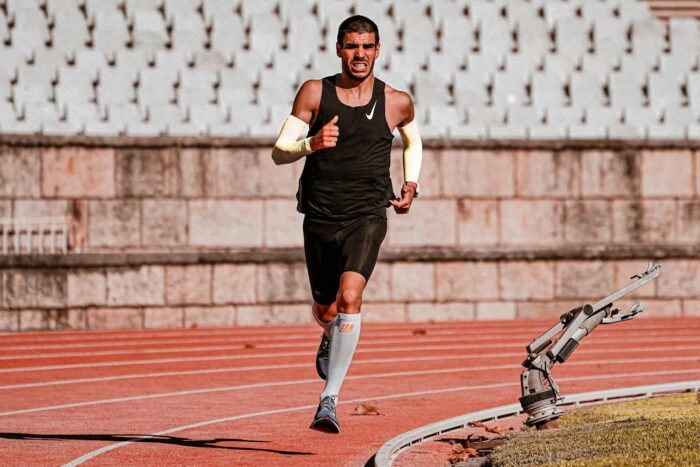
Limits of athletic performance across sports
Athletic performance depends on more than motivation and a training plan. In some sports, long limbs and high oxygen uptake offer an advantage; in others, a shorter bar path, fast-twitch muscle fibers and a strong nervous system matter more.
The simple truth is that not everyone can reach the same level in every sport. That does not mean training is pointless. It means you are better off choosing a sport where your natural attributes and willingness to work pull in the same direction.
Why does performance potential vary across sports?
If two people follow the same training routine, eat sensibly and recover properly, they may still get different results. One improves quickly at running, while another plateaus on the same training volume. A third seems to build muscle just by looking at the weights in the gym, while a fourth has to work long and hard for every kilo.
This is where limiting factors come into play. Some can be improved through training, some can only be changed to a degree, and others are essentially innate. In this article, we are primarily concerned with the factors that continue to affect athletes even when their training, nutrition and recovery are almost ideal.
Honestly, this can be an uncomfortable subject. The fitness world likes to say that anything is possible if you work hard enough. Willingness to work does matter. But if your goal is elite performance, rather than simply getting into better shape, natural attributes count for much more than people initially want to admit.
In endurance sports such as skiing or distance running, the qualities that prove valuable are often less useful in speed and strength sports. The reverse is also true. A sprinter, weightlifter or bodybuilder needs a different physique and different muscle characteristics from a distance runner.
Athletic performance and muscle fiber composition
One of the most important factors is muscle fiber composition. This refers to which types of muscle fibers you have more of: fast-twitch, slow-twitch or intermediate. A muscle biopsy provides an accurate picture by assessing the distribution of fiber types in a sample taken from a muscle.
Slow oxidative fibers fatigue slowly. They are suited to sustained activity and are also constantly used in everyday movements. They do not generate much force, but they can keep working for a long time.
Fast glycolytic fibers work differently. They contract quickly, help generate high levels of force and rely primarily on carbohydrates and phosphocreatine for energy. These fibers are particularly important in sprinting, weightlifting, powerlifting and bodybuilding, where explosive strength or muscle growth potential matters.
In endurance sports, athletes with more slow-twitch muscle fibers have an advantage. The original suggestion was that a successful world-class distance runner might have around 70 75% slow-twitch muscle fibers. In speed and strength sports, the picture is reversed. Without a predominance of fast-twitch muscle fibers, for example 70 75% fast-twitch fibers, reaching the world’s sprinting elite is very difficult.
Why are speed and strength sports often discussed together? Because their training principles overlap in several areas. Both require high levels of force, a fast-acting nervous system and muscles capable of intense effort in a short time. Bodybuilding adds one more consideration: fast-twitch muscle fibers have greater potential for hypertrophy.
Performance in endurance sports: oxygen uptake
Another major factor in endurance sports is maximal oxygen uptake. This describes how much oxygen your body can deliver to your muscles and use there during exertion. Once you reach that ceiling, wanting it more is not enough.
The original article offered a good example involving the author’s brother, whose maximal oxygen uptake was measured at 54 milliliters per minute per one kg of body weight. For comparison, Jaak Mae’s figure was given as 92 ml/min/kg of body weight. These are enormous differences.
Endurance athletes may have a VO2 of, for example, 75 or 80 or 83 ml/min/kg of body weight. If you start with a reading of 54 and, through considerable effort, raise it from 54 to around 65, that is progress, but it may still fall short of what elite competition demands. If men need to reach 75 ml/min/kg of body weight or higher, the genetic limit becomes a very clear barrier.
So what actually happens? The heart, lungs, blood and muscles form a system. If that system can transport and use large amounts of oxygen, an athlete can sustain a high training load for a long time. If it cannot, fatigue builds up sooner and the pace drops.
An interesting question is whether maximal oxygen uptake is also related to muscle fiber composition. Logic suggests that having more slow oxidative fibers might mean a greater capacity to use oxygen. However, this should not be presented as an established fact without a specific study to support it. It is better to be honest: the connection seems plausible, but needs to be verified separately.
Body type, limbs and muscle shape
Body type is another limiting factor. If you are naturally built with narrow shoulders and wide hips, training cannot change that completely. Muscle building can make your shoulders look broader, but your underlying skeletal structure stays the same. In bodybuilding, where broad shoulders and a narrow waist offer a considerable advantage, this matters a great deal.
Your metabolic type can also influence your choice of sport. If you are prone to obesity and have to work very hard to maintain a low body fat percentage, rhythmic gymnastics or competitive bodybuilding will be a harder path. You may be able to keep your physique in check, but the cost may be too high. The original text used Tarmo Mitt as an example here: he moved from bodybuilding towards powerlifting and strongman sports.
Limb length also affects performance. In distance running and several other endurance sports, a longer stride can be an advantage. The longer your legs, the longer your stride. You can cover the same distance in fewer steps, which may mean using less energy.
In throwing events, overall body size comes into play. Kanter and Tammert readily come to mind as examples of discus throwers. Ott Kiivikas may be very strong, but in discus throwing, height, leverage and build provide an advantage that strength alone cannot make up for.
In strength sports, being shorter and having shorter limbs can actually be an advantage. When you squat, press or deadlift, the weight has a shorter distance to travel. The physics is simple: if the bar travels a shorter distance, moving the same weight requires less work.
Where your muscles attach to your bones also affects strength. The biceps is a good example. If the muscle attaches a little farther from the elbow, towards the wrist, it may have a more favorable moment arm, allowing the same muscle to lift more weight. No exercise or training program can change this.
In bodybuilding, the anatomical shape of your muscles is another factor. Some people have longer biceps, others shorter ones. Some have a higher peak, others a wider shape. If there are 7 judges at the judging table and four dislike the shape of your chest muscles or biceps, this can have a major impact on your result. It is not always fair, but that is how things work in sports with subjective judging.
How do you choose a sport based on your athletic potential?
If your goal is simply to improve your health, build a stronger body and feel better, you do not need a lab to determine your muscle fiber types. Work out, choose a sport you enjoy and stay consistent. For a recreational athlete, enjoyment and persistence are often more important than an ideal genetic fit.
If, however, you want to specialize seriously in a sport, it is worth taking an honest look at your natural attributes. Maximal oxygen uptake and skeletal muscle fiber composition are two measures you cannot assess yourself at home. They require medical or laboratory testing.
You can assess the simpler factors yourself. Your height, limb length, body proportions, muscle shape and capacity for recovery offer clues. Does it make sense for a man who is 170 centimeters tall to plan a career as a professional discus thrower? Probably not. Can he become strong and train well in the gym? Of course.
Another very important factor comes into play here: mental qualities. Your willingness to work, perseverance, ability to tolerate training loads and determination may matter more than they first appear to. Good genetics will not take you far without consistency. At the same time, willpower alone cannot completely erase biological limits.
The best approach is to combine these considerations honestly. Look at what you enjoy. Look at what your body is suited to. Then train smart, not just hard. This will help you avoid years of frustration and find a sport where your efforts have a better chance of paying off.
FAQ: athletic potential and genetic predisposition
Do poor genetics mean there is no point in working out?
No. Most people train for their health, appearance and well-being, rather than to compete at an elite level. Genetics sets a ceiling, but much of your progress still comes from smart training, nutrition and recovery.
Can training change your muscle fiber type?
Training can influence your muscles’ work capacity and characteristics, but their underlying predisposition is largely inherited. Reaching the top level in speed and strength sports or endurance sports usually requires a suitable starting point.
When is laboratory testing worthwhile?
When you are planning to specialize seriously and want to know whether your chosen sport suits your body. Testing is not essential for recreational athletes, but if you are an ambitious athlete, it could save you years of working hard in the wrong direction.
Author: Silvar Rückenberg
Source: https://turg.fitness.ee/et
Come and train! ArtGym