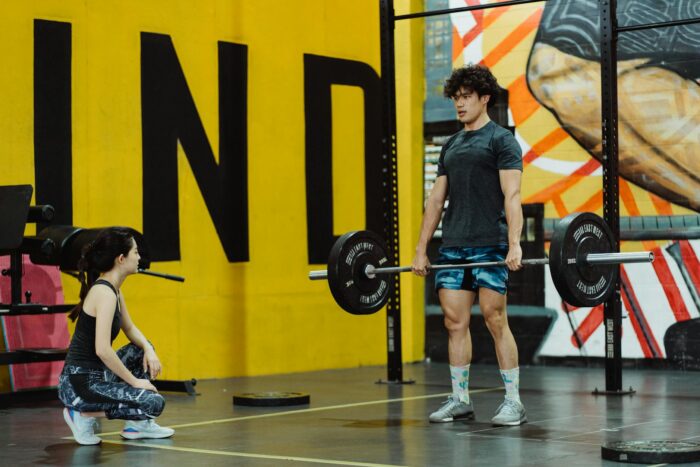
Barbell deadlift: which variant should you choose?
The barbell deadlift often raises the same question in the gym: should you take a regular straight barbell or a trap bar? The answer depends on whether you want to learn technique, keep your lower back less stressed, or put more emphasis on the hips and the posterior chain.
Why does the barbell deadlift variant matter at all?
I come across this question often, because from the outside these two lifts look like almost the same exercise. In both cases the weight is on the floor, you bend down, grab the bar and pull yourself upright. Simple, right?
In reality, the position of the bar changes how the whole movement feels. With a standard barbell you stand behind the weight. With a trap bar you stand inside it. That small difference changes your center of gravity, how hard the knees work, the angle of the hips and how much the lower back has to strain.
If someone is only just learning the basic exercises, it isn’t the smartest idea to start with the most complicated variant right away. The same logic applies to the squat. Before the barbell back squat, the goblet squat is often a better first step. The body picks up the movement pattern, and only then is complexity added.
The trap bar works similarly in the deadlift. It lets a learner lift heavy, but from a slightly easier starting position. It is easier to keep the back straight, the handles are usually higher, and the lifter doesn’t have to go as low as with a standard barbell.
Barbell deadlift: how do the variants differ?
The standard barbell deadlift puts more emphasis on the hip joint. That means the glutes, hamstrings and erector spinae do more of the work. If your goal is a strong posterior chain, the classic deadlift and competition technique, the straight barbell is the logical choice.
The trap bar deadlift shifts the emphasis more toward the knee and ankle joints. In practice, this means the quadriceps and lower legs get more work. For many people the movement feels a bit like a squat and a bit like a deadlift at the same time.
That doesn’t mean one variant trains only the legs and the other only the back. Both put the whole body to work: grip, torso, back, glutes and legs. The difference is in the emphasis, and that is exactly where your choice comes from.
Lower back and center of gravity
For the lower back, what matters is how far the weight is from your body. The closer the weight is to the midline of your body, the less extra work the lower back has to do to balance the bar. With a trap bar you are inside the weight, which makes the deadlift friendlier to the back for many people.
Think of a simple example. Hold a 10 kg plate on straight arms out in front of you, then hold the same weight tight against your body. You feel the difference immediately. In the first case the weight pulls you forward and the torso has to work harder. In the second case the load is close to your body and control is easier.
The same thing happens in the deadlift. With a standard barbell the weight travels slightly in front of the body, whereas a trap bar lets you pull more from the middle of your body. That doesn’t make the exercise automatically safe, but it often gives a beginner a better starting position.
Barbell deadlift by goal
When you teach someone to deadlift for the first time, you’ll often start with the trap bar. It lets them focus on a straight back, a strong grip and hips and legs working together, without mobility limiting them right away.
If your goal is the classic deadlift, the standard barbell has to find its way into your program sooner or later. Its technique is specific. The bar travels along your shins, the hips have to start working at the right moment, and the back has to stay in a strong position throughout the whole pull.
If your goal is general strength, muscle mass and a somewhat lower training load on the lower back, the trap bar can be a very good main exercise even for an advanced lifter. You don’t have to see it only as a tool for beginners. Many people can do quality heavy sets with it without their technique breaking down as quickly.
Body type matters too. A lifter with a long torso and shorter arms often finds it harder to find a good starting position with a standard barbell. A puller with a shorter torso and longer arms may find the classic deadlift comes much more naturally. Taller lifters often feel more secure with a trap bar.
Practical tips for choosing your deadlift
Choose the exercise based on what you really want to train. If you need better technique and confidence, start with the trap bar. If you want to develop the classic deadlift, do the standard barbell deadlift regularly, but don’t rush the weight.
- For learning, the trap bar is often a better fit because the starting position is easier.
- To emphasize the posterior chain, choose the standard barbell.
- If your lower back is sensitive, try the trap bar and pay attention to how you feel.
- If your technique breaks down, reduce the weight rather than switching exercises right away.
- Keep the barbell or the handles as close to your body as possible.
Honestly, you don’t have to pick one and rule out the other forever. A sensible program can use both. For example, in one phase you learn a strong pulling position with the trap bar, and in the next you shift part of the work to the regular barbell.
FAQ: barbell deadlift
Is a trap bar pull a real deadlift?
Yes. It’s a deadlift variation, just with a different center of gravity and a slightly different muscular emphasis. Unless your goal is the classic competition deadlift, it can be a perfectly good staple exercise.
Which one builds more muscle?
Both can build muscle. The regular barbell gives the glutes, hamstrings and spinal erectors more work. The trap bar involves more of the quads and lower legs. The choice depends on where you want to put the emphasis.
Should I switch from the trap bar to the regular barbell?
If your goal is the regular barbell deadlift, then yes, you should learn it eventually. But you don’t have to throw the trap bar out of your program. It can stay as an accessory exercise or as a variation for heavier sets.
Original inspiration: Straight Bar Vs. Trap Bar Deadlifts
What are your thoughts on these two deadlift versions?
Author: Janar Rückenberg (translation)
Source:Turg.Fitness.ee
Come train with us! ArtGym