In short:
- Strength training improves a basketball player’s jumping ability, acceleration and resilience to injury.
- In the offseason, 3–4 strength training sessions per week are recommended; in-season, 1–2 are enough.
- Lower-body strength, the core and upper-body balance are the most important areas to develop in basketball.
- A periodized program – high-volume preparation, an explosive preseason phase, maintenance in-season – gives the best results.
Basketball is one of the most physically demanding ball sports: over the course of a single game, an elite player performs over a thousand high-intensity actions, including sprints, jumps and contact episodes (Stojanović et al., 2018). Strength training for basketball players is, according to the research, the most effective way to build the physical base this requires. A well-designed strength program does not make an athlete slow or stiff – on the contrary, it improves explosive strength and neuromuscular coordination.
Why is strength training essential for basketball players?
In a systematic review, Stojanović et al. (2018) showed that basketball players must consistently maintain high explosive power output throughout the season. This demands well-trained lower limbs, a strong core and upper-body endurance.
In its position stand on progression models in resistance training, the American College of Sports Medicine (ACSM, 2009) confirms that regularly performing resistance exercises improves both maximal muscle strength and the speed at which force is applied – both of which directly determine performance in basketball. Similar principles are applied successfully in other age groups too: both strength training and children and strength training and aging show that the principle of progressive overload works at every stage of life.
Which muscle groups need special attention in a basketball player’s development?
Ziv and Lidor (2009) analyzed the physical profiles of elite basketball players and found that players at higher levels are characterized by significantly greater lower-body strength and a higher vertical jump than athletes at lower levels.
The lower limbs and hip muscles are of primary importance in basketball. The thigh muscles (quadriceps), the back of the thigh (hamstrings) and the glutes are responsible for jump height and acceleration. Classic choices: back squats, Romanian deadlifts and leg presses.
The core acts as the link that transfers force from the lower limbs to the upper body. Every pass, shot and jump requires a stable core, which is why planks, rotation presses and ball rotations are an integral part of the program.
The upper body – shoulders, arms and back – determines both shooting quality and defensive play. A balance of pulling and pushing exercises (pull-up, chest press, shoulder press) keeps upper-body injury risk low.
The ankles and lower legs deserve separate attention, because an ankle sprain is one of the most common injuries in basketball (Stojanović et al., 2018). Standing calf raises and balance exercises add a necessary layer of protection.
How do you build an effective strength training program for a basketball player?
The NSCA’s Essentials of Strength Training and Conditioning (Haff & Triplett, 2016) recommends a periodized approach in which the year is divided into clearly distinct phases.
Offseason (3–4 months before the season)
– Goal: maximum strength and muscle mass
– Frequency: 3–4 training sessions per week
– Exercises: back squat, Romanian deadlift, push press, seated row
– Repetitions: 3–5 sets × 4–8 repetitions for heavy exercises
Preseason (4–8 weeks before the season)
– Goal: converting strength into explosiveness (power)
– Frequency: 2–3 times per week
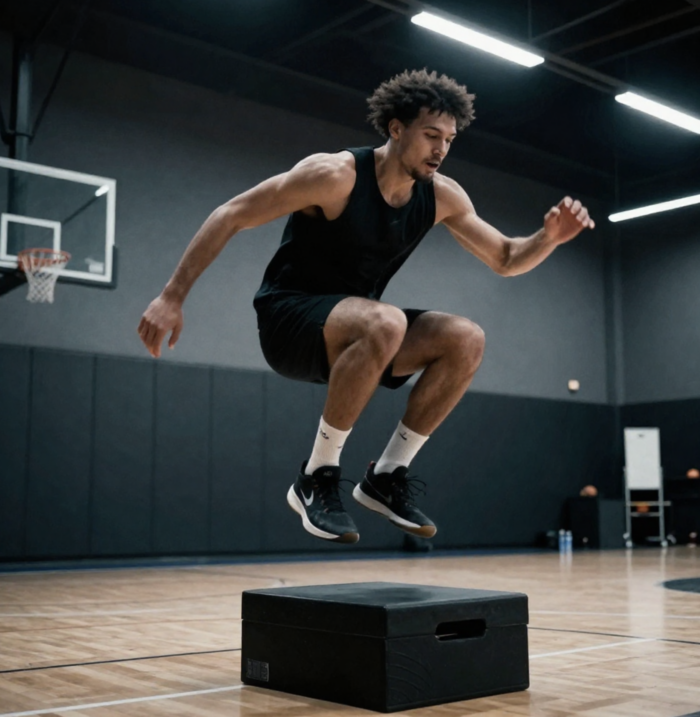
– Plyometric exercises are added: box jumps, depth jumps
– Volume decreases, intensity increases
In-season
– Goal: maintaining what has been achieved
– Frequency: 1–2 times per week
– According to the ACSM (2009), one to two training sessions per week are enough to maintain strength levels, provided the training load is sufficient
Women and strength training: part I explains how to adapt the program with sex differences in mind – for female basketball players this is especially important for preventing ACL injuries.
How many times a week should a basketball player go to the gym?
The optimal frequency is influenced by the phase of the season, game load and the athlete’s training age. As a practical guideline:
| Season phase | Strength training sessions per week |
|---|---|
| Offseason | 3–4 |
| Preseason | 2–3 |
| In-season | 1–2 |
The Estonian Health Board recommends that adults do at least two muscle-strengthening sessions per week (Health Board physical activity recommendations for adults) – a basketball player’s strength protocol meets this recommendation with at least a twofold margin.
For a beginner, 2 sessions per week are enough at first; an experienced athlete can train up to 4 times in the offseason.
What mistakes do basketball players make in strength training?
Neglecting the offseason – many players only start taking the gym seriously right before the season, but by then the window for development has largely gone unused.
A one-sided program – doing only chest press and biceps work without lower-body and pulling exercises creates muscular imbalance and raises injury risk.
Plyometrics too early – explosive jump exercises require a previously developed lower-body strength base (Haff & Triplett, 2016). Without it, the risk of overloading the knees and ankles increases.
Underestimating recovery – strength training, skills camps and games together create a high training load. Strength training and children reminds us that recovery is a prerequisite for training adaptation – the same applies to adult players.
References
- American College of Sports Medicine (2009). Progression models in resistance training for healthy adults. Medicine & Science in Sports & Exercise. 41(3):687–708. PMID: 19204579
- Stojanović E, Stojiljković N, Scanlan AT, Dalbo VJ, Berkelmans DM, Milanović Z. (2018). The Activity Demands and Physiological Responses Encountered During Basketball Match-Play: A Systematic Review. Sports Medicine. 48(1):111–135. DOI: 10.1007/s40279-017-0794-z
- Haff GG, Triplett NT, eds. (2016). Essentials of Strength Training and Conditioning. 4th ed. NSCA/Human Kinetics.
- Ziv G, Lidor R. (2009). Physical attributes, physiological characteristics, on-court performances and nutritional strategies of female and male basketball players. Sports Medicine. 39(7):547–568. PMID: 19530750
Frequently asked questions
How many times a week should a basketball player go to the gym?
3–4 times a week in the off-season, 2–3 times in the pre-season and 1–2 times during the regular season. The frequency depends on game load and recovery.
Does strength training make a basketball player slow?
No. According to the ACSM (2009), a well-designed strength training program improves neuromuscular coordination and explosive strength rather than slowing an athlete down.
Which exercises matter most for a basketball player?
Lower-body exercises (back squat, Romanian deadlift), core stabilization (plank, rotation exercises) and balanced upper-body training (pull-up, shoulder press) form the core of a basketball player’s strength training.
When should you add plyometric exercises to the program?
Only after you have built a solid base of lower-body strength, usually in the pre-season phase. The NSCA recommends starting plyometrics once a player can squat 1.5 times their body weight.
Is strength training for women basketball players different from men’s?
The basic principles are the same, but for women there is particular focus on preventing ACL injuries: strengthening the hip abductors and the core, and practising correct landing technique.
Come and train! ArtGym