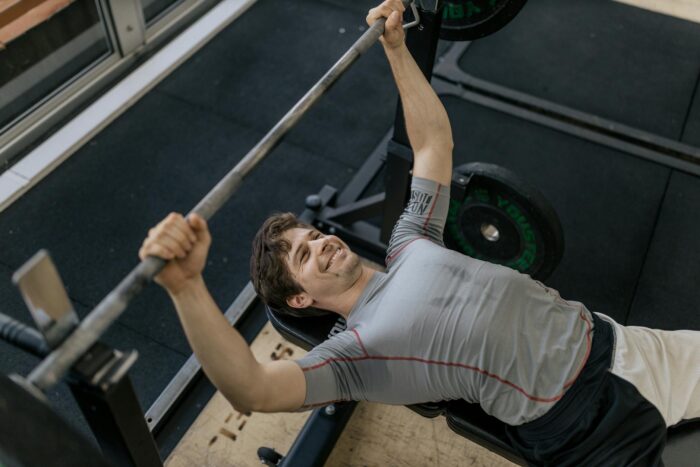
Getting your elbows right on the bench press
Your elbows decide more in the bench press than it first appears. If they flare out too wide or tuck in too close to your body, the training load shifts from the chest to the shoulders or triceps. Here is a simple way to work out which position suits strength, chest muscle work and shoulder protection.
Why do elbows matter in the bench press?
The bench press isn’t just about pushing a bar up. The chest, triceps and front shoulder muscles all do the work. On top of that, your shoulders, shoulder blades and wrists are moving too. If one link in the chain goes out of position, your body lets you know pretty quickly.
An old tip from Muscle&Fitness hit on something important: elbow position affects both your results and the training load on your joints. When your elbows are far from your body, the chest gets more work, but your shoulder may feel pressure. When your elbows are tucked too tightly against your body, more of the training load goes to the triceps and the front of the shoulder.
A simple truth: a good press should feel strong, controlled and repeatable. If the bar path is different every time, you can’t tell whether you’re progressing or just compensating for poor technique.
How do elbows work at different angles?
You can think of elbow position as three basic variations: 90 degrees, a 45-degree angle and 0 degrees. These aren’t rigid rules, just reference points. Your shoulder mobility, grip width and the spot where you lower the bar have a big effect on how it feels.
Elbows out: 90 degrees
When your elbows move far away from your body, to about a 90-degree angle, the chest muscle takes a heavy training load. The shoulders move more horizontally and the role of the front shoulder muscle may shrink. That explains why many people feel a good stretch and tension in the chest in this position.
The downside is clear, though. The top of the shoulder can come under uncomfortable pressure, especially when the weight is heavy or the bar is lowered too high on the chest. If your shoulder starts to twinge after a set, don’t stubbornly call it a “better chest feel.”
Elbows in: 0 degrees
If you keep your elbows almost against your body, i.e. think in the direction of 0 degrees, the chest muscle does less work and the triceps play a bigger role. The front shoulder muscles also take more of the training load, because the movement becomes narrower and the press looks more like a close-grip variation.
This position can be useful if your goal is triceps growth or a stronger lockout. For a standard bench press, though, it ends up too narrow for many people. The bar can start to move awkwardly and the chest no longer does the work you expect from the exercise.
Elbows at a 45-degree angle
For most lifters, the best starting point is elbows at a 45-degree angle to the body. Then the chest, shoulders and triceps work together. That’s exactly what makes this position a good choice for building strength.
Honestly, nobody needs to walk up to the bench with a protractor. The point is that your elbows don’t fly out to the sides, but they aren’t glued to your ribs either. Keep your shoulders stable on the bench, pull your shoulder blades gently together and lower the bar under control.
Practical cues for finding a good position
Start with a moderate weight. If your technique falls apart already in the warm-up set, the weight is wrong or your body position is unstable. In the bench press, the bar should move smoothly down and up, not trace a little circle in the air.
- Arms at a 90-degree angle: the impact on the chest is maximal, the impact on the triceps is significant and the impact on the front of the shoulder is minimal. Overall, it suits chest muscle growth better, but you need to keep an eye on how your shoulders feel.
- Arms at a 45-degree angle: the impact on the chest is almost maximal, the impact on the triceps is almost maximal and the impact on the front of the shoulder is almost maximal. Overall, this is often the best option for strength.
- Arms at a 0-degree angle: the impact on the chest is minimal, the impact on the triceps is maximal and the impact on the front of the shoulder is maximal. Overall, it suits triceps growth better.
A good check is simple: do you feel the movement where you want to? If the bench press is supposed to train your chest, but at the end of the set only the front of your shoulder hurts, it’s worth reviewing your elbow position. The same goes for your wrists. They should be strong under the bar, not bent back.
Don’t chase one “perfect” angle. A lifter with longer arms may need a slightly different bar path than one with shorter arms. What matters is that the bar path is stable and your shoulders don’t feel sharp pain.
FAQ: elbows and the bench press
Is 90 degrees the best for the chest?
The chest feel can be very strong at 90 degrees, but it can also increase the stress on the shoulder. If your shoulders are sensitive, a 45-degree angle is usually the more sensible starting point.
Does 0 degrees work for a regular bench press?
Elbows held in the direction of 0 degrees shift the work more onto the triceps. That isn’t wrong, but it changes the purpose of the exercise. If you mainly want to develop your chest, don’t press too narrow.
When should I change my technique?
Change your technique when your shoulder hurts, the bar moves unevenly or you don’t feel the exercise in the muscles you’re targeting. Lower the weight and find the angle where the movement stays solid.
Author: joker
Source: WHO – physical activity.
Come train with us! ArtGym