Bikini fitness and bodyfitness: Training plans
This article puts bikini fitness and bodyfitness side by side: BODY challenged European Bikini Fitness Champion Anna Virmajoki and European Bodyfitness silver medalist Mari Päkkilä!
Anna Virmajoki: The facts
Date and place of birth: 6 September 1985, Kuusamo
Lives in: Helsinki
Sponsor: Mass Nutrition (mass.fi)
Results:
2012 European Bikini Fitness Championships + 168 cm – 1. place
Fitness Classic – 1. place
Arnold Amateur tall class – 3. place
2011 Finnish Bikini Fitness Championships – 1. place
Lappeenranta qualifier – 1. place
Mari Päkkilä: The facts
Date and place of birth: 3 August 1981, Oulu
Lives in: Oulu
Sponsor: Mass Nutrition (mass.fi)
Results:
2012 European Bodyfitness Championships – 158 cm – 2. place
Fitness Classic bodyfitness – 158 cm – 1. place
2011 World Bodyfitness Championships – 158 cm – 3. place
Finnish Bodyfitness Championships – 163 cm – 2. place
2009 World Bodyfitness Championships – 158 cm – 11. place
Finnish Bodyfitness Championships – 163 cm – 1. place
2008 Finnish Bodyfitness Championships – 163 cm – 5. place
2007 Finnish Bodyfitness Championships – 163 cm – 5. place
2006 Finnish Bodyfitness Championships, newcomers category – 1. place
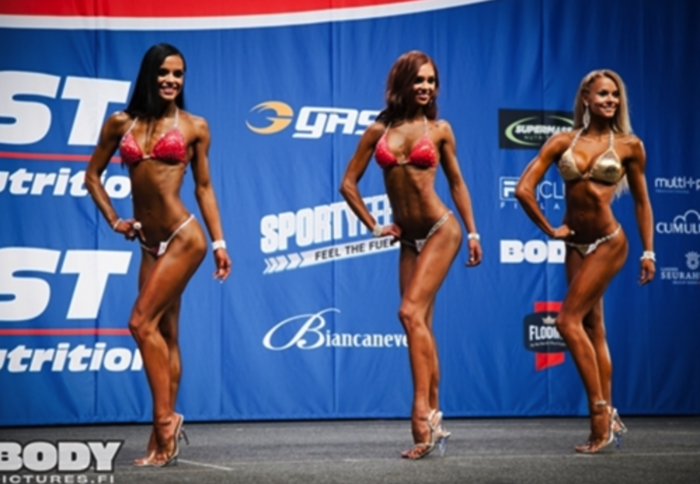
Anna Virmajoki (left) and Mari Päkkilä (right)
Anna Virmajoki and Mari Päkkilä are heading to the Mass Nutrition Finnish Fitness Championships at Fitness Expo with their sights firmly set on winning. A reigning European champion has never appeared on the Finnish Championships stage before, but that will change when Anna takes the stage on Sunday to defend the Finnish Bikini Fitness title she won last autumn. Mari also has expectations to live up to: she needs to hold on to the top spot she secured with her Finnish Bodyfitness Championships gold medal in the short class in 2009, and this time she needs gold in place of last autumn’s Finnish Championships silver.
These women are unquestionably the best in the world in their weight category.
Although Anna entered her first bikini fitness competition only last year, she traveled to Columbus, Ohio, to test herself at the Arnold Amateur, where she won bronze. After winning the Fitness Classic in Turku in the spring, she also brought a European title home to Finland. Anna is clearly on a roll!
Mari placed second at the Finnish Championships last autumn, then went on to win bronze at the World Championships. Like Anna, Mari won a competition in Finland in the spring and later took silver at the European Championships.
Bodyfitness vs bikini fitness
Finland’s first bikini fitness competition took place last autumn and immediately received a positive response from competitors and spectators alike. Bikini fitness places great emphasis on body structure. A bikini fitness competitor’s leg muscles do not need to be large, but they must be toned, and showcasing the glutes also plays a major role in the discipline.
Bodyfitness is almost 10 years old as a sport and has already developed a following of its own, which grows year after year as Finnish competitors bring home medals and strong results from international competitions. Bodyfitness competitors need more muscular thighs than bikini fitness competitors, but their thighs must still never be large. The ideal bodyfitness physique calls for slightly curvier thighs than bikini fitness.
In pursuit of success
Anna and Mari have shown in international competitions that their physiques meet the expectations of their disciplines, which is why they will both be competing again this autumn. Once you compete at an international level, you cannot take years off: every competition you miss is a lost opportunity to build on your success.
Having already developed the muscle mass they need, Anna and Mari can compete twice a year without needing a bulking phase. Their regular training keeps their bodies competitive throughout the year, leaving only a contest prep phase to put the finishing touches on their physiques before competitions.
Neither of these top competitors plans to gain weight, which would not be possible anyway when competing twice a year.
Another interesting point is that both get their training plans from abroad, rather than from Finland as almost all their fellow competitors do.
Anna gets her plans from her team, Team Bombshell, which is very well known in the United States, while Mari’s new coach is Kim Oddo, who also coaches Figure Olympia winner Nicole Wilkins.
A third thing Anna and Mari have in common is their sponsor, Mass Nutrition, whose website hosts their blogs.
That connection made it possible to bring these two highly successful competitors together for a leg workout after the European Championships.
“If the goal is muscle building, women need to dare to lift weights heavy enough to get results!”
How do you train your legs?
Mari: I train legs twice a week: one workout is traditional strength training, and the other takes a different approach. In my strength workout, I do 3-4 sets per exercise, increasing the weight with each set. I do around 8–15 reps. I don’t use any special techniques, just straight sets. Depending on how well my legs have recovered from the previous workout, the second leg workout is even more active, combining treadmill training with strength exercises that differ from those I’ve done in previous sessions.
Anna: I also train legs twice a week. The basic exercises—leg extensions and leg curls, leg presses, different squats, step-ups, and seated and standing calf raises—have worked well for me.
How do you think athletes in your discipline should train their legs?
Mari: It depends on the athlete’s endurance, which needs to be developed, but generally I’d recommend training legs with weights in the gym and adding something active, such as hill running, rows, jumps and so on, to develop springiness and shape and improve oxygen uptake and recovery.
Anna: Bikini fitness competitors are expected to have nicely rounded lower-body muscles. In my opinion, training depends entirely on your starting point. A skinny girl, for example, needs to build more muscle mass in her legs and glutes, while girls who are already well trained need to maintain their existing muscle mass. If the goal is muscle building, women need to be willing to use weights heavy enough to get results! I plan to change exercises as often as possible so that my body never gets used to the same workout and I can keep progressing.
How do you prepare for a leg workout?
Mari: I prepare for a leg workout just as I would for any other workout. When I’m dieting, my nutrition stays the same regardless of the workout. To have more energy during training, though, I’d prefer to train in the afternoon, when I’ve already had several meals. Of course, the best time to train varies from person to person; some people have plenty of energy first thing in the morning. Before a leg workout, I use the pre-workout stimulant MassPump to get myself going. I recommend it! To warm up, I cycle or jump rope for 10 minutes.
Anna: I try to train as late in the evening as possible. By then, my body has had plenty of nutrients throughout the day, and I find my workout goes better. Since I sleep well, I can take stimulant supplements even a little later in the evening. I take my supplements about half an hour before training. After my workout, I take whey isolate, glutamine and amino acids.
What has been your toughest leg workout?
Mari: It was probably a leg workout led by Marko Savolainen… we worked through the techniques, Smith machine exercises, leg presses, lunges… it was a good workout both mentally and physically. Thanks for that, Marko!
Anna: Since my legs have always been relatively muscular, I train them to keep the muscle I already have in shape. So I hardly ever do tough leg workouts. But after workouts where I do around a hundred reps for my legs, the burning sensation afterwards is pretty intense!
Training plans
Anna’s leg training program
Anna does 3–5 sets of each exercise, with 15–20 reps per set.
Quad training day:
(The following exercises are used on quad days—not all in the same workout)
– Leg extension
– Narrow-stance Smith machine squat
– Narrow-stance hack squat
– Narrow-stance leg press
– Different lunge variations
Hamstring training day:
– Seated or standing leg curls, on one leg or with a lifting movement
– Romanian deadlifts with a barbell, with dumbbells, on a Smith machine, or on one leg
– Wide-stance squats
– Wide-stance leg press
– Lunges
– Step-ups
Mari’s leg training program
I usually train legs once a week, but if I train them twice a week, I split the exercises into two groups and add some hamstring exercises to my back training day.
Leg extensions 3 x 8 – 15
Leg press 4 x 8 – 15
Hack squats 4 x 8 – 15
Dumbbell lunges 3 x 20
Standing calf raises 3 x 10 – 20
Seated or leg press calf raises 3 x 10 – 20
Squats
Mari: When I squat with free weights—a barbell—I use lighter weights for longer sets. You can add more weight when doing Smith machine squats, but you should always pay attention to your technique to avoid injury. Having a training partner beside you can help here.
Anna: I often use the Smith machine for squats. To vary my Smith machine squats, I most often also do squats with a stance somewhere between wide and narrow. I don’t use particularly heavy weights; my leg training is close to what I need to maintain my current muscle mass. When squatting, you also need to make sure your lifting belt is tight. Focusing on the muscles you’re working helps in every workout, too.
Dumbbell lunges
Mari: I do lunges with either dumbbells or a barbell, keeping my back straight and my shoulders back, and taking deep lunging steps at a comfortable pace.
Anna: Lunges should be part of almost every leg workout. There are so many variations that your body never gets used to any one exercise. I work each leg in turn, either doing repeated lunges on one leg or walking lunges. Here’s a useful tip: learn the techniques and how to control your body before adding weights. At first, I couldn’t manage lunges because I struggled with my balance.
Hack squats
Mari: When doing hack squats, I want to see results primarily in my quads, and I vary my stance width from one workout to the next.
Anna: I used to do quite a lot of hack squats, but my massage therapist Vellu Niskanen told me to stop because I have some minor lower back problems, and hack squats don’t help.
Romanian deadlifts
Mari: Using dumbbells also lets you work other areas effectively, and bending your legs slightly makes your glutes work harder too. When doing different exercises with dumbbells, it’s easy to move up to even heavier dumbbells and use specialized techniques as well.
Anna: I also do deadlifts in different ways: with dumbbells, on the Smith machine, or with a barbell. Doing Romanian deadlifts with completely straight legs works your hamstrings more, while bending your knees slightly makes the exercise very effective for your glutes. To avoid injuries, you need to learn the movements and proper technique first, and you could start with a barbell.
Translated by: Kertu Koronen
(BODY. August/2012)
Source:Turg.Fitness.ee
Come and train! ArtGym