In short:
- A correct box jump has three phases: a preparatory countermovement, an explosive takeoff and a soft landing with the knees at 30–45° of flexion.
- Start with a 30–40 cm box and only raise the height once your technique is solid.
- The main mistake that creates injury risk is the knees caving in on landing — work on strengthening your glutes.
- Train 2–3 times per week, 2–3 sets of 6–8 repetitions, and give your muscles 48–72 hours of recovery time.
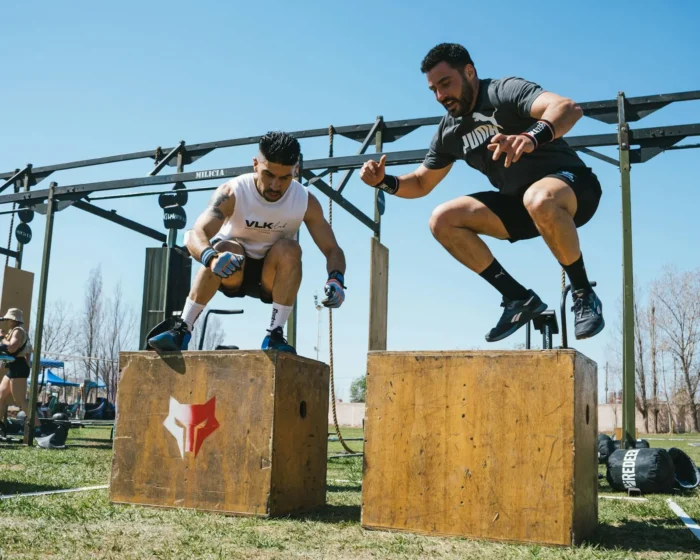
Box jump technique is one of the most effective plyometric exercises for developing explosive strength and acceleration. Correct box jump technique requires the whole body to move in coordinated sync — from the countermovement to a controlled landing. In this guide, we explain step by step how to perform the box jump safely and effectively.
How does the biomechanics of the box jump work?
The box jump is based on the muscles’ stretch-shortening cycle (SSC), in which the eccentric phase loads the muscles for an explosive concentric push. Research confirms that SSC-based plyometric training significantly improves both jumping ability and lower-limb strength measures (Markovic & Mikulic, 2010). The main working muscle groups are the quadriceps, glutes and calf muscles, which EMG measurements show are activated simultaneously during the takeoff and landing of a box jump (Chimera et al., 2004).
From a neurological standpoint, the box jump trains the proprioceptive system and shortens reaction time — important for athletes as well as for anyone looking to improve their everyday physical activity. The WHO recommends that adults add exercises that develop explosive strength to their weekly activity plan to maintain muscular fitness and balance (WHO guidelines on physical activity).
A proper warm-up is absolutely essential before the exercise — check out our guide to the right way to warm up so that your muscles and joints are truly ready to work.
How do you do a box jump step by step?
Step 1 — Starting position
Stand in front of the box with your feet shoulder-width apart, toes turned slightly outward. Keep your back neutral, chest up and eyes on the box.
Step 2 — Countermovement
Quickly bend your knees to about 60–90° while swinging both arms back and down. This eccentric phase loads the muscles with energy — in his classic review of plyometrics, Bobbert (1990) describes it as the core mechanism of jumping power.
Step 3 — Takeoff
Push off powerfully, extending your hips, knees and ankles at the same time. Swing your arms quickly forward and up. The NSCA recommends full triple extension — hip, knee, ankle — to ensure maximal force transfer (Haff & Triplett, 2015).
Step 4 — Landing on the box
Land with soft shock absorption: knees flexed 30–45°, hips back, back neutral, feet hip-width apart. A soft landing spreads the joint load across several muscles and reduces injury risk (Chimera et al., 2004). Don’t let your knees cave inward.
Proper breathing is a critical element of the box jump: inhale before the takeoff and exhale on landing to stabilize your trunk and support your spine throughout the movement.
Step 5 — Leaving the box
Step down off the box — don’t jump down, especially as a beginner. Jumping down demands extra eccentric control that beginners don’t yet have, and it overloads the Achilles tendon.
What are the most common box jump mistakes and how do you avoid them?
Valgus collapse (knees caving in): Your knees must not cave inward on landing. This significantly increases the risk of anterior cruciate ligament and meniscus injury. First strengthen your glutes and hip rotators with squats.
A box that is too high for beginners: Start with a 30–40 cm box. Raising the box height is not the goal until your technique is fully clear and controlled.
Jumping down from the box: Jumping down puts repeated loading on the ankles and the Achilles tendon. Always use the step-down variation until all the technique elements are secure.
Inadequate warm-up: Jumping with cold muscles significantly increases injury risk. More and more athletes also use precision-technology solutions in training — smart clothing – a new step in health technology makes it possible to monitor movement patterns in real time and spot faulty patterns early with the help of sensor-equipped functional apparel.
Who is the box jump suitable for, and what training volume is appropriate?
The box jump suits intermediate and advanced trainees who have mastered the squat, the lunge and controlled landing. Complete beginners should start with squats and jumping exercises without a box, so that their muscles and joints adapt to the training load gradually.
The ACSM recommends plyometric training 2–3 times per week, allowing 48–72 hours of recovery time (ACSM, 2018). In terms of volume, a good starting point is 2–3 sets of 6–8 repetitions per session, adding volume and intensity progressively.
Recovery also depends heavily on nutrition: choosing the right food — especially protein- and carbohydrate-rich recovery food — supports the replenishment of muscle glycogen stores and the repair of muscle tissue after plyometric training.
References
- Markovic G, Mikulic P. (2010). Neuro-musculoskeletal and performance adaptations to lower-extremity plyometric training. Sports Medicine, 40(10), 859–895. PMID: 20726621
- Bobbert MF. (1990). Drop jumping as a training method for jumping ability. Sports Medicine, 9(1), 7–22. PMID: 2263636
- Chimera NJ, Swanik KA, Swanik CB, Straub SJ. (2004). Effects of plyometric training on muscle-activation strategies and performance in female athletes. Journal of Athletic Training, 39(1), 24–31. PMID: 15085211
- Haff GG, Triplett NT. (2015). Essentials of Strength Training and Conditioning. 4th ed. Human Kinetics (NSCA). ISBN: 9781492501626
- American College of Sports Medicine. (2018). ACSM’s Guidelines for Exercise Testing and Prescription. 10th ed. Wolters Kluwer.
Frequently asked questions
What box height should you start box jumps with?
A box 30–40 cm high is suitable for beginners. Technique matters more than height — only raise the box once your landing is controlled and your knees don’t cave inward.
Are box jumps suitable for women?
Yes, box jumps are suitable for everyone. Women need to pay particular attention to valgus collapse, meaning the knees caving inward on landing, because women have a biomechanically higher risk of anterior cruciate ligament injury. Regularly work on strengthening your glutes and hip rotators.
How often can you do box jumps?
The ACSM recommends plyometric training 2–3 times per week, with 48–72 hours of recovery between sessions. For beginners, 2–3 sets of 6–8 repetitions per session is a good starting point.
How do you know if your box jump technique is correct?
Film yourself (phone on a tripod) or ask a coach for feedback. The main checkpoints: your knees don’t cave inward on landing, your back stays neutral, and the landing is soft and controlled rather than hard.
Which muscles do box jumps mainly develop?
Box jumps mainly work the quadriceps, glutes and calf muscles. The takeoff phase strongly activates the hip extensors, while the landing works the knee extensors and ankle stabilizers eccentrically.
Come and train! ArtGym