
In short:
- A Bulgarian split squat at home can be done with an ordinary chair — the back leg rests on the seat, the front leg stays on the floor.
- The best equipment-free alternatives are the reverse lunge, the step-up and the pistol squat progression.
- Start with body weight for at least two weeks before adding weight.
- Single-leg exercises build strength similarly to two-legged squats, but load the spine less (Speirs et al., 2016).
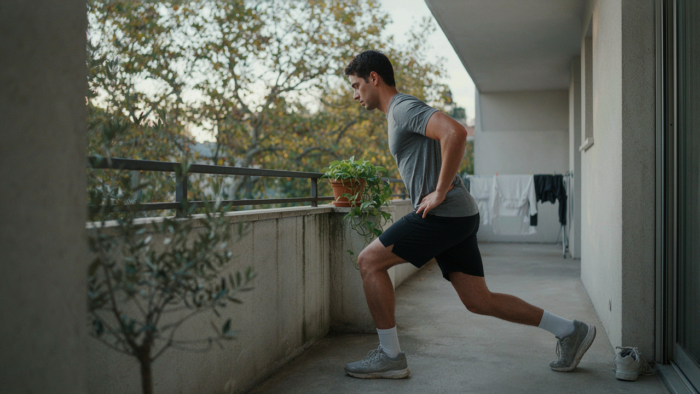
A Bulgarian split squat at home is one of the most effective single-leg exercises you can do in an ordinary living room without buying any equipment. A lunge with a raised back leg activates the quadriceps, glutes and hamstrings at the same time, giving you a complete lower-body workout. In this guide you’ll find a description of the classic technique and all the best alternatives if you want to adapt a single-leg exercise to home conditions.
How does the Bulgarian split squat work at home, and why is it effective?
The Bulgarian split squat at home means placing the back leg on a chair or sofa arm at about knee height, with the front leg stepping forward so that both knees reach a roughly 90-degree angle as you lower. This position forces the muscles of the front leg to do all the work without help from the back leg. Single-leg strength exercises build strength similarly to two-legged squats, but load the lumbar vertebrae and spine considerably less (Speirs et al., 2016).
To understand the basics, it’s worth reading Squat, squat, squat, squat, squat — it explains the fundamentals of squat mechanics that apply to every squat variation.
The bodyweight version has another advantage: hip mobility improves with every repetition, which reduces injury risk in the long run.
What are the best alternatives to the Bulgarian split squat without equipment?
The following exercises imitate the Bulgarian split squat using body weight and are suitable for training at home:
1. Reverse lunge
You step back with one leg until both knees are at a 90-degree angle. Studies show that the electromyographic activity of the quadriceps in the reverse lunge is comparable to the split squat (McCurdy et al., 2005). This exercise also suits those with sensitive knees, since the knee does not travel forward as much as in a forward lunge.
2. Step-up (squat onto a bench)
Use a sturdy chair, a stair step or the edge of a sofa. You step up with one leg and lower back down in a controlled way. The step-up works the quadriceps and glutes at the same time and improves balance.
3. Pistol squat progression
To start, rest a hand on the wall and lift the front leg slightly off the floor, then slowly lower your body weight. With step-by-step progression you build both mobility and strength. To understand similar single-leg mechanics, read Jefferson squat, which explains how an asymmetrical body position affects muscle recruitment.
4. Lateral lunge (sideways)
You step out to the side, shifting your weight onto the stepping leg. This variation also builds lateral stability at the hip joint, which ordinary squatting does not provide.
5. Upper-body stabilized squat
Combining a single-leg exercise with opposite-direction arm movement increases core muscle work and coordination demands. Upper-body squat explains how upper-body position affects the recruitment of lower-body muscle groups and technique accuracy.
How do you start the Bulgarian split squat safely at home?
When training at home, the most common mistake is moving on to heavier weights too quickly, before the technique has settled. A recommended progression for beginners:
- Weeks 1–2: The exercise movement without the lift, hands lightly supported on a wall. 3 × 6 repetitions per leg.
- Weeks 3–4: Chair behind you, arms hanging freely at your sides. 3 × 8–10 repetitions per leg.
- Weeks 5–6: Full range of motion, slower tempo (3 seconds down, 1 up, 1-second pause at the bottom).
- Week 7+: Adding weight (a backpack with books, water jerrycans) as needed.
NIH MedlinePlus recommends always starting with body weight and adding training load only once your form is free of errors — this applies especially to single-leg exercises, where a balance error easily turns into a knee joint injury.
In addition, Why and how to train at home helps you plan a comprehensive training program in which single-leg exercises support each other as part of well-rounded lower-body development.
What mistakes do beginners make when doing the Bulgarian split squat?
The most common mistake is the front knee collapsing inward on the way down — this sign shows that the hip abductors are weak or fatigued. Always check that the knee tracks in the direction of the toes and that your chest stays upright.
Another typical problem is a stride that is too short: the front leg is too close to the back one, so the knee passes the toe line excessively. The correct stride is about 60–70 cm, depending on leg length.
The third mistake is the back foot sliding off the chair while lowering. Use a non-slip chair or put a towel under the chair. Muscle hypertrophy is optimal in the 8–12 repetition range with moderate weight (Schoenfeld, 2010) — for a beginner this means the last 2–3 repetitions should feel noticeably hard, but the technique stays free of errors.
References
- Speirs DE, Bennett MA, Finn CV, Turner AP (2016). Unilateral vs. Bilateral Kükk Training for Strength, Sprints, and Agility in Academy Rugby Players. Journal of Strength and Conditioning Research. 30(2):386–392. PMID: 26270695
- McCurdy K, Langford GA, Doscher MW, Wiley LP, Mallard KG (2005). The effects of short-term unilateral and bilateral lower-body resistance training on measures of strength and power. Journal of Strength and Conditioning Research. 19(1):9–15. PMID: 15903382
- Schoenfeld BJ (2010). The mechanisms of muscle hypertrophy and their application to resistance training. Journal of Strength and Conditioning Research. 24(10):2857–2872. PMID: 20847704
- NIH MedlinePlus (2023). Exercise and Physical Fitness. U.S. National Library of Medicine.
Frequently asked questions
Is the Bulgarian split squat effective at home without weights?
Yes. A body weight Bulgarian split squat is perfectly adequate for beginners and intermediate lifters. Because the exercise fully loads the muscles of one leg, technique and range of motion matter more than how much weight you use.
What can I use to raise the back foot at home?
Any stable, non-slip object will do: a kitchen chair, the armrest of a sofa, a stair step or a low coffee table. The height should be roughly 40–50 cm, slightly below knee level.
How often should I do the Bulgarian split squat at home?
For beginners, 2 times per week is enough, which gives your muscles 48–72 hours of recovery. More experienced trainees can do it 3 times per week, as long as the workouts in between are lighter.
Is the Bulgarian split squat safe for the knees?
With correct technique, the exercise is safe for most people. The key is to keep the front knee tracking in line with your toes and not let it cave inward. If you have knee problems, start with the reverse lunge, which puts less load on the knee joint.
What is the difference between the Bulgarian split squat and a regular single-leg lunge?
In the Bulgarian split squat, the back foot is raised on an elevated surface, which isolates the muscles of the front leg more and limits help from the back leg. A regular single-leg lunge is performed with both feet on the floor, which allows more of your body weight to be shared between the legs.
Come and train! ArtGym




