Challenge: 200 repetitions for chest and back
The challenge is simple, but not easy: in a single workout you do a large number of quality repetitions for your chest and lats. The goal is to reach 100 repetitions in parallel-bar dips and 100 repetitions in pull-ups, while also recording your time.
Why does this challenge work?
Some workouts stick in your memory precisely because they are a little crazy. This 200-repetition undertaking belongs in the same category as the ideas of Poliquin, Staley or Arnold: a simple framework, a lot of work and very little room to make excuses to yourself.
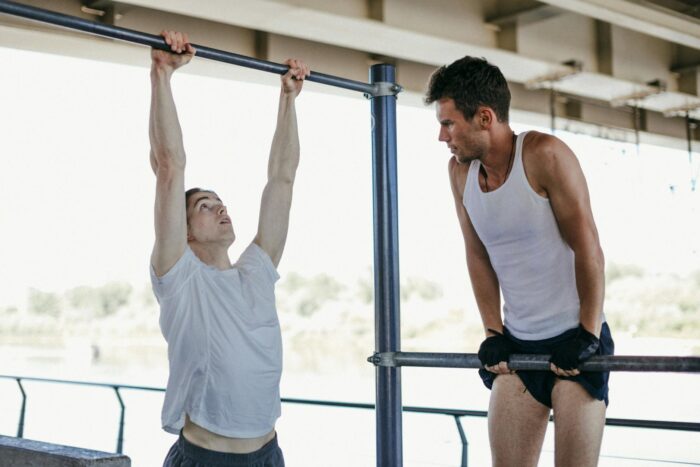
You don’t need ten exercises or a long queue for machines. If you train chest and lats on the same day, pick just two movements: parallel-bar dips and pull-ups with palms facing each other. Then alternate between them until both exercises have reached 100 repetitions.
So what actually happens? Your chest, back, triceps, biceps and grip all get a really solid dose of volume at once. On top of that, you get an honest picture of how well you can hold your technique when fatigued.
How to structure the challenge in your workout
Start with one set of dips on parallel bars. Take a short rest. Then do one set of pull-ups. Carry on like that: dips, rest, pull-ups, rest. The goal is 100 repetitions in each exercise.
Be sure to use a stopwatch. Time both your rest breaks and the whole workout, from the first repetition to the last. Next time you’ll have a concrete time to beat. That makes progress much clearer than a feeling that today was probably a better day.
On dips, choose a slightly wider position if you can. Lower yourself under control and don’t do half repetitions. In a proper rep, your upper arm should almost meet your forearm at the bottom. Hold a short pause there, even a fraction of a second, and press yourself back up.
If you want to hit your chest more, let your body lean slightly forward and keep your legs hanging. A wider grip and a slight forward lean shift the emphasis to the chest muscles. A narrower grip and a more upright body position put more work on the triceps. The triceps take on training load either way, so there’s no need to worry about that.
On pull-ups, start from a dead hang with your palms facing each other. Pull yourself up, pause briefly at the top under control and lower yourself back down calmly. Don’t kick your legs or throw your body up with momentum. If a repetition no longer comes out clean, it’s better to rest than to start breaking down your technique.
Challenge tips and choosing your pace
Experience shows that many people finish the dips before the pull-ups. That’s fine. Alternate the exercises for as long as you can. If you reach 100 repetitions in the dips first, or your strength runs out, finish the pull-ups separately.
Write your sets down. Once the sets pile up, it’s surprisingly easy to lose count. Then you no longer know whether you actually did 100 repetitions or just hoped you did.
If 100 repetitions feels like too much to start with, you can begin with 50 repetitions for each exercise. That doesn’t make it a bad workout. If anything, it gives you the chance to keep your technique clean and raise the volume later.
The translator’s recommendation was to take a steady approach. For example, do 5 pull-ups, rest, then do 5 dips on the bars. Don’t go to failure in every set. If you go in too aggressively at the start, you’ll end up so seized up that all the enjoyment goes out of the exercise.
Rest breaks should be fixed, but a little flexible. A good range is 60 – 90 seconds. In the first sets, keep your rests at 60 seconds. As fatigue builds, you can extend the rest up to 90 seconds, but no longer. In later sessions, keep trying to shorten them, but don’t push rests below 60 seconds.
If you can’t do pull-ups with your palms facing each other, use a V-handle. A classic pull-up with an overhand grip, thumbs on top, also works. The main thing is that the repetitions are comparable and your technique doesn’t turn into something else with every set.
Challenge variations for other muscles
The same idea can be applied to other opposing muscles. The front and back of the thigh go well together. For example, a barbell hack squat combined with leg curls gives a very clear lower-body workout.
For arms, you can pair seated dumbbell biceps curls with skull crushers. Another option is the standing barbell curl together with the close-grip floor press. Lats can also be combined with shoulder muscles, for example the seated dumbbell press together with pull-ups.
A simple truth: this challenge doesn’t need a complicated plan. It needs honest technique, recorded sets and patience. When those three things are in place, you get a really tough yardstick out of a very simple workout.
FAQ: the challenge and 200 repetitions
Is 100 repetitions in each exercise too much for a beginner?
For many people it’s too much at first. Start with 50 repetitions for each exercise and see whether you can hold your technique to the end.
Should every set go to failure?
No. Usually it’s better to keep your sets under control, for example 5 and 5 repetitions, and leave a little in reserve. That keeps the quality higher.
What should I write down at the end of the workout?
Write down the total workout time, the time for 100 repetitions of each exercise and how you split your sets. That way it’s clear next time what to improve.
Translated by: Janar Rückenberg
Source: https://turg.fitness.ee/et
Come and train! ArtGym