
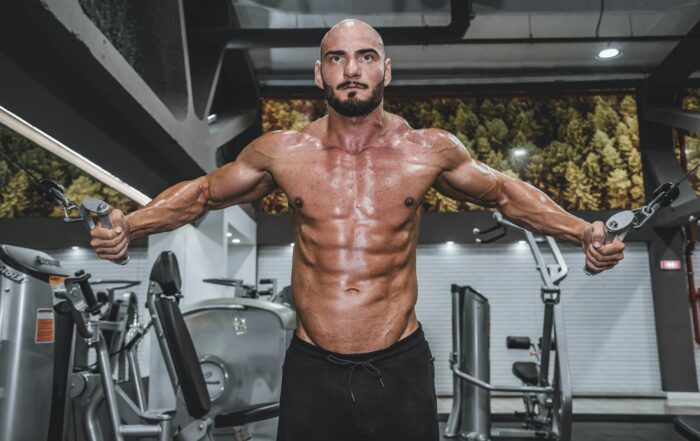
Chest workout with Jay Cutler’s tips
A Jay Cutler-style chest workout doesn’t mean you should do a 19-set pro routine tomorrow. Based on an interview in Flex, August 2003, here is a simpler, smarter version for the everyday lifter: how to choose exercises, reps and weights so that your chest gets the training load, not your ego.
Why does chest training need a clear head?
Let’s be honest: you are not a Mr. Olympia competitor. The chances of becoming one are tiny. Even if you weigh 120 kg and have a washboard-flat stomach, you will most likely still lack the genetics, time and dedication that the top athletes live with every day.
That’s why it makes no sense to copy the full-volume program of Jay Cutler or any other pro bodybuilder directly. If you’re not preparing for the Mr. Olympia stage, a constant 19-set chest workout will most likely lead to overtraining, a sore shoulder or simply a plateau. That doesn’t mean Jay Cutler’s experience is of no use. Quite the opposite.
For Jay Cutler, the chest was a weak area for a long time. Jay analyzed technique, changed the training load and learned to feel the chest better. That is exactly what makes this advice valuable to the everyday lifter. Not “do exactly what a pro does”, but “take the principle and use it in a sensible volume”.
Chest workout: frequency, volume and reps
Jay’s recommendation for the everyday lifter is simple: train your chest every 5 to 7 days. Pick 4 exercises and do 3 working sets of each. That is enough volume as long as the sets are done properly and your technique doesn’t fall apart.
The workout should start with the bench press. Next, do a barbell or dumbbell press on an incline bench. Third, dumbbell flyes work well, on a flat bench or on an incline or decline bench. Finish with a machine fly, also known as the pec-deck, or with cable crossovers, also known as cable machine crossovers.
When it came to reps, Cutler was blunt. If you can do fewer than six reps, the weight is too heavy. If you do more than 10 reps, the weight is too light. In practice, this means that by the sixth rep it should already feel hard, but you push on to the eighth rep. If you have a spotter, that eighth rep can be a forced rep.
The first working set can be a little lighter. Use a weight you can do about 8 reps with. In the second and third sets, add weight so that you stay in the range of 6-8 reps. This is better than a long pyramid where the big effort only comes right at the end. Here you are working close to your maximum already in the last two sets.
Don’t count your warm-up as work. With the first exercise, do two sets of 15-20 reps. These prepare your shoulders, elbows and chest for movement. If you start straight away with a heavy weight, you often pay for it in technique.
Stretching is not a break but part of the workout
Jay was a big believer in stretching. Between warm-up sets, stretch your chest for 20 seconds with your arms overhead and then with your arms extended out to the sides. Don’t stretch only your chest. Your shoulders and back provide a large part of the stability and strength when pressing.
After training, when your chest is full of blood and tight, calm stretching helps support recovery and reduce soreness. A simple truth: the better a muscle moves, the easier it is to train it cleanly.
Chest workout and technique: what did Jay Cutler emphasize?
Bench pressing for very few reps is often an ego thing. Jay Cutler admitted to going down that road while trying to feed the ego. But once Jay learned to understand how the pec muscle really works, the result was a better bodybuilder.
As a teenager, Jay’s chest was weak because it was trained too aggressively. The weight was heavy, but the load didn’t go into the chest enough. When you do sets of 3-4 reps, the shoulders and other muscle groups start to do more of the work. This can lead to injury. Even if it doesn’t, some of the tension leaves the chest. A chest workout should make the chest’s job harder, not easier.
On the bench press, Jay usually used a medium grip, slightly wider than shoulder width. In Jay’s view, a medium grip works the inner chest better than a very wide grip. At the top, don’t lock your arms out completely, but get very close. There you can count to two or three and deliberately squeeze the pec muscle.
Sometimes Jay also paused at the bottom and counted to two. This takes a lot of the momentum away and forces the muscle to really work. A common mistake is arching the back too much and rolling the shoulders forward. Your lower back must be tight, your shoulders back, your lats relaxed and your chest high. That way the pecs get more of the load and the front of the shoulder gets less stress.
Flyes teach you to feel your chest
Jay sometimes did 5 sets of dumbbell flyes, even as the first exercise, to pre-fatigue the chest before pressing. Still, Jay didn’t recommend this to intermediate lifters. If your muscle mass and feel aren’t yet sufficient, an incline press after flyes can simply turn into a messy struggle.
Over the years, Jay realized that, because of a broad-shouldered build, the chest grew better with flye movements. Dumbbells, cables or a machine give the chest a deep stretch and a strong end position. Presses emphasize a forceful contraction more, while flyes help stretch the muscle and bring blood into it.
Here’s the catch, though: technique has to be learned. Jay said it took eight years of training before the chest muscle could be properly felt working during dumbbell flyes. Before that, the same exercise produced almost no sensation.
What changed? Jay set the back in the right position and slid far enough down the bench that the head hung over the edge. That left the chest as the highest point of the body and let the shoulders travel past the sides of the bench. A bench that is too wide ruins this. Imagine doing flyes on a bed: the stretch disappears. Rest mainly your mid-back on the bench and let the chest move through its full range.
Practical tricks for breaking a plateau
Free weights were the foundation of chest building for Jay. You can use a Smith machine, but in Jay’s view there is nothing better than the barbell and dumbbells for growing the chest muscle. A machine can give you control, but free weights teach the body to hold tension.
Pullovers are often used in back training, but Jay sometimes placed them at the end of chest day. The focus there was not on the lats or the rib cage but on the chest. In the fully stretched position, Jay counted three to five so that the stretch would be long and controlled.
Variety was a keyword for Jay. That doesn’t mean the program has to be turned upside down after every workout. Rather, choose four exercises of a different character: one heavy press, one incline press, one fly and one machine or cable exercise. That way you develop mass, density and the overall shape of the muscle.
Not every set has to go to burnout. If you take every set all the way, you simply train yourself into the ground. Jay compared it to an engine: if you keep it at maximum revs all the time, it will soon fall apart. Jay’s recommendation was to do only 2 burnout sets in a 12-set training program, for example in the last sets of the final couple of exercises.
If progress stalls, Jay recommended drop sets. For example, if you bench press 140kg on the last set, do as many repetitions with it as you can. Then reduce the weight to 100kg and again do as many as you can. Finally, reduce to 60kg and finish with complete muscle exhaustion. If you can, use two helpers so the weight can be reduced quickly. Do this every three or four workouts, not every time.
Jay didn’t favor partial reps. Jay’s point was clear: if the goal is a full contraction of the muscle, a partial movement won’t give the same result. In some powerlifting situations a partial rep may have its place, but from a bodybuilding standpoint Jay considered them pointless.
Jay Cutler’s chest training program
Jay Cutler’s chest workout for the average gym-goer:
- Bench press — 3 x 6-8
- Barbell/dumbbell incline press — 3 x 6-8
- Dumbbell fly — 3 x 6-8
- Machine fly (pec-deck) or cable machine crossovers — 3 x 8-10
Jay Cutler’s chest program for preparing for the 2003 Olympia:
- Dumbbell fly — 5 x 8-10
- Barbell incline press — 3 x 8-10
- Machine fly — 3 x 8-10
- Smith machine press — 3 x 8-10
- Cable crossover — 3 x 8-10
- Dumbbell pullovers — 2 x 8-10
When preparing for the Olympia, Jay’s main goals were back and chest. The aim was to bring out overall mass, with special attention to the lower and outer chest. In Jay’s own eyes, the chest was still a weaker point compared with the other men, but Jay promised that this would no longer be the case the next time Jay stepped on stage.
FAQ: chest workout according to Jay Cutler
Should the average lifter do Jay Cutler’s full program?
No. 4 exercises and 3 working sets per exercise suit the average lifter better. The volume of a pro program is built for a different level of recovery, experience and goal.
Which repetition range makes sense for the chest?
Jay’s recommendation mostly stayed at 6-8 and 8-10 reps. If you get fewer than six reps, the weight is too heavy. If getting past 10 feels too easy, you can add weight.
What should you do if your chest isn’t growing?
First look at your technique, grip and shoulder position. If those are in order, you can use a drop set every three or four workouts, for example following the 140kg, 100kg and 60kg scheme.
Author: Translated by Ken Hüüdma
Source: WHO – physical activity.
Come and train! ArtGym




