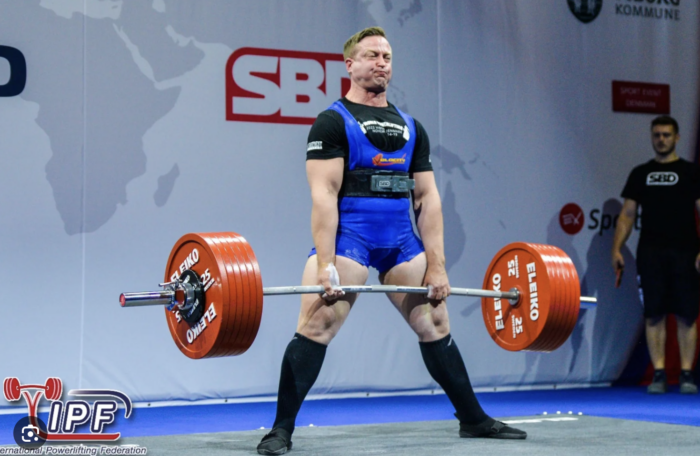
Deadlift: conventional or sumo style?
The deadlift is the exercise people argue about most in the gym. Which style is better: conventional, with your feet shoulder-width apart, or sumo, with your feet much wider and your hands gripping the bar on the inside? The short answer: it depends on your build. The longer answer lies in biomechanics and the studies below.
Deadlift: conventional vs sumo in brief
In a conventional deadlift, you place your feet shoulder-width apart under the bar and grip it outside your legs. In the sumo variation, your feet go considerably wider than your shoulders and your hands stay inside your legs (McGuigan & Wilson, 1996). The conventional technique tilts the torso further forward and therefore loads the lower-back muscles and the spinal erectors more heavily. Sumo is performed with a more upright back and shifts the load more onto the hip and thigh muscles (Piper & Waller, 2001).
Both styles are used successfully at the elite level. Neither is unambiguously “right” — the question is how well your body proportions favor the application of force.
What deadlift biomechanics tell us
Cholewicki and colleagues (1991) compared the sumo and conventional deadlift and found that the compression between the L4 and L5 vertebrae of the spine was roughly the same. However, the shear force acting on the L4/L5 vertebrae was significantly higher with the conventional technique. Put simply: with sumo, the load on the lower back and the movement there are smaller. As early as 1988, Horn showed in EMG studies that the spinal erectors (erector spinae) were twice as active during the conventional deadlift as during the sumo technique.
McGuinan and Wilson (1996) carried out a biomechanical analysis of both techniques. Their conclusions boil down to four practical points.
The start: breaking the bar off the floor
In the sumo variation, the upper body is much closer to a vertical position than at the start of a conventional deadlift. The knees and hips are at a larger angle, which shifts the load onto the hip muscles and the quadriceps. A conventional lifter’s body is bent further forward in the starting position, so even when breaking the bar off the floor, more of the lower-back muscles come into play.
Bar travel distance
With the sumo technique, the distance the bar travels is about 19% shorter than with the conventional deadlift. We know from physics that work done is the product of force and distance. If the distance is 19% smaller, the mechanical work needed to get the bar up is reduced as well.
Bar trajectory
Grabiner and Garhammer (1989) stressed long ago that when lifting a heavy weight, the bar must travel as close to the body as possible. This shortens the distance and directs the force as vertically as possible. Cholewicki and colleagues (1991) found that the sumo style lets the bar travel closer to the body while also reducing movement in the lumbar spine. McGuinan and Wilson (1996) confirmed that the sumo deadlift as a whole keeps the bar closer to the body and more vertical.
Pull time and the “sticking point”
Power is the ratio of work done to the time it takes. McGuinan and Wilson (1996) measured that the pull takes an average of 2.0 seconds with both techniques — there is no difference. What does differ is the place where people get stuck. Around 50% of sumo lifters hit a sticking point, or a serious struggle zone, in the second half of the pull. Among those using the conventional technique, only 15% get stuck in this phase. McLaughlin and colleagues (1977) explained that sticking points occur precisely when the most important muscles involved in the pull are in their most unfavorable position. Because everyone’s skeleton is slightly different, this point occurs at a slightly different height for each athlete.
The exact moment the sticking point occurs can be identified individually with EMG and kinetic analysis. This shows which muscles are weak, and from there you can start working on them further with accessory exercises.
Which deadlift suits your build?
Biomechanically, the sumo style has some clear advantages over the conventional one:
- Greater involvement of the thigh muscles in the early phase of the pull.
- A more upright body position and less load on the lower back.
- A shorter pull distance (about 19%).
- A more vertical bar trajectory, with fewer disruptive forces.
Even so, McGuigan and Wilson (1996) point out that the world records in the elite absolute class are mostly held by lifters using the conventional technique. Sumo lifters, on the other hand, have greater relative strength — the gap between their record deadlift and their body weight is larger. The practical conclusion is simple: the conventional deadlift tends to suit a powerlifter with long arms and a higher body weight, while sumo suits an athlete with shorter limbs and a lighter body weight. If you’re in doubt, try both for 6–8 weeks and see which style your results progress better in.
The deadlift in practice: technique and mistakes
The conventional deadlift recruits the erector spinae, trapezius, quadriceps and biceps femoris (Stone & O’Bryant, 1987). A closer look shows that the glutes, latissimus dorsi, teres minor, subscapularis, supraspinatus and infraspinatus, biceps, abdominals and calves are loaded as well (Farley, 1995). So a single exercise moves around half of the body’s muscle mass.
The starting position is decisive in the conventional deadlift. Your feet go under the bar, shoulder-width apart. As a rule, you grip the bar with one hand overhand and the other underhand, because this keeps the grip more secure. Your shins should be against the bar or very close to it (Farley, 1995).
By keeping the bar as close to your body as possible, you take advantage of a mechanical benefit that lets you apply more force (Stone & O’Bryant, 1987). The classic recommendation is that your pelvis should be level with your knees or slightly lower. Your back is straight or slightly arched, and the angle to the floor is about 45 degrees. In practice, the cue “hold your back in the same position as when standing” suits most athletes even better than a forced arch — try it in front of a mirror and you’ll see.
Daniels (2003) adds that the back must be flat (straight or arched) and the hips even slightly below knee level. So in the starting position you are essentially in a half squat, just a little deeper. This directs much of the load to the quadriceps at the start of the pull and reduces unnecessary stress on the lumbar spine (Groves, 2000).
Mechanical work is done when a force acts on a body and the body moves a certain distance as a result (Siff, 2000). Force is most effective when it acts in exactly the opposite direction to the force resisting the movement (Stone & O’Bryant, 1987). In the deadlift, that opposing force is gravity — which is exactly why the bar has to travel close to your body and as vertically as possible. Poor technique and “pulling against” the laws of physics is less effective and leads to injuries.
FAQ — deadlift
Is the sumo deadlift “cheating”?
No. Sumo is a fully legal technique under powerlifting rules, and a large share of elite lifters use it. A shorter range of motion doesn’t make the weight any lighter — you still have to pull the same weight off the floor.
Is the conventional or the sumo deadlift better for a beginner?
For most beginners, the conventional style is more intuitive and easier to control in terms of hip movement. But if you have very poor hip mobility in flexion or short arms, sumo may be the safer choice. Have an experienced coach look at both before you choose.
How many times a week should you deadlift?
One heavy deadlift session a week is enough for most recreational lifters, because the entire body’s musculature takes a heavy training load. Advanced lifters can add a second, lighter technique session that focuses on movement quality rather than maximal weight.
References
Cholewicki, J., McGill, S. and Norman, R. (1991). Lumbar Spine Loads During the Lifting of Extremely Heavy Weights. Medical Science Journal of Sports Exercise. Vol 23, pp 1179–1186.
Daniels, D. (2003). Deadlift 101, Part 1. Powerlifting USA. Vol 26. No. 8.
Farley, K. (1995). Analysis of the Conventional Deadlift. Strength and Conditioning Journal. Vol 15, No. 2, pp 55–58.
Groves, B. (2000). Powerlifting: Technique and Training for Athletic Muscular Development. Champaign: Human Kinetics.
McGuigan, R. M. & Wilson, B. D. (1996). Biomechanical Analysis of the Deadlift. Journal of Strength and Conditioning Research. 10(4), 250–255.
Piper, T. J. & Waller, M. A. (2001). Variations of the Deadlift. Strength and Conditioning Journal. Vol 23, No. 3, pp 66–73.
Stone, M. & O’Bryant, H. (1987). Weight Training: A Scientific Approach. (2nd ed.). Edina: Burgess International.
McLaughlin, T. M. et al. (1977). Kinematics of the Deadlift.
Siff, M. (2000). Supertraining.
Translated and summarized by Janar Rückenberg
Come and train! ArtGym