
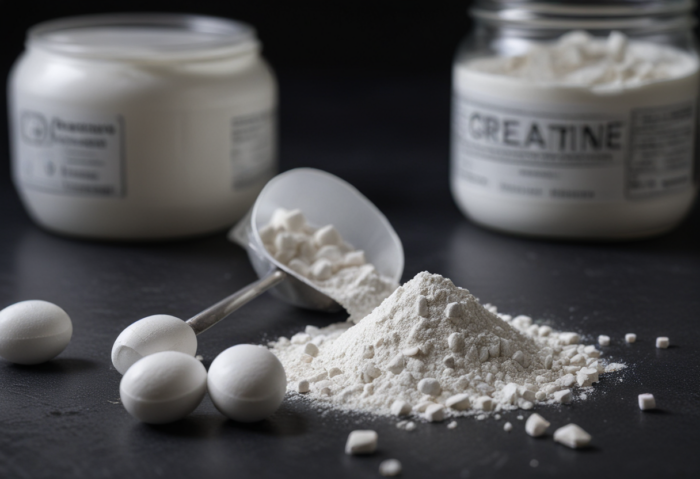
Creatine supplementation: effects on performance
Creatine supplementation is one of the most extensively researched topics in sports nutrition for strength and speed sports. The short version: it offers no benefit in endurance sports, provides a substantial boost during high-intensity exercise, and produces very different responses from person to person. Below, we look at what actual studies have shown — with numbers, not promises.
Creatine supplementation in endurance sports
Stoud and colleagues had participants run on a treadmill with a progressively increasing training load. The speed was 10 km/h, and the training load increased in stages corresponding to 50, 60, 70, 80 and 90% of VO2 max. Participants ran for 6 minutes at each intensity level and received 20 g of creatine monohydrate per day on test days for 5 consecutive days. The result: no notable change in either blood lactate levels or the composition of exhaled air.
In another study, participants took 20 g of creatine per day for 6 days, then completed a 6 km cross-country run. There was no improvement in performance — their finishing times actually increased. The most likely explanation is simple: creatine increased body weight, and in endurance sports, every extra kilogram slows you down.
These trials indicate quite clearly that creatine monohydrate supplementation offers no benefit in long-distance and endurance sports. Exercise physiology supports the same conclusion: muscle phosphocreatine levels are not what determines performance in endurance sports.
Creatine supplementation during high-intensity training
A delayed onset of fatigue and rapid recovery — these two qualities distinguish elite athletes from those who are simply good. That is precisely why numerous studies over the past 5–7 years have examined people training at submaximal and maximal training loads: lifting heavy weights, performing fast, explosive movements and generating high levels of force in a short time.
Many creatine products on the market promise benefits for strength training — and on that point, they deliver. There are fewer studies specifically involving strength athletes than trials using running and cycling tests, but some important findings exist. Earnest and colleagues assessed ten experienced powerlifters using three tests: the Wingate cycling test, a bench press 1 RM test and a bench press test at 70% of maximum weight, performed to failure.
- Participants who took creatine improved their anaerobic capacity in the Wingate test.
- Bench press 1 RM increased by 6%. However, when relative strength was considered, the difference from the placebo group disappeared — creatine increased body weight, while relative strength stayed the same.
- The rep count at 70% of maximum weight increased by as much as 26%.
Another research group had participants perform 5 sets of bench press to failure, with 2-minute rest intervals. Those taking creatine monohydrate showed a clear increase in rep count across all five sets compared with the control group.
Creatine as a dietary supplement
How your body takes up creatine
The importance of phosphocreatine for physical activity has long been known, but concrete evidence of the effects of supplementation has emerged only over the past couple of decades. Harris and colleagues wanted to find out whether oral creatine increases creatine levels in both blood plasma and skeletal muscle.
Normal plasma levels are 50–100 µmol/L. A 5-gram dose of creatine raised the peak concentration to 795 µmol/L, measured 1 hour after ingestion. Levels returned to normal within 6–7 hours.
For the skeletal muscle measurements, 17 volunteers received 5 g of creatine monohydrate, divided into 4–6 doses per day, for 4 consecutive days. Muscle biopsies were taken from the vastus lateralis before and after the experiment, then frozen and dried. The result: levels rose from 126.8 mmol/kg of dry weight before supplementation to 148.6 mmol/kg dm afterward. Free creatine monohydrate content and, specifically, phosphocreatine content increased by 20–40%. ATP content, however, did not increase.
Harris also noted that baseline muscle creatine levels vary considerably between individuals. Those with naturally low baseline levels showed the greatest increases in muscle creatine after supplementation. This is an important point that we will return to.
The same trial also monitored urine composition in three participants. On the first day, 40% of the ingested creatine was excreted in urine, rising to 61% on the second day and 68% on the third. This suggests that muscles take up creatine monohydrate most readily during the first few days — and then reach their limit. That limit was estimated at 155 mmol/kg dm and is reached within a few days at doses of 20–30 g per day.
Harris also investigated the effect of training on uptake. Five participants pedaled a cycle ergometer with one leg for 1 hour, while the other leg served as a control. The baseline level was 118.1 mmol/kg dm. After the hour, levels in the resting leg had risen to 148.5 mmol/kg dm, while those in the pedaling leg reached 162.2 mmol/kg dm. Working muscles clearly take up creatine more actively — probably because of increased blood flow and greater activity of transport mechanisms in the cell membrane.
Carbohydrates help too. Green and colleagues gave participants 93 g of simple carbohydrates in solution 30 minutes after they took creatine, resulting in 60% greater creatine uptake into muscle cells. Insulin did the work: carbohydrates trigger insulin release, and creatine is drawn into the cells along with the carbohydrates.
Responders and non-responders to creatine supplementation
Although most studies show that muscle creatine levels rise with supplementation, a substantial number have also found surprisingly small changes. Greenhaff studied 8 volunteers: muscle creatine levels increased by an average of 19–35 mmol/kg dm in five of them, but by only 8–9 mmol/kg dm in the other three.
This led to the classic distinction between creatine responders and non-responders. According to Greenhaff’s data, the thresholds are roughly as follows:
- Natural creatine level < 120 mmol/kg dm → supplementation has a substantial effect.
- Natural level ≥ 130 mmol/kg dm → the effect is modest.
This also fits with the observation that vegetarians respond particularly well to creatine supplementation — their baseline levels are usually lower because they do not eat meat. When supplementation stops, muscle creatine levels return to normal in about 30 days.
Practical conclusions — where is the cutoff?
For endurance sports, taking creatine makes no sense, at least based on this research article. But exactly where is the cutoff? That is a good question.
Male 100 m sprinters definitely benefit from creatine, and male 200 m sprinters probably do too. In a trained athlete, the creatine phosphate system can sustain ATP regeneration for a maximum of 10 seconds, usually 5–6 seconds. In a 100 m sprint, creatine and phosphocreatine (PCr) fuel the vast majority of the work. For 200 m — which takes around 20 seconds — at least a third of the distance could therefore be supported by creatine phosphate.
What about 400 m? Probably yes — athletes with higher creatine levels have an advantage. Remember that creatine increases body weight, and over 100 m–200 m, every explosive movement is worth its weight in gold. Over longer distances, the extra weight starts to work against you.
In his writings, Prof. Ööpik has identified 60–110 m as the distance range where creatine matters most. The review article by Bemben and Lamont (“Creatine Supplementation and Exercise Performance — Recent Findings”, University of Oklahoma) adds: “activities lasting between 10 seconds and 2 minutes would benefit … i.e. 200m, 400m and 800m sprints.” So creatine is beneficial up to 800 m. Does that mean male 1500 m runners should no longer use creatine — or is that exactly where the cutoff lies? Probably yes, but there is no definitive answer.
On the other hand, many long-distance runners still take creatine quite enthusiastically. The truth is probably that sprinting ability could come into play in the battle for the finish, but by then, carrying the extra weight throughout the race may already have cost them a significant advantage.
Frequently asked questions about creatine use
How much creatine should you take per day?
The studies used 20–30 g per day for a few days, split into 4–6 doses, to saturate the muscles. After that, much smaller maintenance doses are enough. Muscles have a ceiling (around 155 mmol/kg dm) — any creatine beyond that is simply excreted in the urine.
Why doesn’t creatine work for some people?
If your natural muscle creatine levels are already high (≥130 mmol/kg dm), you are close to the ceiling, so supplementation adds little. Meat eaters generally have higher levels than vegetarians — which explains why vegetarians respond particularly well to creatine.
Does taking creatine with carbohydrates really help?
Yes. In Green’s experiment, 93 g of simple carbohydrates taken 30 minutes after creatine increased uptake into muscle cells by 60%. Insulin does the work — it carries creatine into the cells along with the carbohydrates.
Includes translated material from the research article “Creatine Supplementation and Exercise Performance — Recent Findings”, Michael G. Bemben and Hugh S. Lamont, Neuromuscular Research Laboratory, Department of Health and Sport Sciences, University of Oklahoma, Norman, Oklahoma, USA.
Translated and compiled by Janar „Oskar” Rückenberg
Browse the creatine range in the Fitness.ee marketplace HERE
Come work out! ArtGym




