
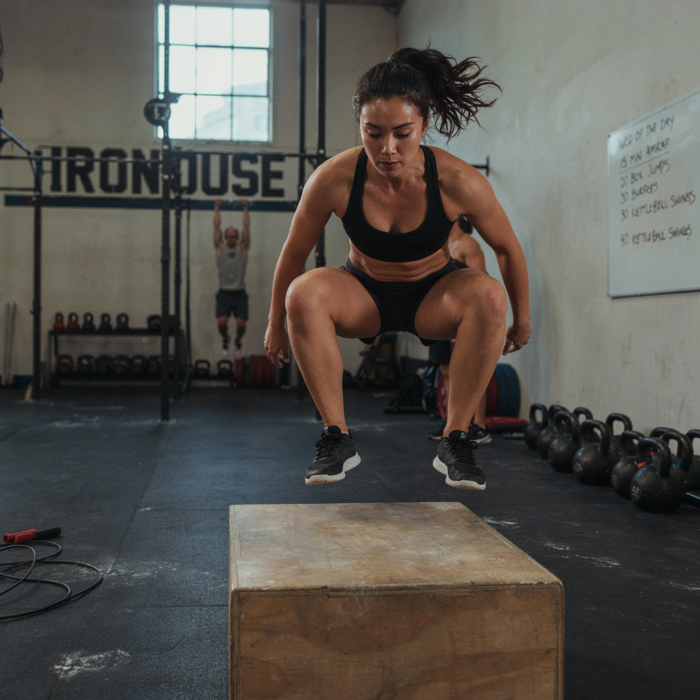
CrossFit: what this training really involves
CrossFit brings strength, endurance and technique together in a short but demanding block of training. If you want to understand why that might mean squats on one day, pull-ups on another and a race against the clock on the next, here is a straightforward explanation.
CrossFit and its core idea
CrossFit is often described as a strength and endurance training program. The idea is that training should develop more than a single quality. You work on strength, speed, balance, coordination, flexibility, power, accuracy and endurance together.
The simple truth is that CrossFit does not aim to make you just a good runner, a strong squatter or a fast sprinter. The goal is general physical preparedness. You should move better, lift sensibly, handle exertion and be able to perform different types of exercise even when your heart rate is already high.
That is why you often hear about the lack of specialization in CrossFit. It suits you well if you want to be fit across a range of activities. However, it may not be the best choice for an athlete whose entire development needs to serve a very narrow discipline.
How does CrossFit training work?
At the heart of each training session is usually a WOD, or workout of the day. This is the day’s set of exercises. Sometimes you need to complete a fixed amount of work as quickly as possible. Other times, you have a set time limit and aim to complete as many reps or rounds as possible within it.
This brings us to the first major warning. When speed is the goal, technique can easily break down. This is where a good coach and an honest assessment of how you feel matter more than the score on the board.
The training load can be adjusted. If the workout calls for squats at 60 kg but the weight you can manage today is 20 kg, you start with 20 kg. If an injury prevents you from squatting, you can choose a similar movement. If the rep count is too high, you do as many as you can with proper technique.
A typical workout structure
- Dynamic warm-up. This usually includes jumps, jumping rope, squats, push-ups, lunges, pull-ups and gentle mobility exercises. Translator’s note: there is nothing wrong with 5 – 10 minutes of jogging or using an ergometer either.
- Technique work or strength training. This involves basic exercises such as the squat, deadlift and press, or learning more complex movements, such as single-leg squats or handstand presses against a wall.
- WORKOUT OF THE DAY, or WOD. This is the main part of the class, where you complete a set number of reps quickly or do as much work as possible within a set time.
- Stretching and relaxation. You can do this with the group or take your time on your own.
Who is CrossFit suitable for?
CrossFit is flexible in that people at very different fitness levels can do the same set of exercises. The differences lie in the weight, pace, volume and exercise variation. As a beginner, you do not need to take on the same training load as an experienced athlete.
- Beginners who want to start strength training. This assumes that a coach is present during training and that you learn the basic movements at an unhurried pace.
- People who enjoy exercising in a group. This was also what initially drew me, the author of this article, to CrossFit.
- Fitness fanatics. CrossFit requires consistency, and many people train on a 3 : 1 schedule, although some end up going to the gym every day.
- Masochists, in a good way. A short workout can mean having to give 100% and really push yourself.
- Former athletes. The competitive element, shared effort and comparison of results can feel familiar.
There are also people for whom CrossFit may not be the best fit. That does not mean you cannot try it, but it is worth setting realistic expectations.
- Specialists. If your goal is to maximize your performance in powerlifting, for example, you need to devote a large proportion of your time to that discipline.
- Athletes with sport-specific demands. If your sport requires a particular movement, speed or type of strength, your training needs to support that.
- Solo exercisers. CrossFit is mostly group training. If you always want to follow your own plan on your own, you may find this format frustrating.
CrossFit at home and for beginners
CrossFit.com publishes workouts of the day that you can do in a training studio, at the gym or, if needed, at home. Translator’s note: you can also start with no equipment at all, using only your body weight.
A good example is “Cindy”. This is a simple bodyweight workout. You need a pull-up bar, but otherwise you can do it almost anywhere.
“Cindy”: as many rounds as possible in 20 minutes.
- 5 pull-ups
- 10 push-ups
- 15 squats
Set a timer for 20 minutes and work through the exercises in the order given. There are no scheduled rest periods between rounds. Rest when you need to, but frankly, that also means you’ll complete fewer reps.
Some easier variations
- 20 minutes: 3 pull-ups, 6 push-ups, 9 squats.
- 12 minutes: 5 pull-ups, 10 push-ups, 15 squats.
- 12 minutes: 1 pull-up, 4 push-ups, 7 squats.
- 10 minutes: 1 pull-up, 4 push-ups, 7 squats.
Complete as many rounds as possible in the time given. But don’t let the clock dictate your technique. A poorly executed pull-up or a squat when your back is fatigued won’t improve your fitness.
CrossFit FAQs
Is CrossFit suitable for a complete beginner?
Yes, provided a coach helps you adapt the exercises and technique comes before speed. As a beginner, you should start with less volume and easier variations.
Is CrossFit dangerous?
The danger comes when fatigue and time pressure lead to sloppy movements. An appropriate training load, a proper warm-up and a realistic pace greatly reduce the risk.
Can you do CrossFit at home?
Yes, especially bodyweight circuits. For heavier lifts and more technical exercises, though, working with a coach or in a safe training environment is a better choice.
Article source: The original Nerd Fitness guide
Author:Janar Rückenberg (translation)
Come and train! ArtGym




