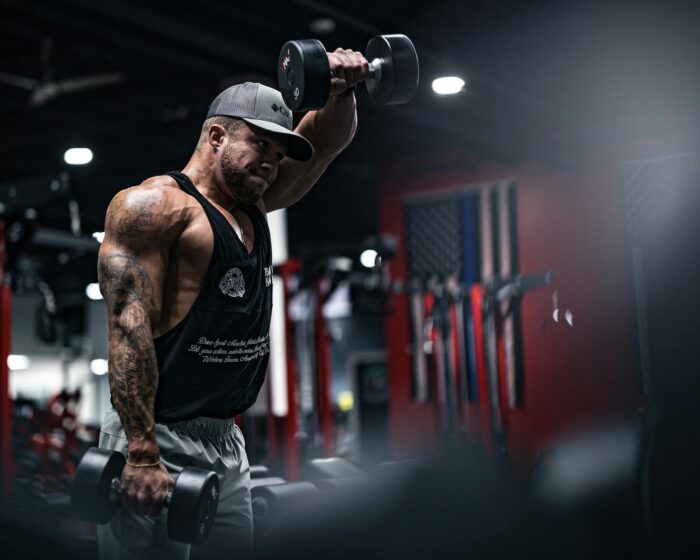
Dennis James: shoulders and triceps in the gym
The triceps worked just as hard as the shoulders in this workout: the weights increased with every set, technique had to hold up, and egos had to stay at the door. Dennis James showed us at Kadriorg Sports Center after the Tervex fair how an IFBB professional bodybuilder works when you take the audience out of the equation.
Why train triceps and shoulders in the same workout?
Dennis James was in Estonia for the Tervex fair, and that evening it was time to train. Officially, it was a demonstration workout, but Dennis was really just doing his usual work. There were three of us training: Dennis, Vladimir and me. When Dennis asked who wanted to join in, there wasn’t much to think about.
Shoulders and triceps make sense on the same day because many presses work both. The shoulders initiate the movement, and the triceps straighten the arms to lock out. If either is weak, the whole press falls apart. The simple truth: the big man’s workout wasn’t some secret miracle routine. It was precise execution, progressively heavier sets and pushing hard right to the end.
Training shoulders the Dennis James way
The first exercise was a Smith machine shoulder press to the front. Sit on the bench, grip the barbell and lower it to your chin. There’s no need to go any lower. Straighten your elbows as you press up. We loaded 20-kilogram plates for the warm-up, then increased the weight in a pyramid.
Dennis followed the same principle for every exercise: add weight from set to set. In the final sets, he introduced drop sets. Helpers removed plates either when the barbell was briefly racked or during the set itself. Your training partner needs to pay attention here. If the plates come off one side faster than the other, the barbell tilts.
On the Smith machine, Mr. James eventually reached 150kg plus the barbell. He managed about 5-6 reps with that, then we reduced the weight and the set continued. A pretty strong guy, to be honest.
The second exercise was seated dumbbell lateral raises. That sounds easier than it is. Keep your wrists relaxed and your arms almost straight at the elbows, lifting from your shoulders without using momentum. Raise the dumbbells out to the sides, pause briefly at the top, then lower them slowly under control.
Dennis finished with 20-kilogram dumbbells. I got 12-kilogram dumbbells, which he called baby weights. In his world, there are men’s weights, women’s weights and, finally, baby weights. That stung, but it stuck.
Next came dumbbell front raises. We held the dumbbells in a hammer grip and raised them to face height. Dennis used 14kg here. The idea was the same: don’t jerk the weights, don’t use your back to haul them up, and keep the movement under control.
We finished the shoulder portion with dumbbell upright rows. We used dumbbells instead of a barbell. Stand upright, keep your arms close to your body and row the dumbbells up to shoulder height. Done correctly, this gives your shoulders a substantial training load.
Triceps: technique before weight
Triceps work began with cable pressdowns. Stand close to the cable machine, keep your elbows fixed and press your hands down. Fully straighten your arms at the bottom. This helps engage the lateral head of the triceps more effectively. If the weight is too heavy and your elbows start wandering, you’re only cheating yourself.
The second exercise was the EZ-bar French press. This was Dennis’ favorite triceps exercise. You could call it a nosebreaker, and I understood why very quickly. Lower the barbell directly over your nose, stopping about 1-2cm away. Not to your forehead or behind your head. This keeps more of the training load on your triceps and makes it harder to use momentum.
Dennis James eventually used 80kg plus the barbell. Mr. James thought I could finish with a slightly more manly weight too, so we added ten-kilogram plates. I managed about three more or less passable reps. The next rep flattened my nose. Luckily, Vladimir, who was spotting me, got his hand in between. The last rep went completely out of control: the weight came hurtling down, I turned my head to the side, and Vladimir saved the day just in time again.
We finished with single-arm underhand cable pressdowns. Keep your elbow against your side, with the tip slightly raised relative to your torso. Start with your palm facing up, then turn it inward midway through the movement. This engages both the outer and inner portions. And the same rule applies again: fully straighten your arm at the end.
Practical takeaways from the workout
So what was the actual difference between an amateur’s workout and a professional’s? The routine itself was nothing extraordinary. The difference was in focus, work capacity and how much each could get out of every set. I used to think I gave 100% on my sets. After this workout, it was clear there was always room to do better.
Honestly, I didn’t get the full experience of the workout myself. I’d spent the previous 12h rushing around on my feet at the Tervex fair, and my shoulders and triceps had had only one day of rest since my last workout. But if you get the chance to train with Dennis James, I recommend it. Those little details stick with you better than ten dry paragraphs of theory.
- SHOULDERS: Smith machine shoulder press 4 x 12 – 8
- SHOULDERS: Seated dumbbell lateral raises 4 x 12 – 8
- SHOULDERS: Dumbbell front raises 4 x 12 – 8
- SHOULDERS: Dumbbell upright rows 4 x 12 – 8
- TRICEPS: Cable pressdowns 4 x 12 – 8
- TRICEPS: EZ-bar French press 4 x 12 – 8
- TRICEPS: Single-arm cable pressdowns 4 x 12 – 8
FAQ: triceps and shoulder training
Should you train triceps after shoulders?
Yes, if your shoulder workout includes a lot of pressing. Your triceps are already warmed up, and targeted exercises finish the job.
Are drop sets suitable for everyone?
They are better suited to experienced lifters, especially when someone is on hand to help. If you are a beginner, it makes sense to learn proper technique first.
Why lower the barbell toward your nose during a French press?
This keeps your form stricter and reduces the use of momentum. However, it requires good control and a spotter when the weight gets heavy.
Author: joker
Come work out! ArtGym