Groin stretches and lower back care
Stretching your groin muscles is a small thing that is easy to skip. Yet tight inner thighs often make themselves felt when you walk, squat or lunge, and even in your lower back. Here is a straightforward, practical look at why stretching exercises benefit your body and how to make them work for you.
Why does stretching your groin muscles matter?
Your pelvis is more than just where your legs attach. It is the foundation of your spine. When the muscles around your pelvis are too tight, movement throughout your body can become more awkward. Your abdominal muscles need to control the position of your pelvis, but they cannot do that well if one side is constantly pulling against them.
Tension in your groin and inner thighs can affect how you walk, run, squat or climb stairs. Sometimes you do not feel the problem in your groin at all. Instead, it shows up in your lower back, hip or knee. What is actually happening? Your body finds a way around the tightness and starts shifting the demands of the movement onto another area.
When flexibility is poor, a muscle cannot produce force through its full range of motion. Your movements become shorter, coordination suffers and unnecessary compensations creep into your training. This does not mean everyone needs to do the splits. The goal is simpler: your joints move more freely, and your muscles do not hold back your usual training.
How do stretching exercises work in your body?
Stretching exercises do more than give you the sensation of a muscle lengthening. Gentle groin stretching helps increase blood flow to the muscle and supports recovery after exertion. When a muscle can relax more easily, this may also reduce the stiffness that otherwise builds up after a leg or full-body workout.
Another benefit is muscle awareness. Learning to recognize where tension develops and when it becomes too intense helps you move more intelligently in the gym. For example, difficulty with a squat does not always come down to weak legs. Sometimes tightness in your hip or groin muscles simply stops you from reaching depth comfortably.
Groin stretching can also be a useful transition between bouts of exertion. Before training, gentle dynamic exercises are a better fit: they wake your body up and prepare your joints for activity. After training, you can use slower stretches to release tension. Honestly, the biggest mistake is not the choice of exercise, but rushing and forcing the inner thigh stretch.
Groin stretching in practice
Start in a position where you feel a stretch in your inner thigh, rather than sharp pain in your groin. Keep your body under control. If you have to hold your breath or find yourself grimacing, you are pushing too hard. A groin stretch does not need to be dramatic to work.
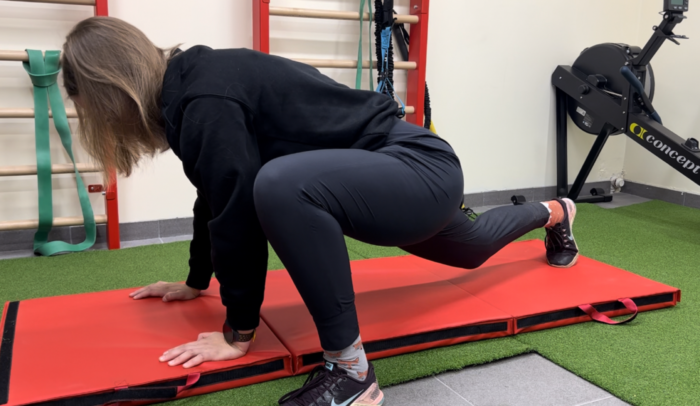
A lateral lunge is a good option. Keep one leg straighter as you bend the other knee and move your hips back. Keep your spine long. Move slowly until you feel a distinct but tolerable stretch in your inner thigh, then return to the starting position. The same principle applies to a gentle butterfly stretch on the floor, if your hips allow it.
The key is to avoid jerking movements. You do not need to force your groin muscles into a stretch. A sudden movement can make your body respond by tensing up even more. The simple truth is that stretching gently and often is better than stretching rarely and too forcefully.
If you have had a groin injury, hip pain or sharp lower back pain, do not push through discomfort. In that case, choose gentler movements and seek advice from a physiotherapist if needed. Pain is not a sign of a job well done.
What should you look for when stretching?
The first sign of a good stretch is control. You can breathe calmly, maintain your position and keep the stretch in the muscle you want to target. If your lower back sags or your knee turns inward uncomfortably during a groin stretch, adjust your position.
The second sign is how it affects your movement. After stretching, walking, squatting or opening up your hips should feel a little freer. If you notice no difference at all or feel irritation, the exercise you have chosen may not suit you at the moment. Your body gives honest feedback if you listen to it.
Third, do not use stretching as punishment. It is not a chance to quickly “fix yourself” at the end of a workout. Stretching exercises are part of training, rather than a separate, tedious extra. Their role is to help your muscles recover, reduce excess tension and keep your movement technique cleaner.
FAQ
Can groin stretching help with lower back pain?
It may help if tension around your hips and pelvis is partly responsible for the strain on your lower back. However, not all lower back pain originates in the groin. If the pain is severe, recurring or radiates into your leg, it is worth having it assessed separately.
Should you stretch before or after a workout?
Before a workout, lighter, more dynamic groin stretching helps prepare your body for activity. After a workout, groin stretching can be slower and gentler to help release muscle tension and support recovery.
Why are stretching exercises sometimes uncomfortable?
Discomfort often occurs when a muscle is used to a limited range of motion or when the position is too aggressive. You should feel the stretch in your inner thigh, but the sensation should not be sharp or alarming.
Author: Marek Morozov
Source: WHO – physical activity.
Come train with us! ArtGym