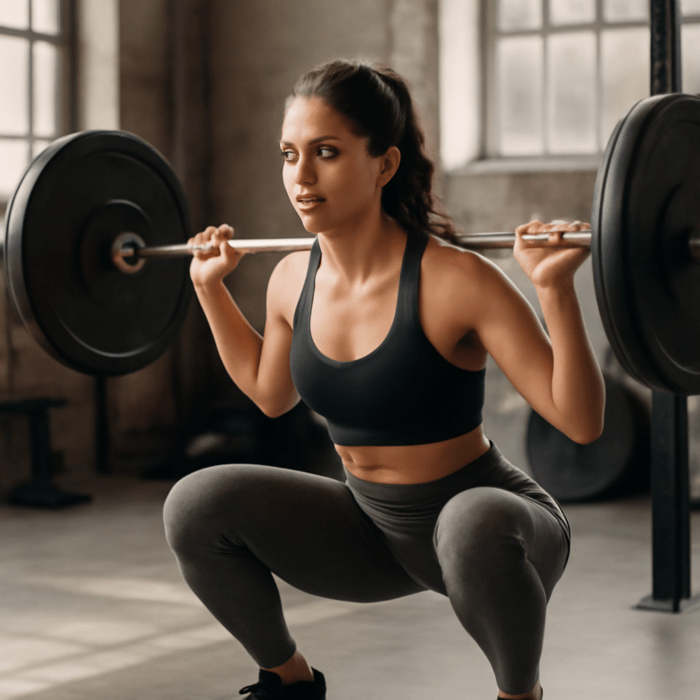
Women in the gym: six mistakes to avoid
When women spend years stuck in the same place in the gym, laziness is usually not the reason. Often the program is simply full of exercises that look hard but don’t give the muscles enough training load to build strength or muscle.
The simple truth: it’s better to do fewer gimmicks and more real work. Squats, deadlifts, presses, pull-ups and rows aren’t just for men.
Why do women sometimes end up on the wrong track in the gym?
In the gym you often see programs where every movement has to be complicated. Lunges combined with a dumbbell overhead press. Squats on a Bosu ball. Light triceps kickbacks with endless repetitions. Burpees with a push-up, because otherwise it supposedly isn’t hard enough.
So what actually happens? Balance and coordination get the training load, but the muscle doesn’t receive a strong enough signal. If the dumbbells have to be very light just to hold the exercise together, the work done by the shoulders, back or legs stays watered down.
That doesn’t mean every exercise that develops balance or mobility is bad. They can have their place in a warm-up or in recovery. But if the goal is a stronger, fitter and more confident body, the main part of your training has to let you lift weights with correct technique and gradually add more weight.
Women and heavy weights: six typical mistakes
1. Fear of becoming masculine
This myth is stubborn. Many women fear that a barbell and dumbbells will instantly give them a bodybuilder’s physique. In reality, it doesn’t happen just like that. Building muscle takes time, hard training, enough food and very good recovery.
Training with heavy weights mostly gives you better posture, firmer muscle tone and a more confident feeling instead. It doesn’t take away your femininity.
2. Not listening to a good coach
Sometimes a person comes to the gym with a fixed idea: I only want abs, glutes and arms. A good coach, though, sees the bigger picture. They build the basic exercises into the program, teach technique and keep the training load logical.
A coach makes a mistake when they quietly go along with a weaker program for the client, even though they know it won’t get far. The client makes a mistake when they pay for advice but never really try to follow it.
3. Overestimating the calorie burn of jumping exercises
Jumps and burpees feel brutal. You’re out of breath, your heart rate shoots up and you break a sweat fast. Honestly, a minute of them can be hard. But a hard feeling doesn’t always mean a big overall result.
Most people can’t do these exercises for long or with good quality. On top of that, the knees and ankles take a heavy beating. When the benefit is small and the risk is high, it’s worth asking: is this exercise really worth it?
4. Not being able to stand boredom
Effective training can be quite simple. The same squat, the same deadlift, the same press and the same row come back week after week. That doesn’t sound as exciting as a new P90X-style program where every workout is different.
But the body develops through repetition and consistency. You need to see whether your weights, repetitions or technique are improving. If the exercises change every time, progress is harder to measure.
5. Sticking to what comes out well
That’s only human. When mobility, endurance or a complex sequence of movements comes easily, you want to do more of it. But the gym shouldn’t just stroke your strengths.
If your lower body is strong but your upper body is weak, the upper body needs attention. If hard exercises make you uncomfortable, you need to learn to do them safely instead of running away from them.
6. Ending up with a coach who doesn’t take you seriously
The original text made a sharp observation: some male coaches have a male client do squats, pull-ups, deadlifts and standing presses, but a female client is first sent to the exercise bike for 10 minutes. Then come the band around the knees, light sumo squats, dumbbell flyes and a simple glute bridge.
The problem isn’t the warm-up. The problem is when the whole workout ends up being just preparation. Women deserve the same serious program, the same clear progression and the same attentive work on technique.
How can women get more out of strength training?
Start with a simple framework. Every week should include a squatting or pressing movement for the legs, a deadlift or hip thrust for the hips, and one press and one pull for the upper body. Alongside that you can add core work, mobility and smaller muscle groups.
The weight doesn’t have to be an ego matter. It has to be enough that the last repetitions demand effort, while your technique stays clean. If you do the same repetitions with the same weight for months, your body gets very little reason to change.
Write down the exercise, weight, repetitions and sets. That way you can see whether you’re progressing. If you do 8 repetitions one week and 10 with the same weight a couple of weeks later, that’s already a sign of progress.
What do women do well in the gym?
Men have something to learn here too. Women often do a better job of maintaining movement quality. They don’t push the weight up at all costs when range of motion and control suffer as a result.
Women are also less likely to push through pain that signals a risk of injury. That’s smart. Training has to be demanding, but sharp pain is not a sign of bravery.
Three things are worth remembering: quality before ego, consistency before gimmicks, and real training load before exhausting busywork. Once those are in place, the gym becomes a much more honest place.
FAQ: women and the gym
Should women do the same exercises as men?
Yes, the basic movements are the same: squatting, pulling, pressing and hinging at the hips. Training load, volume and technique are chosen according to the individual’s level.
Are exercises on a BOSU ball always bad?
No. They can be suitable for balance or coordination. But if your goal is strength and muscle mass, heavier work on a stable surface is usually the better choice.
What should you do if heavy exercises intimidate you?
Learn the technique calmly, start light and add training load in small steps. If needed, ask a coach for help, but choose one who takes your goal seriously.
Article source: https://www.t-nation.com/training/6-mistakes-women-are-still-making-in-the-gym
Translated by: Janar Rückenberg
Come and train! ArtGym