
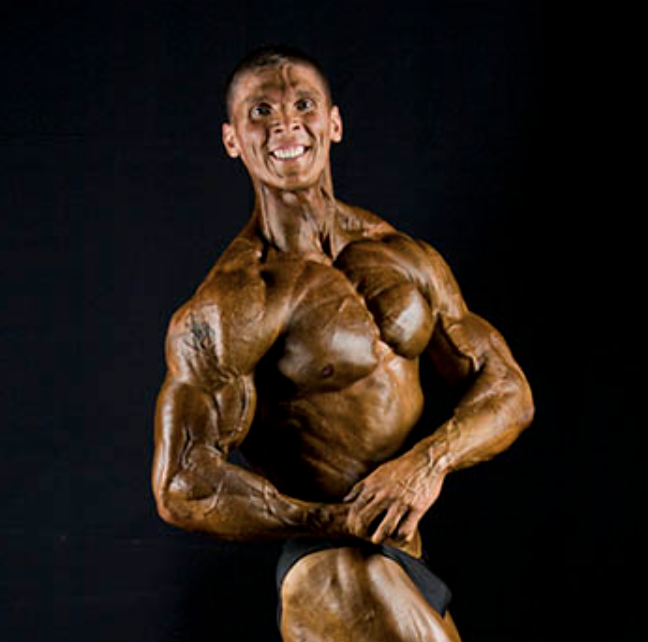
I’m heading to my fifth teacher in turn. I seem to have worked through all the other muscles by now. The chest is still untrained. Who has one of the undeniably best chests in Estonia? One of them is definitely Janar Rückenberg — the man who surprised everyone in spring 2005 and is remembered for being in truly great shape.
With the other teachers it was simpler — agree on a time and walk into the gym — but with Janar I had to make a longer trip. To Rakke, specifically. A place between Rakvere and Jõgeva in Lääne-Viru County. A place you won’t easily find without a map. On some maps it probably isn’t even marked.
The road to Rakke — to Janar Rückenberg
The closer I get to Rakke, the more I feel myself leaving civilization behind. The traffic thins out. There are fewer houses. Proper houses give way to abandoned buildings. The forests grow denser and denser. If anyone believes dinosaurs are still alive, this is definitely the place to look for them.
At last I reach the sign that says “Rakke”. Right, I’m here. After a bit of searching I find Janar’s residence too, where Janar is waiting for me at the window with a coffee. A man built like a tank — 110 kg. The rumors about the size and the lightning-fast progress are true. We head on to the gym, and the training can basically begin.
The gym where Janar trains is hardly among the elite gyms. The machines are old and worn. Most of the equipment is homemade, re-welded and repaired with whatever was at hand. My first thought — a primeval gym. It even brings on a nostalgic feeling. Long ago, when I started training on my own, I began in roughly the same conditions.
With the equipment being what it is, there’s no proper warm-up to be had. One option is simply to run around the house; the other (which we used) is to warm up the chest muscles by doing flyes on the pec-tec machine. Once you’re warm, you can start pressing. Wait, wait. Since there’s no bench press bench as such, you have to build one first.
A chest workout, Janar Rückenberg style
Decline bench press
As I said — when the conditions aren’t ideal, you have to put the bench press bench together yourself first. Take an ordinary bench. Place it inside the power rack (the power rack, by the way, was also built by Janar). To give the bench some slope, put a few wooden blocks under its rear legs and hope the whole contraption doesn’t tip over while you’re pressing.
Otherwise it’s simple. Take the barbell off the supports and start pressing. Increase the weight from set to set. Janar’s reps are currently between 6–8, but it often happens that the sets stretch quite a bit longer. In the end Janar was up to 165 kg, doing quite a few repetitions with it. For the last sets, reduce the weight from set to set and do more repetitions.
A nice change from the regular bench press and the incline press. It also shifts the emphasis more to the lower chest and the outer edges. Janar doesn’t use this exercise all the time, but now and then it’s a good alternative.
Flyes on a flat bench
In this exercise you simply lie on a bench. You pick up the weights and start doing flyes. There’s no other secret — choose a suitable weight and push to the end. It helps if someone assists with the last reps by pushing from the elbows. Here we used, I think, 32 kg dumbbells. It’s hard to say exactly, because the dumbbells are made up of plates of different colors and kinds, and how much one plate or another weighs is a big secret.
Since the regular press was left out this time, we took up regular flyes — they load exactly the same region as pressing. Flyes are simply the isolated variant. As a rule, Janar’s approach is that after pressing on a flat bench, the flyes go on an incline bench, and after pressing on an incline bench, the flyes go on a flat or decline bench.
Incline bench flyes
This gym even has an incline bench. We lower the weight on the dumbbells a little and start doing dumbbell flyes on the incline bench. Exactly like the previous exercise. The only difference is that the last set is done with a heavier weight than usual. That means adding small plates to the dumbbells.
Janar complains that more weight could be added and then reduced between sets, but since there are no other dumbbells to swap to, plates have to be added to or removed from the existing ones. And since the collars are nuts, changing the plates takes a huge amount of time and wouldn’t pay off. Janar recommends always using the incline bench, because it’s usually the most lagging area of the chest.
Pec-tec machine flyes, or the butterfly
So, an ordinary chest machine, albeit welded over a bit to make it more comfortable. Here we use the so-called drop-set tactic: you do a certain number of repetitions, reduce the weight and do as many more as you can. This is a good one to take as the last chest exercise. It also gives you a good feel for how the pec muscle works and how the muscle contracts. As a rule, Janar always tries to keep the sets of this last exercise longer than usual — somewhere between 15 and 8 repetitions.
To Mr. Rückenberg’s question of whether we train triceps too — on chest day there is always a little triceps work in the session — I answer: OK, because I train the same way: a little triceps on chest day.
Triceps exercises
French press
Here we use an old special barbell that I haven’t seen in a long time. The point is that it lets you keep your hands in a so-called “hammer position”. Lie back on the bench. Take the barbell and start lowering the weight over your head. We do three sets. After the first set we add weight — a small pyramid, so to speak. If you lower it down behind your head, you get a good stretch, which gives the exercise its own feel.
Press between two benches as a superset with a cable French press
Start with the good old triceps exercise, which does require a partner’s help. Take two benches. Place them parallel next to each other. Put your feet on one bench and support yourself with your hands on the other, with your back to the bench. Someone places the weight (barbell plate(s)) on your lap and you start pressing with your arms. Janar and I used a 3 × 20 kg plate. It’s a good mass-building exercise and an alternative to dips on parallel bars. We keep the rep count between 15 and 8.
If you use this superset combination, do the press between the benches first and go straight into the French press on the machine right after it. The principle of the second exercise is simple — you lie down on the bench, set the cable on the pulley to run from the bottom, take the end of the cable in your hands and start imitating the French press movement. Here, again, it’s more comfortable if someone else hands you the end of the cable.
Seated one-arm triceps extension on the cable machine with a rope
The finishing exercise. Janar likes to do this one at the end to get a so-called pump. You can do it with a dumbbell or on a machine — Janar prefers the latter, because when you lower the arm, the machine pulls the triceps into a nice stretch. We start with 2–3 regular sets, and the last set is, once again, a drop set.
Workout plan — chest and triceps
CHEST
- Bench press on a decline bench — 9, 9, 5, 10, 12
- Fly on a regular flat bench — 10, 8
- Fly on an incline bench — 12, 8, 7
- Pec deck — 12, 9 + last set a drop set 13 x + 16 x
TRICEPS (lighter)
- Lying triceps extension, palms facing each other (also known as the skullcrusher) — 12, 8
- Weighted press between benches + lying triceps extension on the cable machine — 15/8, 12/12
- Seated one-arm triceps extension on the cable machine with a rope — 15, 12
This is one of many variations of a chest and triceps workout. The workouts keep changing, i.e. the order and selection of exercises differ in almost every session.
Janar Rückenberg’s weekly plan
- Deadlift, traps, rear delts, biceps (7–10 sets).
- Shoulders (front and middle delts), triceps (7–10 sets).
- Quads and hamstrings.
- Lats, biceps (lighter, 4–6 sets and not every time).
- Chest, triceps (lighter, 4–6 sets and not every time).
- Calves, abs and forearms.
- Rest.
Janar’s comment
Every now and then I take a rest day after leg day too, but that’s not a rule. I do it when I feel tired. And sometimes the day after leg day is, once again, the one when I train abs, calves and forearms. So over a six-day cycle I may hit abs, calves and forearms once, and another time twice.
I usually train arms (biceps, triceps) 2 x per cycle, but that isn’t a rule either. If I feel tired, or the triceps, for example, hasn’t recovered from its main day, then I don’t train it on chest day. The main arm days are the first day for biceps, together with the deadlift, and the second day for triceps, together with shoulders.
I do train arms 2 x a week, but then I try to arrange it so that one day is lighter and the other heavier. I’ve mainly used the number of sets to define the difficulty. On the heavier arm day I do 7–10 sets, on the lighter one 4–6 sets.
I definitely don’t do the same exercises from workout to workout. It may happen that your next triceps workout doesn’t include any of these exercises, or that I swap out only one, and so on. Right now I’m in the 9–5 phase, but that doesn’t apply to the lighter arm days. On those days I still try to stay in the classic bodybuilder rep range (12–6). On the other hand, when I train triceps on its main day together with shoulders, the reps definitely stay more in line, i.e. they fall within the rep range of the given phase.
I’d definitely recommend close-grip presses for triceps. They’re a permanent fixture on my main day, and I feel they’re the No. 1 exercise for triceps mass. No. 2 would be all the different skullcrusher variations on benches set at different angles, followed by the various presses (on benches, on parallel bars). If you want mass and are chasing arm thickness, you should put isolation exercises on the back burner altogether, at least to start with. I’m not saying they’re pointless, not at all, but when arm size is the priority, you should favor compound exercises that work all three heads of the triceps.
Questions are bound to come up about the unusual combination on the first day (deadlift, traps, rear delts, biceps). The reason I put pulling on a day of its own is that when I put it on back day and give it everything, I feel that after the first exercise (the deadlift) I’m no good for any lat work. The foundation of lat mass training is exercises like bent-over barbell rows, rows with the end of the barbell, and bent-over dumbbell rows. These exercises are also very demanding in terms of energy and effort, and just holding the position puts a lot of the load on the lower back.
Traps come second because they’re already warm from the deadlift, so they’re a good place to start after it. Also, traps aren’t as global a muscle: the exercises that train them are mostly local in nature and affect only the traps.
Rear delts pair well with traps, again. As a rule, I do only one exercise for the rear delt region: bent-over dumbbell lateral raises. What I do try to vary is the execution (long and short reps, supersets, negative reps, isometric contraction, etc.).
And biceps comes at the very end of this first day. I feel that biceps fits this day. Although the deadlift takes a lot out of you, it doesn’t directly affect the biceps. By the time I get to biceps, the body is warm enough, and the biceps has of course picked up some fatigue, but not directly. That’s why even after the deadlift I can start biceps work with a reasonably “fresh head”. All in all, every exercise on this day is individual in nature, but they prepare each other and fit together.
Periodization and rep ranges
I also try to use certain periodization principles. At the moment I’m trying the following scheme:
- Strength — REPS 6–4 (arms 7–4 in this period)
- Strength + Mass — REPS 9–5
- Mass (mostly pure hypertrophy) — REPS 12–7
Each phase lasts 4–5 weeks, and when the cycle is complete, I start over. Depending on the phase, I try to structure my sets so that 2/3 of the sets fall within the rep range I’m currently in, and 1/3 of the sets fall below and above it.
For example, if I’m in the 9–5 rep range and a workout calls for 12–13 sets per muscle group, 8 of them should fall in the 9–5 rep range, 3 sets in the 6–4 range, and 2 sets in the 12–7 rep range. And depending on the phase, that first priority shifts/changes! I should also say that this periodization is the kind of thing that sounds great in theory but doesn’t always work out in practice. Fortunately, my concept has by and large held up so far.
It’s also important to understand that the rep ranges given for the phases can’t apply to every muscle. It’s pretty obvious that nobody is going to do 4 or 5 reps for traps and abs.
For traps, abs, calves and forearms I use the following rep ranges: 15–8, 20–12 and 25–15, and these rep ranges and how I use them don’t depend on the phase. It may well be that I train traps in the 20–12 rep range in one workout, 15–8 in the next, and so on. With abs, what I’m actually doing at the moment is staying only in the 15–8 rep range, because I also want to build abs muscle mass. I used to train abs with high rep counts and frequently the whole time, which is why they’re lacking in mass.
You’re sure to wonder where such odd rep ranges come from: 12–7, 9–5, 6–4? Simply because I feel that the usual, classic split of 12–8, 8–6 and 6–4 just doesn’t suit me. When I’m in the 8–6 phase, I always feel like I could grind out a ninth rep as well, and it would come. So I’ve individualized the classic approach a little, and I feel the results are good. For arms, I feel that even in the strength phase the rep range shouldn’t get too low. That’s why I chose 7 reps as the upper limit.
Variations from another training split
I’ll also share my variations of the other training split that I use from time to time.
Variant I
- day — Thighs, calves
- day — Lats, biceps (light)
- day — Chest, front delts, triceps (light)
- day — Rest
- day — Deadlift, traps, rear delts, abs
- day — Biceps, triceps
- day — Rest
Variant II
- day — Deadlift, traps, rear delts, abs
- day — Biceps, triceps
- day — Rest
- day — Thighs, calves
- day — Lats, biceps (light)
- day — Chest, front delts, triceps (light)
- day — Rest
Pyramiding and a sample with weights
This chest workout came to 13 sets. Then again, there are workouts where I manage perfectly well with 10 sets — the chest responds to training very well. 10 sets for chest is actually quite normal. In the workout with Joker, too, I tried to follow the principle that 2/3 of the sets fall in the rep range of the first priority, and 1/3 below and above it. This keeps your strength numbers up and lets a few sets touch the pure hypertrophy zone. And that’s exactly how it turned out.
I like to train by pyramiding up through the warm-up sets, then doing 3 working sets that keep pyramiding up, and finishing with 1–2 lighter sets pyramiding back down.
For example, the press on the decline bench, done as the first exercise, looked like this:
- set — 60 kg — 12 x — warm-up
- set — 90 kg — 8 x — warm-up
- set — 120 kg — 6 x — warm-up
- set — 135 kg — 9 x — FIRST WORKING SET
- set — 150 kg — 9 x — SECOND WORKING SET
- set — 165 kg — 5 x — THIRD WORKING SET
- set — 140 kg — 10 x — FOURTH WORKING SET
- set — 120 kg — 12 x — FIFTH WORKING SET
At first glance it may look like an awful lot of sets, but it isn’t — pyramiding up like this is necessary to prevent injuries and to prepare/adapt the nervous system for heavy weights. And I don’t do two sets on the way down every time; sometimes it’s only one, which leaves the number of working sets at four.
I’m sure that if I did a 60 kg warm-up and then slapped 150 kg on the barbell right away, I’d never get 9–10 x with it. That’s exactly why I need this kind of pyramiding and gradual warming up. And as I said, the risk of injury is also lower with this approach.
Our workout was intense and lasted 1 hour and 15 minutes in total!
FAQ — Janar Rückenberg’s training
How often does Janar Rückenberg train chest and triceps?
Chest and triceps are combined on one day, with the triceps getting the main training load on shoulder day and a lighter volume added on chest day. Janar generally trains arms twice a week — once heavier (7–10 sets) and once lighter (4–6 sets).
What is Janar’s maximum chest press weight in this workout?
The heaviest working set of this workout was 165 kg × 5 reps on the decline bench. He gets there through a pyramid scheme: 60 → 90 → 120 → 135 → 150 → 165 kg, followed by two descending sets (140 kg × 10 and 120 kg × 12).
According to Janar, what is the most important exercise for triceps mass?
No. 1 is the close-grip press. No. 2 is the different skullcrusher variations on benches set at different angles, followed by presses on benches and on parallel bars. Isolation exercises take a back seat when you’re chasing size.
***If you have any questions or something wasn’t clear, just ask. Janar was happy to answer.
Author: joker
Source: WHO – physical activity.
Come and train! ArtGym




