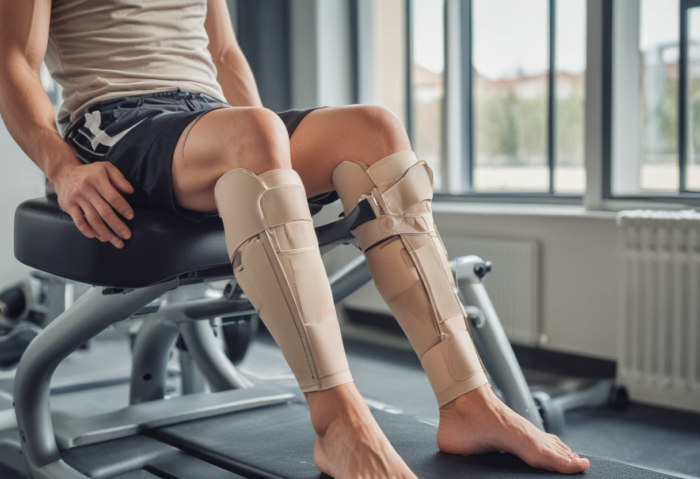
Which measures to apply in this situation can be extremely individual and depend on the specifics of each case. It isn’t possible to give everyone the same instructions, but I can offer some general principles that may help a little when applied.
Before I make any recommendations, let me add that, of course, if all the helpful measures have been applied and your knees still don’t allow any training load on the lower body at all, the best temporary solution is to pause loading for a period. But only if truly no approach brings relief.
There are three main aspects through which it may be possible to direct and regulate the training load on the lower body even with sensitive knees or knees recovering from injury. They are training frequency, exercise selection and the weights used. It’s possible that applying just one measure is enough to let you load a sensitive or injured (or recovering) knee or knees. In practice, though, these measures often have to be combined.
Training frequency
If your knees start to hurt, are simply sensitive or you’re dealing with a milder (still developing) injury, you should definitely reduce your training frequency. What I mean here mainly is that if you’re used to training the lower body, say, twice a week, then with these symptoms you should seriously consider training it once a week or even once every two weeks. It all depends on how serious the situation is. It makes no difference whether the source of the sensitivity or injury is overuse or simply an injury: training frequency (and reducing it) is one of the measures you should definitely apply.
Exercise selection and exercise variations. General recommendations are possible here, but a lot also depends on each lifter’s individual characteristics, that is, “who, doing what, how much and exactly where it’s felt”. One lifter can do a certain exercise with a sore knee, while another with a sensitive knee may not even be able to think about that same exercise. Generally, though, you should favor lower-body exercises, or versions of exercises, that shift the training load away from the knees and more onto the hip joints and the posterior chain. Which exercises and variations direct the training load away from the knees and more onto the posterior chain, while the leg as a whole still gets a proper training load?
Leg press
One way to load the knees (and the back) less is to use the leg press in your workouts. When pressing on the leg press, we can reduce the training load on the knee joints further by placing the feet fairly wide and as high as possible on the platform. Pressing like this, you can feel the quadriceps working, but a lot of the training load also falls on the hamstrings and glutes.
Box squat or sumo-style squat. In both squat versions you descend into the squat and come back up, again with the emphasis on the posterior chain.
Sumo deadlift, Romanian deadlift, conventional deadlift and trap bar deadlift/squat
Of course, deadlift variations don’t train the lower body or develop the quadriceps the way a traditional squat does, but we’re talking about doing some exercises versus doing none at all during the period when your knees are giving you trouble. We’re talking about the fact that your knees are making themselves felt, you don’t want to skip training entirely, and you should still be doing something. Deadlifts also load the posterior chain more heavily, and the lower back too, yet the quadriceps still get some training load. Of the three deadlift variations, the one that likely loads the quadriceps most, along with the posterior chain, is the trap bar deadlift/squat. This exercise is done with a fairly upright torso. It is really a hybrid of a squat and a deadlift.
Long-stride lunges or standing reverse lunges
Lunges are done the way lunges are normally done, but if you take longer steps and the shin of the front leg stays more upright than in a usual lunge step, the emphasis of the training load again shifts more to the glutes and hamstrings.
Weights
It’s obvious that if something hurts, loading that painful joint with even heavier weights would be foolish. With leg exercises and sensitive knees you should definitely use lighter weights than usual and do longer sets. Of course, for a powerlifter, timed sets or sets of 15–20 repetitions won’t produce the same effect as heavy sets of five. But again, we’re talking about doing nothing at all versus trying to stay active in some way with modifications, according to your options. It’s simply that when the situation demands it, you do longer sets for a period and focus on advancing the muscle qualities that long sets develop.
Additionally
The most important thing is to find the exercises and joint movements that load painful or sensitive knee joints the least. Although many similar foreign articles list leg extensions as a “knee-friendly” exercise, I wouldn’t be quick to recommend it, because seated leg extensions are actually a very knee-loading exercise. If you can do this exercise without feeling any (pain), go ahead, but in quite a few cases, quite a few lifters with sensitive or painful knee joints may find that leg extensions make themselves felt rather unpleasantly.
It may be that your knee joints have started to complain when squatting with the stance width you’ve perhaps been squatting with for a long time. Definitely lower the weights for a while and try different stance widths; maybe there’s a stance and a direction of knee travel at which the knee joints don’t complain at all. It’s important to be creative and work with your body. Quarter squats and half squats are also worth considering during an injury period, with sensitive or painful knees. Again, this means feeling it out and experimenting: squat to a depth that doesn’t hurt your knees.
Exercises for one leg at a time are worth trying; maybe your knees will allow them. Using such exercises also automatically means using lighter weights. Split squats, step-ups and the one-leg leg press: perhaps painful knees will let you do exactly these exercises, though again it’s a matter of trying.
Also, maybe there are some exercises you can do without having to lower the weights, and your knees don’t complain. For example, if the regular squat starts to bother you, leave it out for a while and focus for a period on, say, the machine hack squat.
In closing
You have to judge for yourself how bad the situation is, because these are your knees and only you feel the pain, personally. As I said at the beginning, there is always the option of not training at all, and if the pain comes from overuse, then stopping loading the knee joints altogether for a period may well be the best thing. But people and situations vary, which means that long periods of doing nothing at all are often not an option for many lifters. In that case it’s good to know how, how much and what to do!
Author: Janar Rückenberg
Come and train! ArtGym