
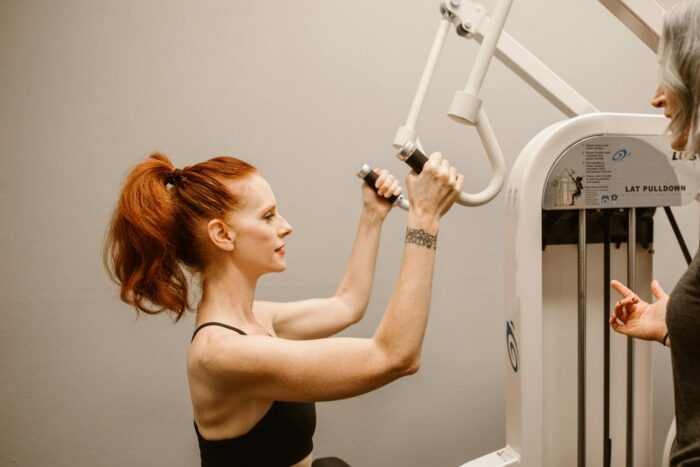
Biomechanics: how your lats work in the gym
Biomechanics helps explain why your lats work well in some rows yet seem to do very little in other exercises. If your shoulder moves in the wrong direction or you start using your body to assist the movement, your biceps, deltoids or lower back take over some of the work.
This article looks at the latissimus dorsi from the muscle’s own perspective. It goes beyond simply saying “do lat pulldowns” to explain why your grip, elbow direction, shoulder blade movement and finishing position really matter.
Why biomechanics matters for your lats
The latissimus dorsi is a large, triangular muscle that covers much of your back. In the gym, it is often thought of as the muscle that gives your back width, but its role extends beyond pulling downward. Its main actions are shoulder extension, shoulder adduction and shoulder rotation.
It can also indirectly assist with drawing your shoulder blades together, extending your spine and tilting your pelvis forward and sideways. This is precisely why the same muscle can contribute to several very different exercises. Lat pulldowns to the front, pull-ups, straight-arm pulldowns and rows all feel different, even though your lats can work in all of them.
The simple truth is that when a muscle has several functions, one exercise is not enough. Different fibers of the latissimus dorsi receive a more effective training load when you vary your grip, pulling angle and range of motion at the shoulder joint. This does not mean every workout needs to be a parade of exercises. Instead, it helps to understand what a particular exercise actually trains.
Biomechanics of lat pulldowns and rows
The latissimus dorsi is a strong shoulder adductor, particularly when your shoulder is externally rotated. During a lat pulldown to the front, this means keeping your forearms as perpendicular to the floor as possible throughout the movement. This keeps your shoulders slightly externally rotated, putting your lats in a better position to contract.
You often see the opposite in the gym: someone pulls the bar down, then pushes their elbows backward at the end of the movement. It may feel like a stronger pull, but the lats are actually contributing less. Other muscles do more of the work to finish the movement. Frankly, this is a small mistake that can make a very big difference to the exercise’s effectiveness.
The latissimus dorsi is also a strong shoulder extensor when your arm starts with the shoulder in a flexed position. There is an important limit, however: the lats do not extend the shoulder joint beyond the anatomical position. Once your arms reach your sides, the lats have completed the main part of their work in the movement.
What happens if you pull your arms farther back? Other muscles that move the shoulder, such as the triceps brachii and deltoids, become more involved. The example given in the original is a familiar sight in the gym: during cable rows, the arms are pulled 30-40 degrees backward beyond the anatomical position. Those final degrees offer little more for your lats and may make the entire exercise less targeted.
Practical tips for training your lats
If you want your lats to do the work, you need to keep your body reasonably still. This does not mean holding a rigid, uncomfortable position. It means avoiding cheating on a rep by using your lower back, hips or momentum.
During pulling movements, think about moving your shoulder, rather than just bending your elbow. Your elbow moves along with it, but the aim is not to yank the bar down with your biceps. The aim is to bring your upper arm toward your body or down to your side, within the range where your lats can exert force.
- 1 – Never extend your spine through your lower back while moving your shoulder.
- 2 – Avoid moving your hips during the exercise so that your lats continue to do the work.
- 3 – Pause at the end of the concentric phase, when your elbows are closest to your body.
- 4 – Avoid shoulder hyperextension, because once you move beyond the anatomical position, your lats stop contributing to shoulder extension.
- 5 – Vary your exercises, grip width and range of motion at the shoulder joint to stimulate different bundles of muscle fibers in your lats.
- 6 – During the exercise, focus on shoulder adduction rather than bending your elbows. Remember that the focus is on your lats.
- 7 – Always do your lat exercises before your biceps exercises.
- 8 – When doing rows without chest support, avoid starting the movement by rounding your entire back, to reduce the risk of damaging your spinal discs.
- 9 – During rows, draw your shoulder blades together at the end of shoulder extension to allow your lats to contract fully.
- 10 – During pulling exercises, lower your shoulder blades at the end of the shoulder contraction to allow your lats to contract fully.
These points are not just a list that looks good on paper. They are checks to use during your next back workout. Is your lower back taking over? Are your elbows moving too far back? Does the pull finish while your lats are still working, or are you simply making the rep longer?
FAQ: biomechanics and your lats
Is one pulling exercise enough to build your lats?
Usually not. Since your lats perform several movements, it makes sense to use different pulling angles and grips. This helps you work the muscle from multiple directions.
Why shouldn’t you bring your elbows too far back during a row?
Because once your elbows reach your sides, your lats have largely done their main job. If you move your arms much farther back, other muscles take over more of the movement.
Can your biceps interfere with a back exercise?
Yes. If you train your biceps before your back or focus only on bending your elbows during a row, your biceps may fatigue, reducing the work your lats do.
Source: www.ifbb.com
Professor Mauricio de Arruda Campos
IFBB Educational Commission
Translated by Jupp, written by Professor Mauricio de Arruda Campos
Come work out! ArtGym




