Leg press or squat: which is right for you?
The leg press and squat often serve the same purpose in the gym: stronger thighs, better leg function and greater strength. The difference lies in how much your body has to control the weight and how much your back, hips and core contribute.
If you can choose only one, start with the squat. But if your goal is to fatigue your thigh muscles more while sparing your back, the leg press can be a very useful tool.
Leg press and squat: why does the difference matter?
The squat is often called the “mother” of all exercises, and for good reason. It does more than train your thighs. Performed correctly, it works your quadriceps, hamstrings, glutes, lower back and core. Longer sets also challenge your breathing and circulation.
Variations of the squat feature in many sports: weightlifting, powerlifting, CrossFit, bodybuilding and fitness, athletics, cycling and more. It is a movement that teaches your body to work as a whole. That is why the squat often offers more overall benefits than any single machine exercise.
A traditional deep squat involves lowering the barbell at least until the top of your thigh at the hip joint is below the top of your knee. This depth is also accepted in competitions held by all powerlifting federations.
Frankly, deep squats often inspire more fear than they need to. Extremely heavy half squats, with a short range of motion and excessive weight, can actually be more dangerous. If you squat down only 10 to 20 centimeters, the effort tends to go into maintaining your balance rather than developing your muscles evenly.
How to make the leg press work for you
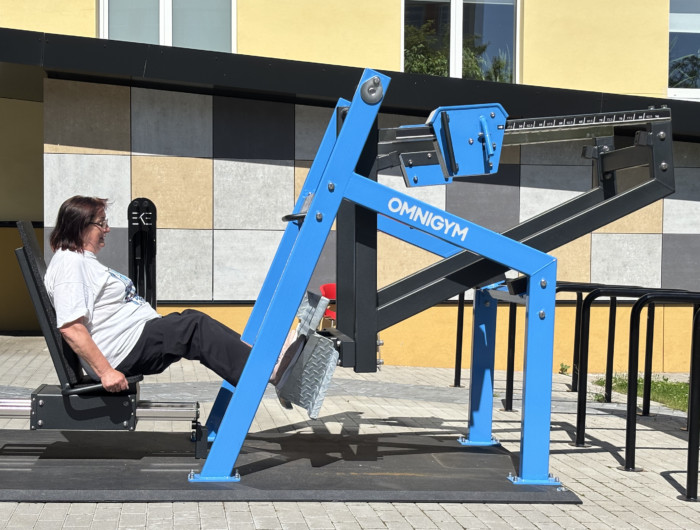
The leg press is a machine that largely removes the need to balance. This lets you focus on your thighs and glutes without having to control a barbell on your shoulders. For some, that is a major advantage, especially if your lower back tires before your legs when you squat.
The leg press offers plenty of variations. You can place your feet closer together or farther apart, higher or lower on the footplate. A higher foot position shifts the sensation more toward your glutes and hamstrings. A lower position places more emphasis on your quadriceps but also requires greater control at the knees.
Pressing with one leg also provides good isolation. One leg works while the other rests. This is usually done with the same weight throughout, alternating legs without rest for 3–5 longer sets in a workout.
Correct execution starts with something simple: place your feet roughly in the middle of the footplate. Use as full and deep a range of motion as possible, but keep your hips against the backrest. If your hips lift off the seat, the load shifts to the wrong place and can put more pressure on your lower back than necessary.
If your gym does not have a leg press with an ergonomic backrest, you can use a back support cushion. This may increase your range of motion and help shift the load from your lower back to your thigh muscles. The point is not to make the movement more comfortable at any cost, but to keep your body in a position where your legs actually do the work.
The HIT squat technique
One well-known squat technique is called HIT, a high-intensity exercise technique. The idea is to move slowly and with control. Resist the weight as you lower it, and avoid jerking or bouncing as you rise. Do not rest at the top: maintain tension and continue the set until you reach concentric failure.
That sounds easier than it is. Leave your ego aside and choose a weight you can genuinely control, and a slow squat can make your muscles work harder than a sloppy squat with a heavy weight.
Leg press or deep squat in practice
So which is actually better? If you can perform a deep squat, even with an empty barbell, it is worth starting to train the squat. You will get a wider range of benefits for your whole body. Surprisingly, your performance in upper-body exercises such as the bench press may also improve as you develop greater overall strength and learn to engage your body more effectively.
Still, the leg press is no ego trip when performed correctly. It is a good exercise for bodybuilding and fitness training because its isolation effect lets you specifically fatigue your thigh muscles. If your goal is to build leg muscle mass and your squat is limited by technique or mobility, the leg press has plenty of practical value.
The simple truth is that the squat teaches your body to work as a whole, while the leg press lets you target your legs more precisely. They do not have to compete. For many people, the best approach combines the squat as the main strength exercise with the leg press later as accessory work.
If your knees start complaining, do not immediately blame the exercise. First check your range of motion, foot position, weight and tempo. Knees generally do not respond well to uncontrolled, jerky movements, excessive weight or a partial range of motion. This applies to both the squat and the leg press.
Choose a weight that makes the last repetition hard without your technique breaking down. If you have to lift your hips off the seat, let your knees cave in or yank on the machine with your hands, the weight is too heavy. Training should build your legs, rather than briefly prove a point to the person on the next bench.
Leg press: FAQ
Can the leg press replace the squat?
Partly, yes, but not completely. The leg press trains your legs well, but the squat does more to develop full-body control, core tension and overall strength.
Are deep squats bad for your knees?
A deep squat performed with proper technique is not automatically bad for your knees. Problems are more likely when the weight is too heavy, the movement is uncontrolled or the squat is performed through a partial range of motion.
Which is better for muscle building?
Both work. The squat places a broad training load on your body, while the leg press lets you target your thigh muscles more precisely and fatigue them for longer. A good leg workout has room for both.
Timo Majuri
Come train with us! ArtGym