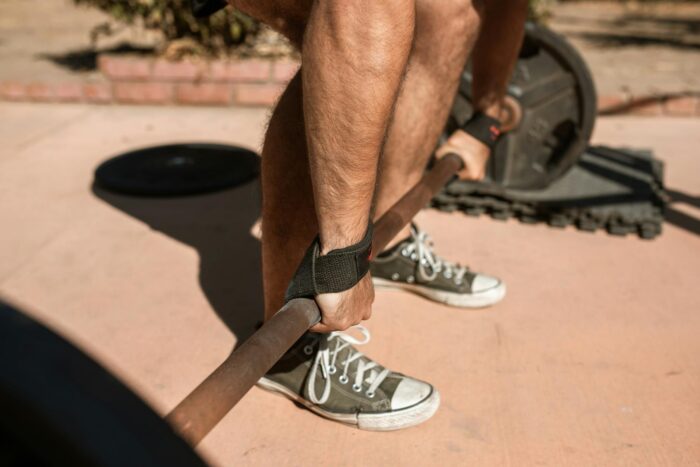
Lifting straps: when they help your training
Lifting straps are a simple aid that keeps your grip more secure when your back or traps could still keep working but your fingers start to give out. A Muscle & Fitness test (Dec 06) showed that straps can give an immediate, noticeable advantage on pulling exercises. The question isn’t just whether to use them, but when they actually help.
Why do lifting straps matter at all?
In pulling exercises, grip is often the weakest link. Your back, shoulders and core may still be ready to go, but your fingers open, the bar or dumbbell slips, and the set ends before the target muscle has received a proper training load. This is especially easy to see in pull-ups, dumbbell rows, cable rows and heavier back-day exercises.
The original question was very practical: should I use lifting straps every time I do different pulling exercises? The answer isn’t black and white. If the goal is building back muscle and a stronger pull, straps can help. If the goal is mainly grip strength, you shouldn’t automatically put them on for every set.
The simple truth: lifting straps don’t make the weight lighter. They remove part of the grip limitation. That means you can focus more on your back and less on whether your fingers can hold on to the end.
How do lifting straps work during a pulling set?
Muscle & Fitness brought together a group of trained bodybuilders and had them do a back workout on two different days. The plan included three sets of bodyweight pull-ups to failure, 3 sets of bent-over dumbbell rows, wide-grip lat pulldowns and seated cable rows. For the cable exercises, a 10-rep max weight was used.
Every set was taken to failure, with 2 minutes of rest between sets. In one workout, all the exercises were done without lifting straps. In the other, on a different day, straps were used in all sets. That made it possible to compare whether straps deliver a real result or are just a feeling of comfort.
The result was fairly clear. In pull-ups, straps added on average one repetition per set. In dumbbell rows and wide-grip lat pulldowns, there were on average 2 extra repetitions per set. In seated cable rows, the gain was 1 repetition in the first set and 2 repetitions in the 2nd and 3rd sets.
One or two extra repetitions don’t sound like much on paper. In the gym, though, it’s a noticeable difference. When you’re doing heavy working sets, those repetitions can give your back extra volume and a better stimulus for growth. Honestly, the difference is clearest when your arms tend to tire before your back.
When are lifting straps a good choice?
Use lifting straps mainly when the main goal of the workout is your back, traps or posterior chain, not the grip itself. Heavy rows, bent-over rows, cable rows and other back exercises suit this well. Straps help keep the movement cleaner, because you don’t have to rescue the bar or handle every time.
A good place to use straps is working sets where the weight is already substantial. In warm-up sets you can let your grip work freely without help. That way your forearms get their share, but in the main sets your back isn’t held back by your fingers.
Straps can also help if you want to feel your back muscles better. The test participants also noted that, thanks to the straps, they could focus more on back training and less on pulling with their arms. That matters, because in back training the main thought shouldn’t be “can I hang on?” every time.
When should lifting straps stay off?
If your grip has clearly fallen behind, don’t always hide it behind straps. Do some workouts without help, or add separate forearm and grip-strengthening exercises to your program. It doesn’t have to be complicated: farmer’s carries, hanging from a bar and holding weights for time give your grip a solid workout.
You also don’t need to use straps on every light set. If the weight is under control and your grip holds, let your hands do the work. Lifting straps are a tool, not a mandatory part of every pull.
Bottom line: if your goal is strength and size in pulling exercises, lifting straps are a sensible choice. If your main goal is tearing phone books in half or simply a very strong grip, leave some sets without straps. Both approaches have their place.
FAQ
Do lifting straps weaken your grip?
If you use them in every pulling exercise and every set, grip development can indeed slow down. The solution is simple: do some sets without straps and train your grip separately.
Should a beginner use lifting straps?
A beginner should first learn a proper grip and technique. Once the weights go up and your grip starts limiting your back training, you can start using lifting straps without worry.
Are lifting straps suitable for every pulling exercise?
They work best for exercises where the weight you’re holding limits the set before the target muscle does. Pull-ups, dumbbell rows and cable rows are good examples.
Author: Lifting straps
Come and train! ArtGym