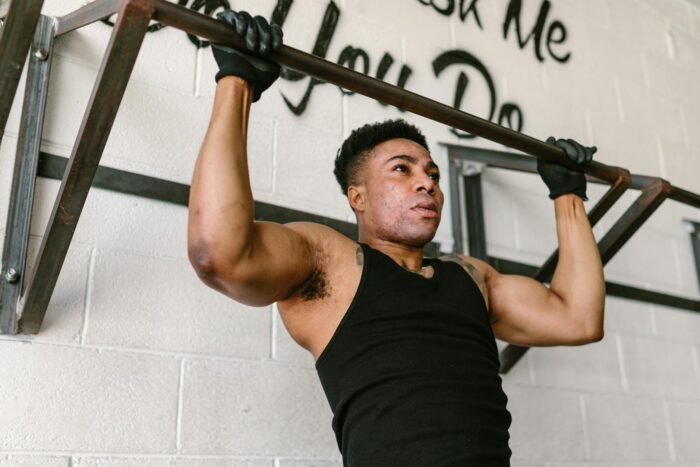
Choosing a pull-up grip for your back
Your grip, or hand position on the bar, changes how a pull-up feels more than you might expect. Overhand, underhand and neutral grips all train your back and biceps, but the emphasis, comfort and strength you can produce differ.
Getting to grips with why pull-ups matter
Ask a coach to name the five best exercises most people should keep in their training program, and pull-ups almost always make the list. The reason is simple: one solid vertical pull works your lats, upper back, arms and core.
Pull-ups are useful both for building strength and for assessing upper-body fitness. If you can pull your body up with control, you already have a pretty good foundation. That does not mean, however, that all pull-ups are the same exercise under different names.
Overhand pull-ups and underhand pull-ups, known as chin-ups, are similar, but the terms are not interchangeable. There is also the neutral grip, where your palms face each other. Your choice of grip often determines which variation feels better for your back, biceps, shoulders or wrists.
Overhand, underhand and neutral grips
The most obvious difference is your hand position. With an overhand grip, your palms face away from your body or downward. You usually hold the bar with your hands slightly wider than shoulder-width apart. With an underhand grip, your palms face you and your hands are usually about shoulder-width apart.
- Overhand pull-ups — an overhand grip, palms facing down, often with your hands slightly wider than shoulder-width apart.
- Underhand pull-ups (chin-ups) — an underhand grip, palms facing you, often with your hands shoulder-width apart.
- Neutral-grip pull-ups — palms facing each other, with your elbows following a more natural path in front of your body.
So what actually happens? With an overhand grip, your upper arms move more out to the sides. With underhand and neutral grips, your elbows move more in front of your body. This difference does not automatically make one variation better, but it changes which muscles you feel working and how comfortably the exercise suits your body.
Both main variations train your lats and biceps. If your goal is to build muscle mass in your back, there is no need to blindly favor one grip over the others. For many people, variety works best: an overhand grip in some training cycles, an underhand grip in others, and a neutral grip mixed in where possible.
Pull-up strength and muscle involvement
Most people are stronger with an underhand grip. It allows the biceps to contribute more effectively to the pull, which often makes underhand pull-ups an easier starting point for beginners. If you can do 10 underhand pull-ups, you might manage only 6 with an overhand grip, for example. That is a normal difference, not a failure.
An overhand grip tends to emphasize the lats more because the biceps are in a less favorable position for pulling. An underhand grip gives the biceps more work to do. A narrower grip generally increases biceps involvement, while a wider grip shifts the sensation more toward your back, although more recent EMG testing suggests the difference may not be as large as once thought.
Honestly, paying attention to which muscles you feel working is very useful here. If you feel your back working better with an overhand grip, use it. If an underhand grip lets you perform cleaner repetitions and keeps your shoulders comfortable, that is a good choice too. A pull-up should be a tool, not a test of your ego.
Grip choice: safety and comfort during training
Both overhand and underhand grips can be safe with proper technique. Problems usually arise when you start swinging, forcing your chin over the bar at all costs or using too wide a grip. An extra-wide grip does not automatically give you extra-wide lats. Instead, it often limits your range of motion and may irritate your shoulders.
It is best to avoid behind-the-neck pull-ups, especially when you are new to training. Some people can do them for years without discomfort, while others quickly feel strain in their shoulders. The same principle applies to wrists and elbows: an overhand grip suits some people, an underhand grip suits others, and many find a neutral grip the most comfortable.
The article’s author preferred overhand pull-ups with a grip slightly wider than shoulder width and reported a personal best of 6 – 8 clean repetitions with 30 kg of added weight. That is a personal preference, not a rule for everyone. If your shoulder or elbow tells you a variation does not suit you, listen to that signal.
How to include pull-ups in your training program
The simple truth is that your back training should include at least one vertical pull. This could be a pull-up, an assisted pull-up or a lat pulldown. What matters is that the movement is controlled and the training load suits your level.
A practical approach is to vary your grips across training days or cycles. For example, do overhand pull-ups on days with shorter sets and underhand pull-ups on days with longer sets. Another option is to do underhand pull-ups for 8 weeks, overhand pull-ups for the next 8 weeks and, if possible, neutral-grip pull-ups for another 8 weeks.
After a while, it will become clear which grip lets you generate the most strength, which helps you feel your back muscles working best, and which keeps your joints most comfortable. The best choice does not have to stay the same forever.
FAQ
Are overhand pull-ups better than underhand pull-ups?
Neither is definitively better. An overhand grip may help you feel your lats working better, while an underhand grip allows many people to do more reps and engages the biceps more.
Which grip is suitable for beginners?
Many beginners start with an underhand grip because they feel stronger and find it easier. If your shoulders or wrists complain, try a neutral grip or assisted pull-ups.
Is a neutral grip the safest?
A neutral grip is often comfortable for the shoulders and elbows, but this depends on the person and the bar. If your gym offers this option, it is worth trying.
This article originally appeared here.
Author: Janar Rückenberg (translation)
Come work out! ArtGym