Last winter my training partner gave me a task: a list of ten mini-tests that every serious lifter should be able to complete. My first reaction was “pff, easy.” Reality told a different story. I failed several of the tests, and each one pointed to a specific weakness I had to work on. Below is the same list, explained honestly.
Why these tests matter
Progress comes from what you need to work on, not from what you enjoy doing. These ten tests cover upper-body strength, core, mobility, balance and endurance. Every failure is information: where you stand today and what to fill the next month with. If you pass all ten, you’re in pretty good shape. If not, you now have a plan.
Serious lifter: upper-body basics
1 — Bench press your own body weight. This is more a sign that you’ve left beginner status behind than a heroic feat. I’ve seen men who have trained for years and still can’t do it, usually for two reasons. The first is technique: the grip is too narrow and the forearm doesn’t stay vertical under the wrist. The elbow has to be directly under the wrist, not drifting off somewhere to the side. Ask someone to take a look; a couple of workouts will sort it out.
The second reason is too much volume. If a single workout has to fit the classic bench press plus incline presses, dumbbell flyes and the pec deck, the main lift has no room to improve. Less variation, more sets of the same movement.
2 — Deadlift twice your body weight. A simple idea that takes years to carry out. What usually holds people back is grip, body positioning and the ability to tolerate tension. A curious observation: you don’t need to hammer the deadlift itself every week to make it better. Pull-ups build grip, kettlebell swings build hip extension and glutes, and squats in long sets build the ability to tolerate full-body tension.
Hugh Cassidy has said that only male gorillas can deadlift more often than once a week. The rest of the time, a smart person uses other work to build a base: push a sled, carry suitcases, squat long sets. Three to six months of that, and your deadlift starts to move.
Serious lifter: core control
3 — Plank for two minutes. I personally like the plank in the prone support position, because it doesn’t let you rest on your stomach. It doesn’t matter which variation you prefer; you should be able to hold it for two minutes. Dr. Stu McGill has put it simply: if you can’t hold a plank for two minutes, you’re either seriously overweight or the quality of your ab training has been poor. I’d add a third possibility: you don’t feel the muscle tension. Feeling and holding tension is the foundation of strength training; newcomers often rely on momentum and the rebound of elastic components rather than real muscle work.
A good alternative is the one-handed carry. Take a 25–50 kg kettlebell or dumbbell in one hand and walk. It’s a plank while standing and moving: the core has to stay braced. There’s no point going over 50 kg, because your grip will give out before your core tires. On the first set you’ll feel your grip; the next morning you’ll feel your transverse abdominal muscles.
4 — Sleeping on one pillow. How many pillows do you need under your head? If more than one, your thoracic spine is either stiff or rounded forward. Vlad Janda described this half a century ago: the pecs, biceps, hamstrings and hip flexors become tonic and tight with age. The result is a tilt in joint position that starts to affect the rest of the body. Simply training more won’t fix it. Stretching, relaxation and, if needed, a visit to a rehabilitation physician go alongside it.
Serious lifter: mobility and balance
5 — Sitting down on the floor without using your hands. Stand up straight, sit down on the floor without using your hands, knees or shins, and then stand back up the same way. Sounds easy. Try it.https://www.youtube.com/watch?v=RPLIDsBABbs
Dr. Araujo’s research shows that this test predicts life expectancy with surprising accuracy. It also gives you an instant overview of flexibility, coordination and general capability. The first five tests are whole-body yardsticks, so hold on to them for as long as you can. After the age of fifty, performing them can no longer be taken for granted.
6 — Balancing on one leg for ten seconds. It seems ridiculously easy. But if you can’t stand on one leg for ten seconds, it points either to a problem in the hip area or to a neurological issue. In my own case it once came down to the hip joint. The bad news is that it’s a clear early warning of a later injury.
Serious lifter: grip, jump and carry
7 — Hanging for 30 seconds plus a pull-up. Hang from a bar for half a minute. If that’s a piece of cake, add a controlled pull-up right away. The next level: lower yourself down, hang again for 30 seconds, do another pull-up, and repeat that ten times. Few people make it to the end. For almost everyone it’s the grip that gives out, not the back.
8 — A standing long jump equal to your own height. A taller person should jump their own height; for an athlete, it’s one of the most telling measures of explosive power. If your result is weak, there’s no need to write a book-length explanation here: practice the standing long jump, measure it every couple of weeks, and watch the line trend upward.
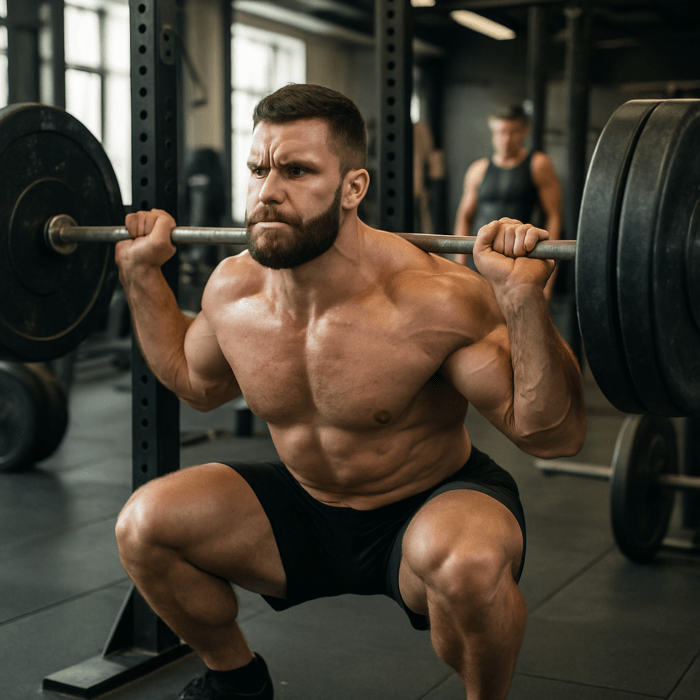
9 — Half squat for thirty seconds. Drop into a squat, hold it for 30 seconds with your thighs roughly parallel to the floor, then stand up without using your hands. This is a combined test of lower-body health and strength: your knees, hips and glutes all have to work at the same time.
10 — Suitcase carry at your body weight. Two weights in your hands, adding up to your body weight, and a few steps. It’s a simple but telling test. If you can do it, you’re functionally strong, in good shape and probably not overweight. If you can’t, you know what to work on next month.
Source: www.t-nation.com
FAQ
Should you do all ten tests on the same day?
No. Spread them over one to two weeks so that fatigue doesn’t skew your results. Do the strength tests when you’re rested, and the mobility tests on a separate day.
What if I can’t pass most of the tests?
Look at it in a positive light — you now have a clear plan for the next half a year. Pick your two weakest areas and focus on those; the rest will often improve on their own.
Are these tests suitable for beginners too?
They work as benchmarks, not as goals. A beginner doesn’t have to nail everything right away — the aim is to move toward them over years of training.
Translated by Janar Rückenberg
Come and train! ArtGym