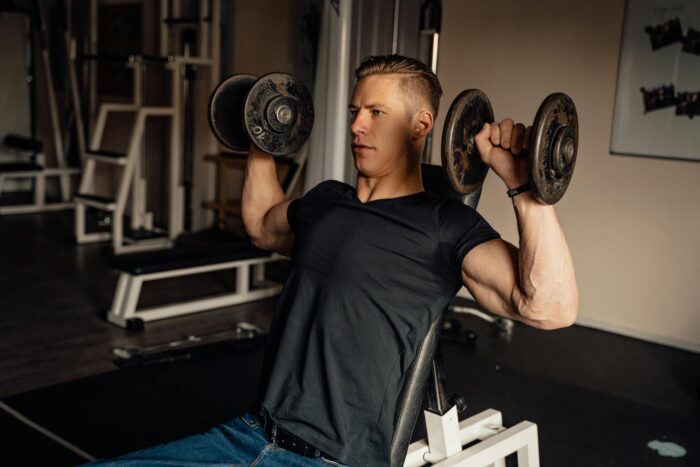
Build bigger shoulders: a practical training plan
If your shoulders are a weak point, don’t leave them for the end of the week, when your energy is already gone. Put shoulder training at the start of the week and do the main work when your focus is at its best.
A simple truth: shoulders don’t grow just because you throw in the occasional set of lateral raises. You need a plan, proper technique, enough frequency and patience.
Why do shoulders need their own place in the week?
Many lifters train shoulders after chest or back. That can work, but only if shoulders aren’t a goal in their own right. If you really want to bring them up, shoulder training has to be work done with a fresh body and a clear head, not a quick finish after a hard workout.
The shoulder is made up of several parts. The front part takes a lot of training load in presses, especially on chest day. The side part gives your shoulders a wider look. The rear part helps keep the body balanced and the shoulder girdle healthier. If one of them constantly lags behind, you can see it in the mirror.
So what actually happens? Usually, lots of presses get done, but the side and rear delts get too little direct work. The result is a stronger press, but not necessarily a wider, rounder shoulder.
How do you make shoulders grow?
Start by putting shoulders into your training program deliberately. If they’re a priority, shoulder training shouldn’t be left to chance. The simplest solution is to make the first heavier workout of the week a shoulder session.
- 1. If shoulders are a priority, start your training week with shoulder training.
- 2. Make all overhead presses your priority.
- 3. Press with both dumbbells and a barbell.
- 4. Train shoulders at least 2 times a week.
- 5. Do all your shoulder presses of any kind in one session a week to avoid overtraining.
- 6. Dumbbell lateral raises are a must. Two sessions a week is enough.
- 7. Dumbbell lateral raises are not the best exercise for measuring strength. Technique counts!
- 8. Don’t forget the rear delts!
Presses are the backbone of shoulder training. A barbell press usually lets you use a heavier weight. A dumbbell press gives you more freedom of movement and forces each side to work separately. Both have their place.
But don’t confuse pressing with growing your shoulders. If every workout turns into a chase for a heavier weight, your technique starts to break down. The shoulder is a mobile joint, and sometimes it makes you feel the mistakes later.
Go hard on presses, keep lateral raises clean
Lateral raises don’t call for ego. If your body sways, the trapezius takes over and the dumbbell swings up on momentum, the side delt doesn’t get the training load that is the whole reason the exercise is in your program.
Keep the weight at a level where you can control the movement. The elbow can be slightly bent, the wrist relaxed and the lift smooth. At the top you don’t have to throw the dumbbell up to the ceiling. It’s enough to feel the side part of the shoulder working.
Practical tips to help your shoulders recover
Training shoulders at least 2 times a week makes sense, but that doesn’t mean both workouts have to be heavy. One day can be focused on presses and strength. The other day can focus on lateral raises, the rear delts and a better feel for the muscle.
If your chest training includes a lot of presses, count that in your total shoulder training load. The front delt doesn’t ask whether the exercise was called a bench press or a shoulder press. Training load is still training load.
The rear delts are often skipped because they’re not as easy to check in the mirror. That’s a mistake. The rear delt helps keep the shoulder girdle in a better position and gives the upper body a more balanced look. Add exercises to your program where you pull the arms out to the sides or back and keep the movement under control.
Honestly, the biggest enemy of shoulder training is often impatience. Shoulders grow when you give them regular work, but don’t beat them into the ground every time. Do the exercises properly, keep an eye on recovery and add weight only when your technique holds up.
FAQ: shoulders and the training program
Should shoulders get their own training day?
If shoulders are a priority, then yes, a separate day can work very well. If your program is packed, another option is one heavier shoulder day and a second, shorter supplementary workout.
Can you train shoulders 2 times a week?
Yes, at least 2 times a week can be a good choice. The key is to split the training load: don’t do the same amount of heavy pressing every time.
Why are lateral raises so important?
Because the side delt gives your shoulders a wider shape. This exercise works best when the weight is under control and the movement doesn’t come from momentum.
Author:Turg.Fitness.ee
Come and train! ArtGym