
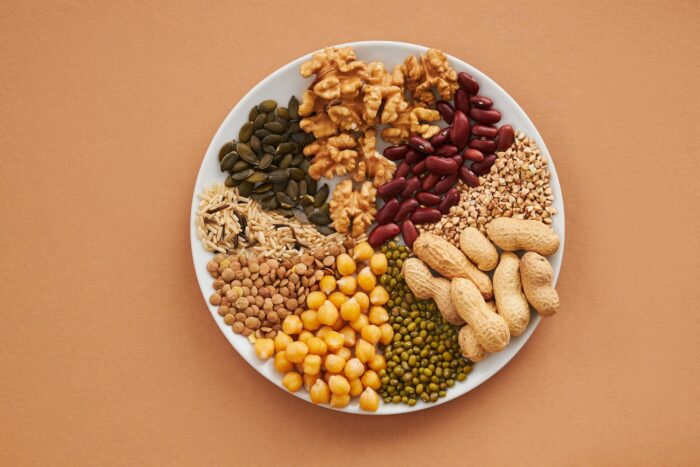
The slow carb diet is neither a single brand’s invention nor a miracle trick – it is simply the idea that meals should avoid triggering sharp blood sugar spikes and a surge in insulin release. In this article, I explore why it makes sense to start with a moderate approach to weight loss, how the body responds to persistent overeating, and when more extreme diets have a place. This is the fourth installment of my thoughts on diets and healthy eating.
In brief: start with a moderate split of around 40% carbohydrates, 30% protein and 30% fat; monitor your total daily calorie intake; choose carbohydrates with a low glycemic index. Only consider more extreme options if your body responds poorly.
The slow carb diet as a moderate starting point
There is an enormous range of approaches out there. High-fat (and moderate-fat), low-carbohydrate diets include: Atkins´i Diet, Carbohydrate Addict’s Diet, Caveman Diet (Stone Age Diet, Paleolithic Diet), Diet Cure, Eat Fat Get Thin Diet, Ketogenic Diet, Life Without Bread, Neanderthin, Protein Power Diet, Schwarzbein Principle.
High-carbohydrate diets include: Macdougall Diet, Veganism Diet, Bread for life, Rice Diet Program, Spark People Diet, Carb Lovers Diet, Gain Weight Diet, Dr. Dean Ornish’s Program for Reversing Heart Disease, Eat More, Weigh Less, The New Pritikin Program.
Then there are isocaloric approaches: Zone Diet and Dan Duchaine`s Isocaloric Diet.
Where do you even begin? I tend to think that moderation gives you a good chance of building a diet that works. At least to begin with. If you have not already wrecked your health and eaten your way into illness, middle-of-the-road approaches such as the Zone Diet or Dan Duchaine’s isocaloric approach can work for the average person. In other words – a little of everything.
Why? The argument is simple. In nutrition – as in life in general – moderate approaches combine the positive aspects of the extremes. I am not claiming that the Zone Diet is the only right answer. You simply have to start somewhere. You may soon find that it does not suit your individual needs either. The more extreme your starting point, the sooner that may become clear: the Zone Diet is probably no longer going to work for an endurance athlete or a severely overweight, middle-aged person with high insulin resistance. But those are already extremes.
Why might this split be a good starting point for the average person today – whether your goal is to maintain your weight or lose weight? The slow carb diet and the Zone Diet share the same principle: nutrients are supplied in roughly equal proportions – 40% carbohydrates, 30% protein and 30% fat.
Whatever split you choose, changes will only begin when the balance between energy intake and expenditure is right. Your total daily calorie intake needs to be under control. Energy balance determines whether anything changes and how quickly. Only then is it worth considering how to divide your intake among the three main macronutrients.
Why it is worth keeping protein intake high. If your goal is healthy eating, weight maintenance or weight loss, protein has to play a major role.
- Digesting protein requires extra energy – this is known as the thermic effect of food.
- Protein-rich foods help you feel fuller and slow down the digestion of a meal.
- 1 gram of protein does not provide much energy.
- Protein helps maintain and build muscle mass – something that matters to athletes and the average person alike.
A carbohydrate intake of 40% is fairly moderate. The typical sedentary person today simply does not need 50–60% of their total calorie intake to come from carbohydrates. I think even 40% is questionable for many people. But if you get at least some physical activity and take carbohydrate timing, composition and glycemic index into account, that figure is no crime as a starting point. That is essentially what the slow carb diet means in practice – not a very low carbohydrate intake, but simply carbohydrates that release energy more slowly.
Why is getting 30% of your intake from fat a good thing? First, there is the familiar issue: people fear fat, and there is a reason for that fear. We grasp direct connections more easily than indirect ones. “If I want to lose body fat, how can I possibly eat more of it?” It is not that simple. This fear is misplaced.
Much of your fat intake should come from essential fatty acids. It is hard to overstate their benefits for health and weight loss. 30% is a large enough share to keep hunger at bay – a little fat with every meal helps you feel full for considerably longer.
You cannot buy health in a capsule – patience is also key to the slow carb diet
The main challenge is getting people to understand that nothing happens overnight. This applies to both training and nutrition. The work that produces results can be seen as a process. Muscle growth, changes in body composition (a reduction in body fat percentage) and gains in strength can only happen through changes in the body’s individual functional components.
For structure to start changing, the function that drives it in the desired direction has to be repeated many, many times. “Many, many” does not mean just 25 workouts. Solid results take care and effort. There are different ways to train. You can spend 7 months going to the gym and see nothing happen. But with commitment, determination and clear goals, you can see significant progress in 3–4 months.
I have always said that success starts with motivation from within. Many people who “order a plan” insist they want results – but when it is time to give something up or put in the work, 9 out of 10 disappear, taking their hopes of “strength and mass” or weight loss with them. Time and again, I am reminded that people expect a miracle. They are superficial and flippant. Consumer society has left a deep mark on us all. People think money can buy anything.
People order training and nutrition plans with that same mindset. The sad truth, though, is that a plan in itself means nothing. I would argue that 10 out of 10 beginners do not even know how to read a training program. With a nutrition plan, the first stumbling block is working out how to measure the prescribed quantities. Then comes the surprise when they discover that, at first, every bite has to go on the scales.
I have written dozens of plans myself. I have been there while some were put into practice, but for many I have not. Experience has shown me that people can interpret a simple plan in ways I could never have dreamed up. My point is this: learn the basics before you order a plan. If you do not know what a repetition is, what a set is or how to read a set and rep scheme of 4 x 5–7, you will not know what to do with a specialist’s plan either.
The same goes for the basics of nutrition: what calories are, what basal metabolic rate is, what the main nutrients are, which foods contain protein and which contain complex carbohydrates rich in dietary fiber. If you want to lose weight, you can lay that foundation yourself beforehand. I am not saying that nobody should ever order a nutrition plan – quite the opposite. But once you have the basics in place, you can get straight down to work.
There are plenty of myths, often rooted in a lack of understanding of the principles of nutrition. Here is an example. At the school where I work, I often keep cheese on the windowsill in the room outside my office – even when I am dieting, I occasionally add it to my meals. “I see you have cheese here on the windowsill. Does that mean I can eat cheese too if I want to lose weight?” asks a severely overweight middle-aged man who weighs about 120 kg.
A difficult situation. How do you explain where eating cheese really fits in? “Yes and no,” is my first reply. And that is exactly how it is: you can, and you cannot. It is hard to explain where cheese with 30% fat or sour cream with 20% fat fits in to someone whose grasp of nutrition is light-years away from what they need. On the one hand, cheese could certainly be recommended even in the situation described above. But only if daily calorie intake and food choices are under control.
You have to be extremely careful with recommendations like these. People who are new to dieting often have no idea how many calories they eat or burn each day, or how small that piece of cheese needs to be to stay within their allowance. Recommending cheese, oily fish or full-fat sour cream to someone who wants to lose weight but has no knowledge of nutrition is certainly justified – but it has to be done skillfully and with a clear understanding of what you are doing. Otherwise, it is much like giving a child a box of matches to play with.
Why the slow carb diet helps when people have eaten themselves ill
There is no doubt that, in some situations, the only solution – a treatment in the literal sense – is a diet very high in fat and low in carbohydrates. Why a treatment? Because people eat themselves ill. Not as a figure of speech, but in a very real, physical sense. Today’s eating habits are an excellent way to reduce insulin sensitivity.
To a large extent, becoming overweight is driven by reduced insulin sensitivity combined with extremely low physical activity. When insulin sensitivity has fallen significantly, high-fat diets have their place, with fat intake naturally considered as a proportion of total calorie intake. The reasoning is simple. For the body to start “missing” a hormone and become more sensitive to it, it needs a break from that hormone for a while. Here, I mean insulin and its effect on cells.
When insulin sensitivity is very poor, insulin released into the bloodstream no longer works normally. Large, frequent spikes have made the cells unresponsive to the hormone. The concentration released after a normal meal no longer has its intended effect. For anything to happen, we have to keep eating. A large meal eventually triggers the release of so much insulin that some nutrients do reach the cells, and we begin to feel as though there is something in our stomach.
Yet in this scenario, we have actually already overeaten. There is a mass of nutrients in the digestive system, and pushing the system so hard has also triggered the release of a large amount of insulin. As well as directing nutrients into cells, the high insulin concentration starts shunting this load of food into storage in fat cells. A lot of insulin in the bloodstream does this job efficiently – and often, not long after the meal, we are hungry again.
A vicious circle. We eat again, because getting even a small amount of nutrients into the cells once more requires a large amount of insulin – the cells do not respond to a tiny concentration. Eventually, we feel full for a moment, but once again, fat is being stored rapidly at the same time.
Breaking out of this cycle requires a diet that keeps fluctuations in blood insulin levels to a minimum and avoids sudden spikes. One solution is a so-called high-fat diet, since fat itself has the least effect on insulin release. For many people, a slow carb diet serves the same purpose: carbohydrates with a low glycemic index enter the bloodstream gradually and do not force the pancreas to release a large surge of insulin all at once. Of course, a high-fat diet also has its own rules that need to be followed.
Individual circumstances matter: the more extreme the dieter’s situation, the more flexible the slow carb diet needs to be
Many factors determine our needs. Clearly, we need all nutrients. But how much, in what proportions, and when we need more or less of each depends on the circumstances and changes all the time. Unfortunately, people fail to understand this. They take one approach that someone claimed worked and follow it blindly.
Neither carbohydrates nor fats inherently cause obesity, nor are they evil. Both nutrients have their functions, and the body needs them according to the circumstances. It all depends on your health status, energy expenditure, and the duration and nature of your physical activity.
It is extremely irresponsible to recommend 100 grams of carbohydrates a day to a triathlete who trains for hours every day at high volumes. Why? Because this is someone with specific needs. So is an overweight person who has eaten their way into poor health and has very poor insulin sensitivity: their health status is extreme, so it makes sense to consider more extreme measures. Yet the same principle applies at both extremes: controlling calorie intake and food choices is the foundation; the rest is a matter of adjustment.
FAQ
Is the slow carb diet suitable for everyone?
A moderate approach with a 40/30/30 split is a suitable starting point for most people. But for an elite athlete or an overweight person with severe insulin resistance, the proportions need to be adjusted: more carbohydrates for the former, substantially fewer for the latter.
How soon can you expect results?
Proper commitment produces results in 3–4 months. With a half-hearted approach, even 7 months of going to the gym may make virtually no difference. Miracles do not happen overnight.
Does dietary fat turn into body fat?
No. Getting 30% of your total calorie intake from fat—preferably from essential fatty acids—helps keep you feeling full and supports your health. Whether your body stores or burns fat depends primarily on the balance between energy intake and expenditure, rather than the presence of fat in your food.
Author: Janar Rückenberg
Source:Turg.Fitness.ee
Come train with us! ArtGym




