
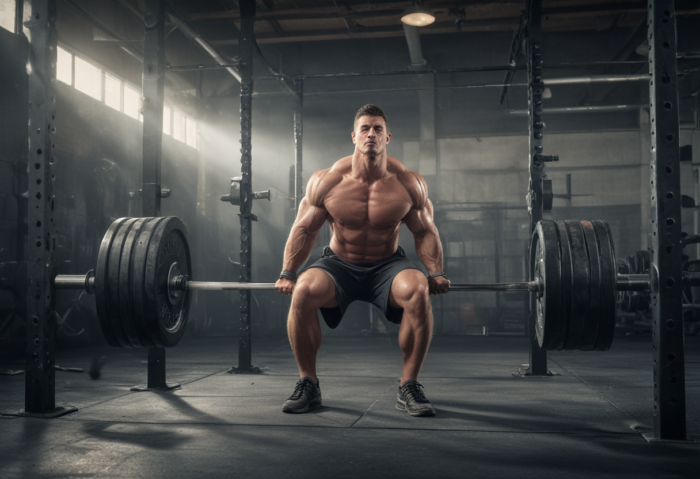
The squat chain reaction: how it works
The squat sets off a chain reaction – one variable affects the next, and in the end they determine which muscles do the main work. Most lifters call the squat a quadriceps exercise, but the reality is more complicated. With a few small changes, the focus of the squat shifts completely: the same movement can become an exercise that loads the glutes and hamstrings, or, conversely, a clearly quad-dominant one. To understand this, we need to look at exactly what we change in the technique.
Why the squat is never one and the same exercise
Four main variables affect squat biomechanics: bar position on the back, the angle between the torso and the thigh, shin angle, and foot position. Each variable influences the others – that is exactly how the chain reaction arises. That is why there is no point arguing about whether the squat is a hip-extensor or a knee-extensor exercise. The answer depends entirely on how a particular person squats and how they set the bar on their back.
The squat can easily be modified so that the primary training load falls on the glutes and hamstrings, but also so that the quadriceps do the main work – as in the front squat. The standard squat sits somewhere between the two extremes.
Bar position sets off the chain reaction
Wretenberg and colleagues compared two squatting styles. With a low-bar position, the bar sits on the rear-lower part of the trapezius and shoulder muscles; with a high-bar position – preferred by traditional lifters – the bar rests between the last cervical vertebra and the first thoracic vertebra.
The results were clear. Squatters with a high-bar position distribute the weight more evenly between the hip and knee joints. Powerlifters using a low bar, on the other hand, rely clearly more on the hip extensors – the glutes and hamstrings take on a larger share of the training load.
The reason is simple. When the bar sits lower on the back, the body has to lean forward more from the hips on the way down to keep its balance. This forward lean stretches the hip extensors, and on the way up those muscles have to work against that stretch. Bar position is the first link from which the whole chain reaction starts.
Hip angle and training load distribution
The angle between the torso and the thigh is one of the most important factors in how the training load is distributed in the squat. The general rule: the smaller the angle between the torso and the thigh, the greater the contribution of the hip extensors. The more the body leans forward from the hips, the more the glutes and hamstrings are stretched – and on the way up, those muscles have to extend the whole of that movement back.
The powerlifting-style squat, the deadlift and stepping up onto a high box all require a large forward lean of the body from the hips. That is why the work of the hip extensors in these movements is considerable – often even greater than the contribution of the quadriceps.
With the front squat, the story is the opposite. The body stays almost upright as you squat, the angle between the torso and the thigh is large, and the knees travel further forward. The angle between the thigh and the shin is much smaller than in a standard squat. The result: the quadriceps take on most of the training load, and the hip extensors less.
If you want to squat in a way that makes your glutes and hamstrings really work, keep a slight forward lean of the torso throughout the squat and use a low bar position. Sit down and back – pushing your hips back from the hip joint, with a relatively wide stance. That way the hip extensors work under full training load.
Honestly, it is all tightly connected: bar height dictates in advance how much you have to lean from the hips, and that lean in turn dictates the muscles’ contributions. Change one, and the rest change automatically along with it.
FAQ – the chain reaction and squat technique
Is the squat really a quadriceps exercise?
It depends entirely on the execution. A squat with a low bar position, large hip extension and a wide stance loads the glutes and hamstrings more. An exercise with a high bar position, an upright posture and a front squat style clearly emphasizes the quadriceps.
How can you tell whether the squat is working the hip extensors?
Watch your body angle as you descend. If the torso leans clearly forward, the hip extensors are doing a lot of work. If the body stays upright and the knees travel forward, the quadriceps are working more. Squatting is not one exercise – it is a family of exercises.
Can you change bar position without ruining your technique?
Yes, but it takes some getting used to. A low bar position demands more shoulder and wrist mobility and feels noticeably different from a high bar position. Start with a light weight and practice the position before you add weight to the bar.
Translated by Janar Rückenberg
Source:Turg.Fitness.ee
Come and train! ArtGym




