Track and field… or strength sports? Part I
Carl Lewis is one of the greatest jumpers and sprinters of all time. Interestingly, Lewis did not use the gym or train with weights until he was 35. He only added gym work to his training a year before his last Olympics. Obadele Thompson, the 2000 Olympic 100 m bronze medalist, was reportedly also “allergic to iron.” His 100 m personal best was 9.87. Of course, it is hard to find fault with sprinters who have run 100 meters in 9.86 (Lewis) and 9.87 (Thompson). Still, we can speculate about whether those performances might have been even more impressive had they taken strength training more seriously. Carl Lewis also briefly held the 100 m world record in 1996. With a tailwind, Thompson ran as fast as 9.69. These men, however, are exceptions that prove the rule. Most athletes we see on the world stage are no Carl Lewis or Obadele Thompson. For most athletes—the “mere mortals” who have not inherited the best genetics of all time—getting stronger is the only route to getting faster.
How strong is strong, and how much strength is enough? As a strength coach with a powerlifting background, one of the hardest things for me to grasp was that every sport has a point or level beyond which further gains in strength no longer improve performance.
Translator’s note: I was sorely tempted to leave this passage out of the translation altogether. In other words, I also find this hard to understand, and I would seriously question the validity of this claim. Why, then, do throwers, shot putters and track and field athletes in general not simply reach the required strength level and maintain it? Why do they keep trying to get stronger and improve their strength? Why does Kanter keep trying to improve his basic lifts? The same applies to sprinters and other track and field athletes who do strength training. Of course, I could be wrong.
Many athletes never reach the recommended strength level, while others may take almost their entire careers to develop the necessary strength and, through it, power. A third group, including Lewis and Thompson mentioned above, barely need to lift anything heavy to develop the power they need. It has also been said that it is crucial for strength coaches to identify the point at which further strength gains no longer contribute to performance. Once that level has been identified, the training program should shift its emphasis to improving other components.
This article examines the strength levels needed for different track and field events.
Throwers, shot putters and javelin throwers
Maximal strength is more important in the throwing events than in any other area of track and field. Yet, as important as strength is, our approach to training throwers here in the USA is still somewhat misguided. We have done well in the shot put, where maximal strength is also important but the movement requires considerably less speed than the other throws. Over the past 20 years, Americans have won 8 of the 15 available medals in the men’s shot put. In the other throwing events, however—javelin throw, hammer throw and discus throw—we have won just 1 of the 40 available medals over the same period. The reason is that the implements used in those other events are considerably lighter than the shot, so throwing them a long way depends heavily on speed as well as strength. This is where our athletes have fallen short. Chad Smith also addressed this in his article “Why we actually suck at Olympic lifting”, noting that “once an adequate level of maximal strength has been reached, further progress depends largely on speed and technique.” What level of maximal strength is required for elite throwing?
Anatoliy Bondarchuk discusses this in his book “Transfer of Training”, which sets out the different strength levels elite athletes in various track and field events need to succeed. For the throwing events, they are as follows:
These figures give coaches a clear picture of where their athletes stand and where they need to improve. The athletes in the following videos, for example, are using Bondarchuk’s figures as their precise targets and working toward them. Maximal strength is a priority and very important, but the speed of the complete movement and injury-free training are equally important. The season is long, lasting a full 25 weeks.
Sprinters
Speed depends on two main factors: stride frequency and stride length. The first is relatively difficult to change. The second is easier to improve. The more force you apply to the ground through your foot with each stride, the longer your stride and the fewer strides you need to cover the distance. There are various ways to increase stride length, including jumping exercises and running drills, but the most effective approach is undoubtedly simply to get stronger.
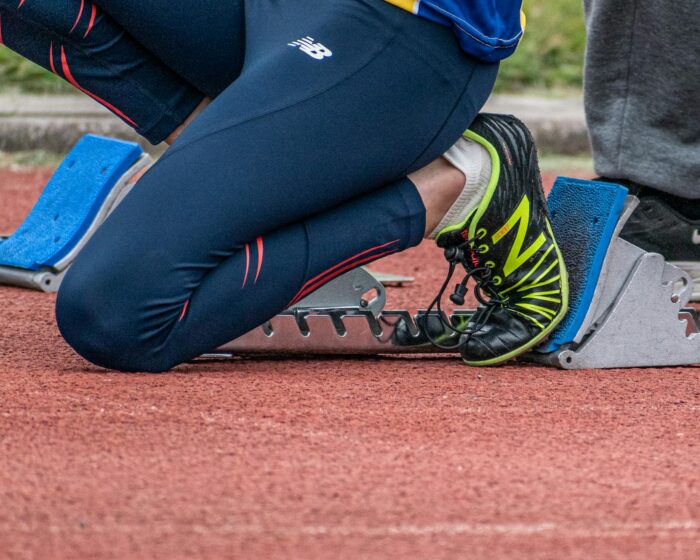
By definition, strength is the ability to overcome external resistance through muscular effort. Translator’s note: gravity is also a form of external resistance. In a sprint, no part of the race is as demanding or requires as much strength as the start. Exploding out of the starting blocks and reaching full speed within seconds takes tremendous strength and power. The shorter the distance, the more important the start and acceleration become, because there is less time to reach top speed. The shorter the race, then, the more the athlete’s strength, force production and power matter. To illustrate this relationship, consider one of our sprinters, whose season’s bests were 6.98 for 60 m, 10.53 for 100 m and 21.33 for 200 m. After focusing on gym training, he increased his squat from 135 kg to 155 kg at a body weight of 77 kg. The following season, his best times were 6.77, 10.41 and 21.29, respectively. As you can see, the greatest improvement came over the shortest distance, 60 meters.
Of course, it is important to understand that throwers can afford to gain body weight without compromising performance, whereas sprinters have much less room to do so. Joe Douglas, founder of the Santa Monica athletics club, has said: “For every extra half kilo of body weight, you need to be able to apply an additional 2 – 5 kg of force per leg”. Translator’s note: presumably, this is what you would need to maintain your previous time after the increase in body weight described here.
For sprinters and jumpers, developing lower-body strength is important, but this must be achieved without substantial gains in muscle mass—in other words, strength must be considered relative to body weight. The priority is to develop strength, particularly relative strength, rather than absolute strength. Translator’s note: of course, the higher your absolute strength without a significant increase in body weight, the higher your relative strength will be. Our (USA) male sprinters aim to squat twice their body weight for at least 1 rep. For women, the figure is 1.5 x body weight. Clearly, these figures are not “set in stone”; they are more of an established general standard for strength. Once this level has been reached, training shifts more toward applying that strength to the ground as quickly as possible.
Jumpers
Training for sprinters and jumpers is very similar, with considerable overlap. Both need to be explosive and fast. Both must be able to generate force rapidly and use elastic strength. The main difference between sprinting and jumping is that the start and initial acceleration are less important in jumping. In the horizontal jumps, speed on the runway is obviously crucial, but the time it takes to reach top speed is less critical than in short sprints. Although acceleration matters less in jumping, this does not mean jumpers do not need to be strong relative to their body weight. For example, during the hop, step and jump phases of the triple jump, the athlete must overcome a force equal to fifteen times their body weight as they push off with the takeoff leg (4). Long jumpers encounter similar, though somewhat smaller, forces. To cope with these forces, athletes must be very strong while maintaining their approach speed and controlling their body at takeoff.
Our (USA) best high jumper, a three-time American champion, has squatted 130 kg and cleaned 110 kg. At 203 cm tall, he does not have the ideal limb levers for jumping, but these lifts still represent considerable strength for a jumper. His training consists mainly of Olympic lifts with light weights and various plyometric exercises. A high jumper must be strong enough to convert horizontal velocity into vertical velocity efficiently. Approach speed in the high jump is not particularly high, but converting that horizontal velocity into vertical velocity takes considerable strength.
In pole vaulting, upper-body strength is naturally a priority. It is not the only one, however, since a successful vault depends primarily on two factors: approach speed and jump height (translator’s note: I take this to mean the power of the vaulter’s own jump) at takeoff. Pole vaulters should therefore follow strength standards similar to those used by other jumpers in athletics.
Beyond its performance benefits, an adequate level of strength is also very important for injury prevention. Although we discussed Thompson’s great success without strength training earlier, his coach, Pfaff, later said he believed many of the injuries Thompson suffered during his career could have been prevented if he had taken strength training more seriously.
The central point is that athletes in athletics must reach a certain level of strength to fulfill their potential. How much is enough, and how much time and work it takes to get there, varies considerably between events and individuals. An athlete’s strength should certainly always be one of the first things a coach tries to improve. However, designing training programs on the assumption that stronger is always better is misguided and is very likely to lead to a plateau in the long run.
As for Carl Lewis, it is quite possible that he would have been even better had he trained with weights early in his career. Perhaps his great showdown with the legendary Mike Powell in 1991 would then have ended with a result more to Lewis’s liking. Perhaps, if Lewis had understood and appreciated the importance of strength training early in his career, in his early twenties rather than his mid-thirties, Bolt would still be chasing the 100 m world record.
Given the absence of strength training for most of his career, it is no surprise that Lewis was never a good starter. As Jere Longman put it in a 1996 New York Times article: “It was the last 40 meters that set Lewis apart, not the first 60 m.” If Lewis had also worked on his start and got it right, there is no telling how far he could have gone.
References
Bondarchuk Anatoliy P (2007) Transfer of Training in Sports. Michigan: Ultimate Athlete Concepts.
Lists of Olympic Medalists. Retrieved May 12, 2011.
Longman J (1996, February 5). Lewis Thinks Gold and Pumps Iron. The New York Times.
Perttunen J, Kyrolainen H, Komi P, Heinonen A (2000). Biomechanical Loading in the Triple Jump. Journal of Sports Sciences 18:363–70.
Pfaff D (2008 October) Training theory in power-speed events.
Smith CW (2011, April 6). Why We Actually Suck at Olympic Lifting.
Smith CW. Online conversation on May 15, 2011.
Zimmerman C (2005, September 1). 21 Tips on Track from Carl Lewis’ Former Coach. Stack.
Original article: “How Strong Is Strong Enough? Training Considerations for Track and Field Athletes” by Matt McManus
Author: Janar Rückenberg (translation)
Come train with us! ArtGym