
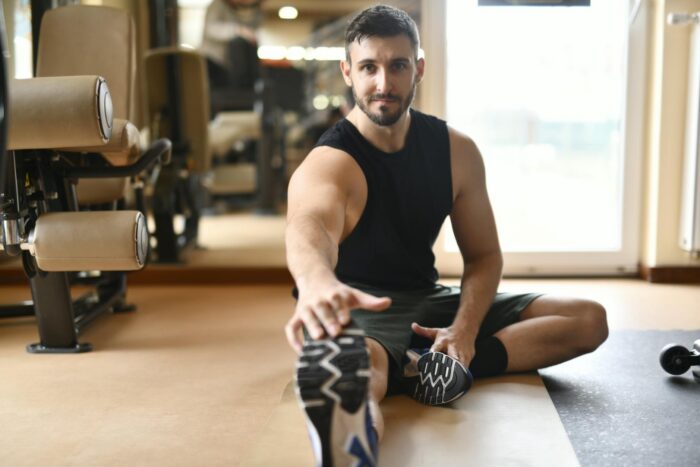
Stretching exercises: why and how to do them
Stretching exercises often feel like the most boring part of a workout — those couple of minutes you could easily skip. Yet they determine whether your body recovers properly, whether you avoid injuries and whether your strength actually translates into movement. In short: you need flexibility to make full use of your strength.
Why stretching exercises work: the pelvis as your foundation
Your pelvis forms the base of your spine. Every muscle around the pelvic girdle — your hip flexors, glutes and thigh muscles — affects your spinal alignment and how your core transfers force. If any of these muscles are too tight, your abdominal muscles can no longer control the position of your pelvis.
So what actually happens? Your center of gravity shifts, your gait becomes awkward and your spine comes under unnecessary strain. The result is usually familiar to any office worker: lower back pain that comes and goes but never quite disappears. Tight hamstrings alone can cause persistent discomfort in your lower back.
A lack of flexibility doesn’t just affect people who spend their days sitting. In the gym, it means you can’t squat through a full range of motion, your technique suffers during presses and coordination between your muscles starts to break down. Insufficient flexibility limits your ability to use your full strength and increases the risk of both joint and muscle injuries.
What stretching exercises actually do for your body
A good stretching routine serves several purposes at once. Let’s go through them one by one to see why those couple of minutes at the end of your workout are worth your time.
- Improve circulation — more oxygen reaches your muscles, and metabolic waste is cleared more quickly. This means faster recovery ahead of your next workout.
- Reduce muscle soreness — that familiar “delayed onset muscle soreness” the next morning won’t disappear completely, but it will be milder.
- Prevent injuries — a tight muscle tears more easily. A stretched muscle can tolerate a greater range of motion and sudden movements.
- Develop body awareness — you start to really feel where each muscle is and when it’s tense. This is the foundation of good technique.
- Improve your muscles’ ability to contract — paradoxically, a stretched muscle can contract more forcefully than one that is stuck in a contracted state.
- Serve as a warm-up — gentle dynamic stretching before strength training prepares your muscles to handle weights.
- Help you relax — after a stressful day or a tough workout, stretching helps ease tension in your nervous system. Put simply, it allows your body to calm down.
Stretching exercises at the gym and at home
Here’s the most common mistake: forcing a cold muscle to the limit of its range of motion. It’s the surest way to strain a muscle. The correct order is always the same — a gentle warm-up, then dynamic stretching, your workout and, finally, static stretching.
Before your workout: a dynamic warm-up
Use movements that take your muscles through their natural range of motion: leg swings, arm circles, gentle bodyweight squats and hip openers. Don’t hold any position — the aim is to raise muscle temperature and wake up your nervous system. Five minutes is enough.
After your workout: static stretching
Now you can hold a muscle in a stretch for longer — hold each stretch for 20–40 seconds, without bouncing. Breathe calmly, easing a little deeper as you exhale. It shouldn’t hurt; you should feel strong tension, not sharp pain. The whole routine takes 8–10 minutes and covers the main muscle groups: quads, hamstrings, glutes, hip flexors, chest and shoulder girdle.
Dedicated flexibility training
If you spend eight hours a day at a desk, stretching only after your workouts isn’t enough. At least twice a week, it’s worth doing a 20–30-minute flexibility workout, stretching each muscle group in two or three different ways. Yoga and mobility exercises serve the same purpose.
Practical tips: how to stretch correctly
A couple of things that often get overlooked:
- Never force a cold muscle into a stretch. Start with five minutes of gentle movement — even walking in place will do.
- Breathe. Holding your breath during a stretch has the opposite effect — the muscle contracts instead of relaxing.
- Keep both sides balanced. If your right thigh muscle is tighter than your left, your body will start to shift out of alignment. Give the tighter side more time.
- Warm up for longer in winter. In Estonia’s autumn and winter, you arrive at the gym after being out in the cold — your body needs more time to reach its working temperature. Add a couple of minutes of light cardio.
- You don’t need to be heroic with your stretching after strength training. A gentle routine is better than an aggressive one that causes fresh muscle soreness.
Frequently asked questions about stretching exercises
Does stretching before training reduce strength?
Holding static stretches for a long time before heavy lifts can temporarily reduce strength. That’s why dynamic warm-ups come before your workout and static stretching comes after. If you want to stretch before your workout, hold each position for less than 15 seconds.
How often should you do stretching exercises?
A minimum of 5–10 minutes at the end of every workout is needed. If you want to really improve your flexibility, add a separate 20-minute routine 2–3 times a week. Stretching every day is also fine — it doesn’t tire your body or interfere with recovery.
Why am I not getting more flexible even though I stretch?
The most common reason is that you don’t hold your stretches long enough. A muscle only starts to really relax after 20 seconds. Another reason is inconsistency — three minutes twice a week won’t produce results. A third reason: you always stretch the same muscle groups and skip the others.
Author: M.M.
Source: WHO – physical activity.
Come and work out! ArtGym




