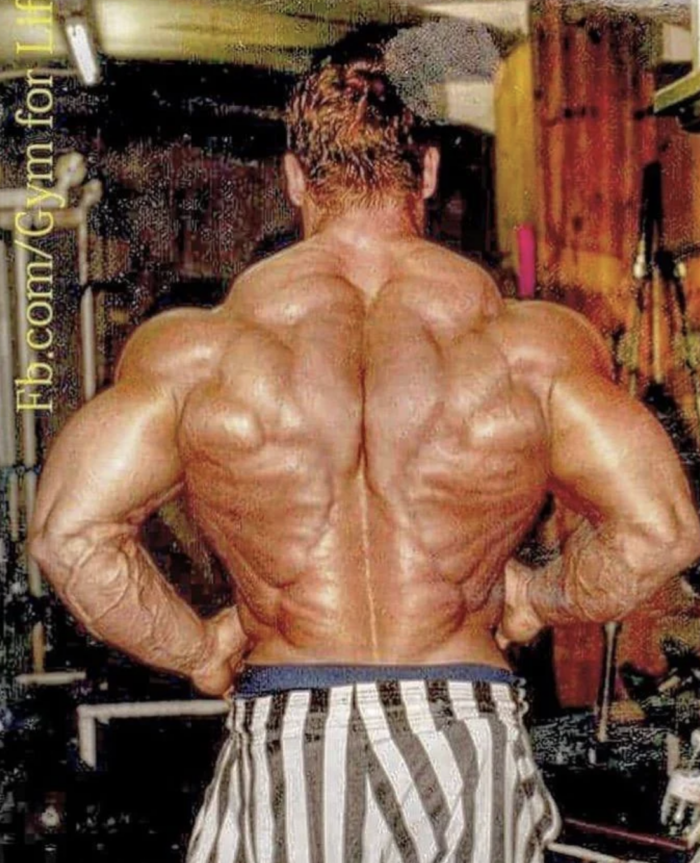
Underhand barbell rows from Dorian Yates
The underhand-grip row is an old-school back exercise, and FLEX once asked Dorian Yates about it quite directly: would he recommend it even after a biceps injury? The short answer is yes, but only if your technique, warm-up and control are truly in place.
Why do underhand barbell rows matter?
The question didn’t come out of nowhere. Dorian Yates regularly used the underhand barbell row, pulling the bar into his stomach, until he injured his left biceps. Many people drew a simple conclusion: the biceps got hurt, so the exercise must have been to blame.
Dorian’s own view was different. In his words, the problem wasn’t the exercise, and it wasn’t that his technique had slipped. He considered underhand barbell rows one of the best basic back exercises. As for the injury, he essentially said that the biceps had reached its limit of tolerance. Honestly, that is a rather sobering thought in the gym: even a good exercise doesn’t make the body endlessly resilient.
The underhand grip recruits more biceps than the overhand grip. That’s why many people can use a heavier weight for the same movement. A heavier weight combined with clean technique gives a strong training stimulus. But the same thing also makes the exercise more demanding. If your arms start pulling more than your back, the goal is quickly lost.
How do underhand barbell rows work?
The idea of the exercise is simple: you pull the bar into your stomach and try to send the training load to the lats, not just to the arms. Dorian stressed that the torso should be at roughly a 70-degree angle to the floor. This position is more stable for the lower back than a fully parallel upper body and lets you load the back harder.
So what actually happens? If the upper body is too low, the lower back in many people starts to bail out the movement. If the torso is too upright, the exercise becomes incomplete and the work done by the back may drop. At roughly a 70-degree angle, it is easier to keep your body secure and pull the bar toward your stomach under control.
Don’t jerk the weight during the pull. Don’t cheat. Pull the weight up powerfully but calmly. Hold it at the top for a second before lowering, then bring the bar down under control. If you can’t hold the weight at the top or slow it on the way down, the training load is probably too heavy or your technique is breaking down.
Underhand or overhand grip?
After his biceps injury, Dorian swapped the underhand grip for an overhand grip. That doesn’t mean the underhand grip is bad. It means training has to be adapted to the condition of your body. If your biceps or elbow is sending a warning, stubbornness is not a sign of strength.
A simple test: do both grips with the same weight. With the underhand grip you usually feel your biceps more and may be able to pull the bar into your stomach more securely. With the overhand grip, the feel in your back may be different, and your arms may not help as much. Which is better? It depends on your body, your goal and whether you can control the weight.
Practical tips for building your back
Back muscle mass doesn’t grow just because the bar is heavy. The weight has to move in the right direction and with the right muscles. Focus on the lats during the pull. Think of your elbows moving back and down, rather than your hands simply yanking the bar up.
The warm-up is especially important here. Start with a lighter set, let your shoulders and elbows get ready to work, and increase the training load only once the movement feels clean. Dorian’s style was intense, but intensity doesn’t mean sloppy yanking. It means hard effort within control.
If your lower back tires before your lats, check your torso angle and the weight. If your biceps burns before your back, try the overhand grip or reduce the weight. If the movement gets shorter, the bar is probably too heavy. A good repetition is one where you lift and lower the weight yourself, rather than letting momentum decide.
Dorian’s view was clear: barbell rows into the stomach held an important place for him because they helped build back mass. It is a basic exercise, not a fancy trick. If you want a bigger back, it’s worth learning this movement.
Underhand barbell rows in a training program
The original included the following back workout as an example. Sets marked with an asterisk are warm-up sets. Keep that logic: before heavy work, the body needs to understand what is coming.
- Machine rows 1* x 15 , 1* x 12 , 1 x 8-10
- Underhand barbell rows 1* x 12 , 1 x 8-10
- One-arm machine rows 1 x 8-10
- Wide-grip cable pulldowns 1 x 8-10
- Back extensions on a hyperextension bench 1* x 8
- Deadlift 1 x 8
This isn’t a random list for a beginner but a dense back day. If you’re only just starting out, you don’t need to copy the same training load right away. Take the principle: the big pulling movements, controlled repetitions, an adequate warm-up and a clear feel in your back.
FAQ: underhand barbell rows
Are underhand barbell rows dangerous for the biceps?
They aren’t automatically dangerous, but an underhand grip recruits the biceps more. If your biceps, elbow or shoulder hurts, reduce the weight or switch to an overhand grip.
What is the best torso angle?
Dorian recommended keeping your torso at roughly a 70-degree angle to the floor. This helps keep your lower back more stable and lets you load the lats better.
Can an overhand grip be the better choice?
Yes, especially if an underhand grip puts too much strain on your biceps. An overhand grip may suit you better after an injury, or if you want to reduce the involvement of your arms.
Author: joker
Source: Turg.Fitness.ee
Come and train! ArtGym