Mythbuster: Women
I don’t think such a sharp line should be drawn between women’s and men’s training. Women develop in the same way men do. You need hard training, proper nutrition and rest. So why does everything seem so difficult for women?
One difference I often see between men and women comes from the way girls and boys are raised. Competitive sport plays a big role in many boys’ youth, and thanks to that they often develop a higher tolerance for competition even before they start training in the gym, not to mention an athlete’s mindset. Girls often have no such competitive sport background at all, so these qualities remain undeveloped, not to mention coordination and the like. Some people will surely see this as a chauvinistic approach to women’s sport.
Of course it’s good that girls play competitive sport too, but anyone can go and see how big the difference is in drive and attitude at football matches for 12-year-old boys and girls. In sporting terms, parents expect something quite different from boys than from girls. Perhaps the girls even have noticeably more energy, but sadly it isn’t demanded of them. And if the same mentality is carried into the gym, the result is obvious.
They do pleasant exercises and want to stay in that familiar, safe comfort zone where training causes no pain at all, or at most a little, because they’re only training for “fitness”. That’s why no real results come. There is no such thing as “fitness gym training”. Fitness disciplines are sports that grew out of bodybuilding, striving for essentially the same things as bodybuilding, only on a smaller scale. Bodybuilders simply go further, past the point where fitness athletes stop, especially when it comes to muscle mass. In the fitness disciplines the goal is smaller muscles and a softer look than in bodybuilding, but that doesn’t mean the training should be different; practicing the free routine required for fitness is of course another matter.
Training
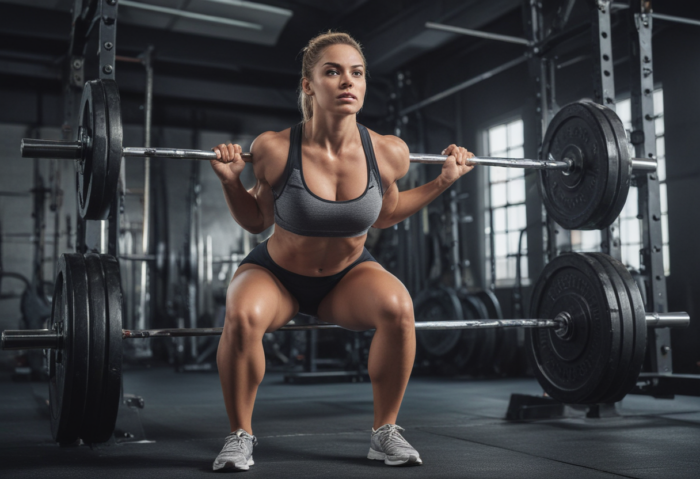
For many women who train in the gym, the biggest problem is that they simply don’t train properly. By that I mean the training is easy, the choice of exercises is wrong, and there is no purpose in all that fussing around. That last one is the most decisive of these problems. People go to the gym fully made up to do a bit of “fitness”, and the main focus of the training goes into looking as good as possible. Lovely in itself, but is that really the goal they came to train for? Hardly, at least not for those who want a strong physique.
Here another problem arises, namely the traditional way of thinking about gender roles. Woman is weak and man is strong. Sorry, but when you train you can’t think, “Since I’m a woman, I have to be treated accordingly.” I don’t know how to put this nicely, so I won’t even try. Building muscle is a hell of a masculine activity. In the gym, women should forget what they have between their legs and train like the biggest male in the place.
In your free time you can be the grandest princess, but in the gym forget the makeup and other girly frills. Hard training comes with sweat, grimaces, grunting and panting, and there’s no point being ashamed of them. They’re part of the game if you want to progress. The threshold may be high, but that’s how it works. People may look at a woman who trains hard a little strangely, but you mustn’t care. Just like a man, a woman only starts to progress properly once the training is hard enough.
Hard training brings pain, and how that pain is tolerated is often tied to progress. This brings us to the problem that many women face when they start training hard. All their lives, less has been demanded of them in sport than of men, and now they’re in a situation where getting visible results that way no longer works. A woman has to learn how to train hard. Almost every day I find myself pushing a woman three times smaller than me to train harder and harder. That doesn’t seem right when you look at it through the traditional man–woman mindset. But I look at it from the angle that I’m training an athlete, regardless of sex, who wants to develop to the maximum. When the person you’re training sheds tears from real pain, you have to understand that this is part of the development process. Little boys shed those tears as kids, but women who missed out on that when they were small have to experience it now in the gym. Once you get past this stage, real training can begin. And no, I’m not a sadist; I just like to see people reach results. Regardless of sex.
Nutrition
I believe that when it comes to nutrition, exactly the same rules apply to women as to men. That is, enough protein and just enough calories for your body weight to behave the way you want. The amounts and ratio of carbohydrates and fats should be such that they serve the body in the best possible way and support the goal you’re striving for. You only learn this by experimenting and researching. The menstrual cycle does cause a slight deviation in women compared with men. During menstruation, minerals and vitamins leave the body with the blood, and this shortfall should perhaps be compensated for with vitamin and mineral supplements during that period, and perhaps even at other times. Being aware of this may help you avoid some moments of weakness.
Loading is also a perfectly workable system for women, but for the most part they don’t need to go down that road. I consider the risk of developing eating disorders and the like too high in women, mainly because women usually have a slightly different attitude toward appearance than men.
The hard knocks of fitness
First, attention should be paid to the harsh fact that the whole “fitness” scene is an unhealthy environment for someone with body-image problems. There are a great many extremely beautiful people in that circle. If you aren’t at peace with yourself and your looks, the whole thing can become a serious problem, for both mental and physical health. Your own mother’s praise doesn’t help much when you’ve surrounded yourself with the whole “fitness” mishmash, compare yourself with competitors and try to follow a very strict lifestyle, even though your mind and body are fighting it. Life can’t be only “fitness”, and in my opinion it’s questionable as a lifestyle too. Think of yourself as an athlete. Other athletes don’t talk about a “swimming” or “running lifestyle” either. Fitness is also a strange discipline in that everyone considers competing in it realistic. I’m quite sure that if an adult, slightly overweight woman who has discovered sport too late for herself decides to start training a free routine, problems will arise.
Problems
Women also run into far more serious health problems than men do. It’s one of those things in this field that is generally treated as taboo, but the fact is that these problems exist. Eating disorders, a complete loss of control over body weight and disrupted hormonal function are the most common. Some lean women gain an unbelievable amount in a couple of weeks after a competition or diet, ending up well above their previous weights even though they are savvy about calories and nutrition. Even depression or panic disorders breaking out during or around a diet are not unfamiliar to many. In some competitors, hormonal function stays out of balance for years after competing, and in the worst case it can lead to infertility.
This isn’t limited to one or two women who have a low body temperature or thyroid problems during a diet. The hardest and most serious of these changes, though, seems to be that many are unable to live a normal life after the diet, because they gain weight just by looking at food. In the end, their whole life revolves around food because they fear weight gain. That is more of an obsession than a sport. Does anyone consider that a normal part of sport? I certainly don’t. So is their weight gain down to their peculiar bodies? Hardly.
Thoughts on the problems and their causes
I have a little theory of my own. It isn’t anything factual, but it’s something I don’t think the public in this field has talked about, or at least I haven’t come across it. Some doctors and experts may also be unfamiliar with this theory, even though research on it does exist.
It isn’t normal to train more than ten hours a week and eat fifteen hundred calories a day, yet still gain weight. “I just have this kind of body/metabolism” is no excuse for that.
I would argue that for quite a few women, the battle with their body only begins once they get swept up in the “fitness lifestyle” or go on a diet for the first time. I don’t consider myself a special expert or any kind of authority; I’m just an ordinary man.
But I have watched this struggle for ten years and looked at it logically, and I would argue that some of the methods women use to diet are quite harmful to their health, and that they are also largely to blame for the problems that show up in women. These problems seem to be much worse in today’s “fitness generation” than in the ones before it.
I believe one of the biggest troublemakers is the combination of absurd amounts of aerobic exercise and too little eating. When the body is under a heavy training load (for example, a large volume of aerobic exercise, strength training and low calorie intake), it starts producing a counter-hormone to the thyroid hormone T3 (triiodothyronine), so-called reverse T3. The job of reverse T3 is to block the work of T-three, and this mechanism is one of the protective mechanisms that keep us alive in hard times; in other words, the body switches to a special survival program. T3 is also linked to body temperature and metabolism, and when its work is disrupted, body temperature drops and metabolism slows down, which in turn shows up as weight loss, or rather as weight that refuses to come off.
All of this again causes symptoms typical of thyroid disorders, such as fatigue, headache, PMS symptoms, migraine, menstrual disorders, irritability, fluid retention, feeling cold, a sense of anxiety and panic. These are symptoms that are quite familiar to many female athletes, and why not male athletes too, during a diet, and to some even under “normal conditions”. The punchline in all of this is that when you try to force the body to do something too harshly, it has a counter-reaction ready. If you try to starve yourself, the body has its own tricks to defend itself against it. I also believe that all of this, and a few related factors, plays quite an important role in the rapid weight gain after a diet, a topic familiar to many competitors. I mean the endless hunger and the unbelievably fast weight gain that some competitors experience; in other words, I don’t believe this “bloating up” comes down to a lack of self-discipline alone, but that there is something much bigger behind it. So what helps? I have a theory on that too, but since this is a truly serious, even life-threatening subject, I won’t give any advice publicly here. Some people may be dealing with these same problems under a doctor’s care or taking medication, and I don’t want to encourage anyone to overturn their approach.
In conclusion
So is “fitness” and going to the gym somehow dangerous or inadvisable for women? No, of course not. But before going after something your current level isn’t yet ready for, you have to lay a proper foundation. Only when training is hard and eating is properly under control can you expect results. Pointless “fitness” struggling leads only to problems in the long run, and those are really not a mandatory part of this field.
Translated from Body magazine; Author: Kalle Aaltonen
Author: Body – translator Greta
Come and train! ArtGym