Muscle growth doesn’t happen by chance – it’s a biological process influenced by training, recovery and nutrition
Understanding how muscles grow helps you get the most out of your training
Muscle growth doesn’t happen by chance. It’s a precisely regulated biological process set in motion by training, recovery and consistency. When you understand why muscles grow and how often to give them the right stimulus, your training becomes noticeably more effective.
How do muscles actually grow?
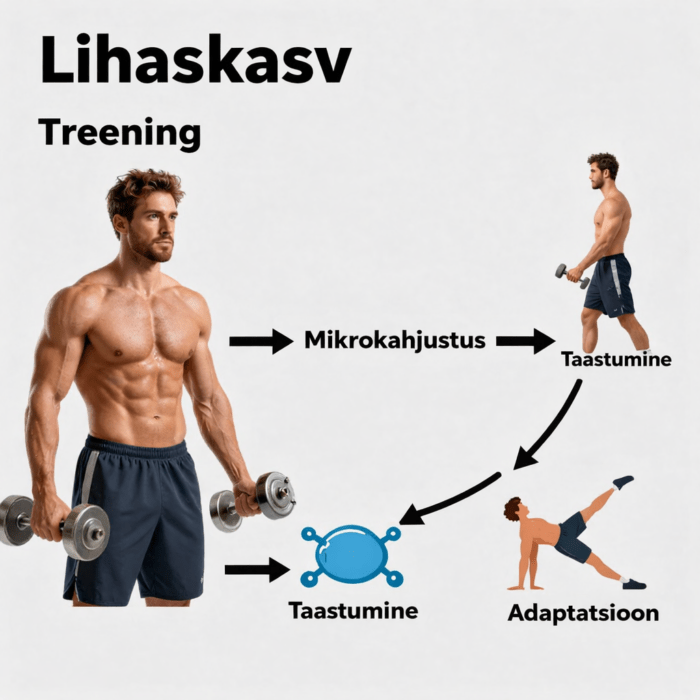
The basic muscle growth cycle
WORKOUT
(mechanical tension)
        ↓
MICRODAMAGE
(to muscle fibers)
        ↓
RECOVERY
(protein + sleep + energy)
        ↓
ADAPTATION
(the muscle becomes stronger and bigger)
A key point to understand:
Muscles grow after training, not during it.
Training sends the signal – recovery does the building.
What is muscle growth, or hypertrophy?
Muscle hypertrophy means an increase in the thickness of muscle fibers. It’s more than just a “muscle pump” – it involves:
- an increase in the cross-sectional area of muscle fibers
- improved neuromuscular coordination
- an increase in the amount of protein and contractile structures within the muscle
Your body’s logic is simple:
“If this training load is repeated, I need to be stronger next time.”
3 main reasons why muscles respond to training
1️⃣ Mechanical tension
Lifting weights and actively contracting your muscles send your body a strong signal that those muscles need to become stronger.
✔ heavier weights
✔ a controlled tempo
✔ proper technique
2️⃣ Metabolic stress
This is the familiar “burn” and “pump” you feel in your muscles.
- it develops through repeated exertion
- it helps activate hormones and signaling pathways involved in muscle growth
3️⃣ Muscle damage
Training causes microscopic tears in muscle fibers.
➡️ It’s specifically as these tears heal that the muscle grows.
How often you need to train for muscle growth
👉 Train each muscle group 2–3 times a week
Why not just 1 time a week?
- the muscle growth signal lasts about 48–72 hours
- after that, the muscle has recovered, but there is no new stimulus
- too long a break = untapped growth potential
Optimal training frequency
| Level | Training frequency |
|---|---|
| Beginner | 2× a week |
| Intermediate | 2–3× a week |
| Advanced | 3× a week (keep volume in check!) |
How many sets and reps should you do?
Weekly training volume (for muscle growth)
| Level | Sets per muscle group |
|---|---|
| Beginner | 10–12 |
| Intermediate | 12–18 |
| Advanced | 16–24 |
💡 These sets are spread across several workouts, rather than packed into a single workout.
Reps and weights
- 6–12 reps → the classic range for muscle growth
- 8–15 reps → highly effective for hypertrophy
- 12–20 reps → effective if you push yourself hard during the set
✔ The last 1–3 reps should be challenging, but performed with good form.
Recovery – the most underrated part of muscle growth
Sleep
- hormones that promote muscle growth become active during sleep
- chronic sleep deprivation = slow progress
Nutrition
- protein: 1.6–2.2 g / kg of body weight
- carbohydrates: the foundation for recovery and intense training
Example: a training week that supports muscle growth
Monday – Upper body
Tuesday – Lower body
Wednesday – Rest / mobility
Thursday – Upper body
Friday – Lower body
Saturday – Light additional workout
Sunday – Rest
👉 Each muscle receives a training stimulus at least 2 times a week.
Summary
- Muscles grow during recovery, not during the workout itself
- The optimal training frequency is 2–3 times a week per muscle group
- Muscle growth is determined by volume, intensity and consistency
- Sleep and nutrition are just as important as training itself
Private training at ArtGym
Want to build muscle and actually see results – without overdoing it or relying on “guesswork”?
At ArtGym, you can train privately and with purpose: we tailor your training frequency, volume and training load to your level and teach you the technique to make every set count toward muscle growth.
Why does private training at ArtGym help?
- The right training frequency (2–3× a week per muscle group) to fit your schedule
- Progression (weight, reps, sets) – rather than just “going by feel”
- Technique and safety – your muscles do the work while your joints are protected
- Get your recovery under control – so you build muscle instead of wearing yourself out
➡️ Explore training options at ArtGym on Fitness.ee: Fitness.ee → Gym → ArtGym
(if you wish, add a direct link to the relevant page here)
References:
Schoenfeld, B. J. (2010). The mechanisms of muscle hypertrophy and their application to resistance training. Journal of Strength and Conditioning Research, 24(10), 2857–2872. https://doi.org/10.1519/JSC.0b013e3181e840f3
Schoenfeld, B. J., Ogborn, D., & Krieger, J. W. (2016). Effects of resistance training frequency on measures of muscle hypertrophy: A systematic review and meta-analysis. Sports Medicine, 46(11), 1689–1697. https://doi.org/10.1007/s40279-016-0543-8
Phillips, S. M., & Van Loon, L. J. C. (2011). Dietary protein for athletes: From requirements to optimum adaptation. Journal of Sports Sciences, 29(S1), S29–S38. https://doi.org/10.1080/02640414.2011.619204
Damas, F., Phillips, S. M., Libardi, C. A., Vechin, F. C., Lixandrão, M. E., Jannig, P. R., Costa, L. A. R., Bacurau, A. V. N., Snijders, T., Parise, G., Tricoli, V., & Ugrinowitsch, C. (2016). Resistance training-induced changes in integrated myofibrillar protein synthesis are related to hypertrophy only after attenuation of muscle damage. Journal of Physiology, 594(18), 5209–5222. https://doi.org/10.1113/JP272472
Grgic, J., Schoenfeld, B. J., Davies, T. B., Lazinica, B., Krieger, J. W., & Pedisic, Z. (2018). Effect of resistance training frequency on gains in muscular strength: A systematic review and meta-analysis. Sports Medicine, 48(5), 1207–1220. https://doi.org/10.1007/s40279-018-0872-x
Morton, R. W., Murphy, K. T., McKellar, S. R., Schoenfeld, B. J., Henselmans, M., Helms, E., Aragon, A. A., Devries, M. C., Banfield, L., Krieger, J. W., & Phillips, S. M. (2018). A systematic review, meta-analysis and meta-regression of protein supplementation on resistance training–induced gains in muscle mass and strength in healthy adults. British Journal of Sports Medicine, 52(6), 376–384. https://doi.org/10.1136/bjsports-2017-097608