Cardio training: 8 options from beginner to advanced
Cardio training does not have to mean sweating on a treadmill for an hour. Below are eight different options — from walking to skiing — with a look at who each suits best and what to keep in mind to keep your joints healthy and your motivation going.
Why cardio training pays off
An aerobic training load puts your heart and lungs to work, improves circulation and helps keep your body fat percentage in check. Most of the health benefits come when your heart rate reaches around 70% of its maximum — the so-called aerobic zone. You can get there by walking briskly uphill or jogging on flat ground; the choice depends on your fitness level and what your joints can tolerate.
The good news: cardio training does not require expensive equipment. A decent pair of shoes and a plan you can actually stick to are usually enough.
Walking — the gentlest form of cardio training
Walking is probably the most common form of cardiovascular training. We all do it every day anyway, it is low impact, and you can keep going for hours if needed. It is ideal for maintaining a low-intensity aerobic training load over long periods. Pick up the pace or head uphill, and your heart rate can comfortably reach the 70% zone.
Walking is particularly suitable for beginners and people in recovery because it does not leave you overly tired. If you are planning to cover long distances, get proper shoes — a cheap pair will cost you in knee and foot pain. One practical finding from research: carrying light hand weights does not noticeably affect calorie expenditure, strength or body fat percentage. Instead, walk for longer and more often.
Running: a classic form of cardio training
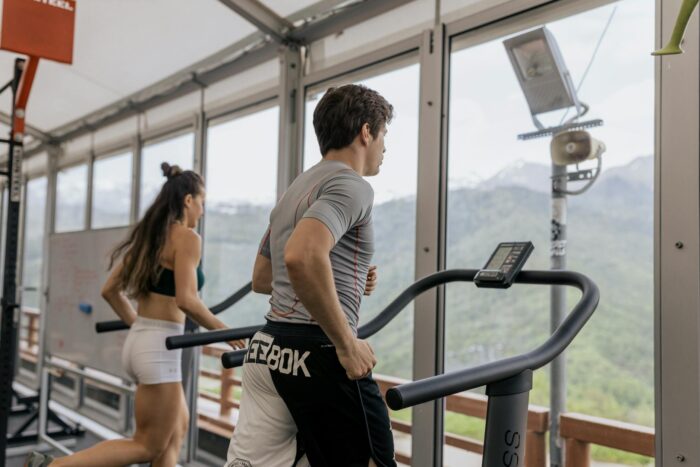
A cardio classic. You can run on roads, tracks, a treadmill or through the woods — all you need is a pair of shoes. Running is a natural movement for the human body and is particularly effective at reducing hip circumference. However, it puts impact stress on your joints, and if you are overweight, it is worth starting with brisk walking, Nordic walking, cycling or swimming.
Increase your training load and distance gradually. A few things to keep in mind:
- Running downhill involves much greater impact — injury can happen sooner.
- Watch your foot placement: your foot should land pointing straight ahead, without turning inward or outward.
- Keep your body upright; do not hunch over as you run.
- Avoid bouncing upward — the aim is to move forward, not to jump.
- Let your upper body contribute to the movement; this lengthens your stride.
- Avoid roads with heavy traffic and polluted air — when you run, you draw air deep into your lungs.
If you get a lower abdominal cramp, stop and let it pass, stretch gently as you move along, or massage or press your fingers into the painful spot. These cramps are usually caused by a localized disturbance in blood flow and pass quickly.
Aerobics and group training
For many people, aerobics is the first thing that comes to mind when they hear “cardio”. A class gives you an instructor, music and company — all of which help keep you motivated. Train with a qualified instructor whenever possible; good workout videos can help when you are at home. If you struggle with rhythm, aerobics may not be your favorite activity, and that is okay.
Wear either dedicated aerobics shoes or running shoes — what matters is good cushioning and support for your feet. The most common styles:
- Low impact — one foot is always on the ground, with no jumping. Suitable for everyone, especially if you are overweight or have been told not to jump.
- High impact — includes jumping movements and is suitable for advanced exercisers.
- Step aerobics — uses a small, adjustable platform and is built around stepping movements. Can be either low or high impact.
- Water aerobics — performed in shallow water at a very low intensity. You do not need to know how to swim, and it is the safest option for your joints.
Newer styles also incorporate elements of martial arts, giving you a little insight into self-defense as a bonus.
Sprinting — short, intense cardio training
Sprinting works well for interval training and is generally not the first choice for beginners. The technique in brief:
- Accelerate as powerfully as you can and keep your stride as long as possible.
- Kick your heels up behind you and bring your legs forward as you run.
- Lean slightly forward to shift your center of gravity forward.
- Run on the balls of your feet for the first couple of seconds, then transition to long strides.
- Swing your arms through a wide range of motion and keep your head facing straight ahead.
- Finishing a longer run with a sprint is a good way to test yourself.
Water, wheels and snow: alternative forms of cardio training
Swimming. Most pools offer swimming lessons if you need them. Swimming is a full-body workout that also suits people who are significantly overweight or recovering from an injury — if you have a leg injury, you can swim using only your upper body. It works well for both long distances and sprints, without jarring your joints. Keep two things in mind: swimming is not strength training and does not increase bone density the way running does; frequent swimming in cold water may cause your body to store fat under the skin as a kind of padding. For this reason, it may not be the first choice for anyone looking to become very slim.
Cycling and off-road cycling. Popular for its convenience and the enjoyment it brings, cycling is especially good out of town in the fresh air. It does not damage your joints unless you go tearing around off-road. A few basic tips:
- Keep your pedaling cadence (rpm) high, especially uphill — this reduces the force you need to apply.
- Keep your tires properly inflated; soft tires make you work harder.
- Always be careful around cars.
- Stand up on the pedals when riding uphill — it makes the climb easier.
Inline skating. A fun lower-body workout. One advantage over ice skating is that you can skate uphill. It puts strain on your lower back, so take breaks to stretch and rest. The intensity is generally low, and you can pick up the skill relatively quickly. There is no jarring impact, but wear protective gear.
Skiing. One of the best aerobic activities, as it engages every major muscle group. Snow, equipment and skill are the limiting factors. It is well suited to long, steady aerobic training and does not jar your joints.
Cardio training FAQ
What is the best form of cardio training for a beginner?
Walking and water aerobics. Both are low-intensity activities that do not jar your joints, and you can increase the training load gradually without overloading your body.
How many times a week should you do cardio?
The general recommendation is moderate aerobic activity 3–5 times a week. Start with less, and only increase the frequency or duration once your current training volume feels comfortable.
Does cardio interfere with muscle mass gains?
Moderate amounts do not interfere and tend to help with recovery. Problems arise when long, hard cardio sessions pile up on top of strength training and your calorie deficit becomes too large.
Translated by: gmaster
Source: CARDIO
Come work out! ArtGym