Squat: technique, strength and safe progress
The squat is one of those exercises where a small technical mistake can grow into a big problem over time. At the same time, a proper squat gives you a great deal: stronger legs, better body control, more strength and a higher vertical jump.
This article sums up the main points of the third part on the squat: the split squat, the problems with the Smith machine, using a lifting belt, rep ranges, speed training and accessory exercises. The tone is blunt, as in the original text. Some passages are harsh on purpose, because a bad squat doesn’t stay forgiving for long.
Why the squat is more than a leg day exercise
The squat is often seen as a thigh exercise. In reality, much more is working at once: the quadriceps, the hamstrings, the hip flexors and extensors, the abdominal muscles and the spinal erectors. If one of these links stays weak, it will show sooner or later.
A simple truth: a chain is only as strong as its weakest link. If you can’t drive up out of the bottom of the squat, it doesn’t always mean your whole body is weak. Often it’s just 1–2 weak spots that let you down. For some people the hips are weak. For others the torso tension disappears. For others the bar drifts off its path before the real effort has even begun.
That’s why the squat is not just moving a weight up and down. It’s a collaboration between posture, breathing, knees, hips and back. When your technique holds, the squat can build strength and muscle mass. When your technique falls apart, the same exercise starts quietly wearing down your joints and lower back.
Squat and split squat: what the technique demands
One well-known squat variation is the split squat. Your feet are about shoulder-width apart, but one foot is in front and the other behind. The position resembles what classic weightlifters use in the jerk, when the bar is taken to the chest and then pushed up with the legs in a split stance.
In the split squat, you lower your body by bending the front leg. The front knee may travel slightly past the toes. The shin isn’t fully vertical but tilts forward by about 10 degrees. The most important thing is to keep your torso upright and controlled. If your body sinks forward or your hips start looking for an easier path, the point of the exercise disappears quickly.
In the split squat, the simultaneous work of the hamstrings becomes more important. The descent phase can be even deeper than in a regular squat, especially when the stride is long. In the eccentric phase, the hamstrings play a protective role for the knee joint (1). This isn’t just anatomy-textbook talk. Anyone who has done a split squat calmly, deeply and without the knee caving in will feel it.
The squat demands honesty, too. If a person can’t perform the movement with proper technique, the weight has to come down. Ego doesn’t lift the bar safely. Good training starts with a weight that suits your technique, not the other way around.
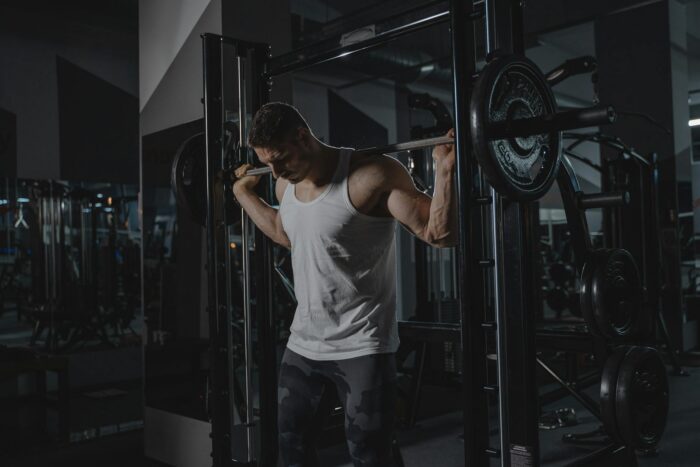
Why the Smith machine doesn’t teach a good squat
The Smith machine seems safe to a beginner. The bar moves on rails, you apparently don’t have to balance, and a coach can say we’ll start here and move on to the real squat later. Honestly, that reasoning is weak.
It’s much easier to learn to do something correctly from the start than to relearn it later. The Smith machine stabilizes the bar for the lifter. That way, a person doesn’t learn to balance the bar, distribute the center of gravity or control their own body position. These skills are important in the squat.
Free weights are more natural and help develop functional strength better (2). On the Smith machine, the bar moves straight up and down, but in a real squat the body doesn’t move that rigidly. A lifter has to be able to use the angles of the hips, knees and torso so that the movement suits their body structure (3).
The Smith machine often keeps the torso in a too-upright position. This can reduce the involvement of the spinal erectors and hamstrings. On paper it sounds like an easier option. In practice, it means that some of the muscles that should protect your knees and back don’t do their job well enough. On top of that, in the Smith squat the knees often travel far past the line of the toes, which can increase the unfavorable forces acting on the knee joint.
This doesn’t mean machines have no place in training. But if the goal is to learn the squat, then you should learn the squat. You get more out of an empty bar, light weight, controlled tempo and proper coaching than from a movement locked between rails.
Lifting belt, volume and the squat in a training program
People have argued about using a lifting belt for a long time. Some say a belt is necessary for heavy squats. Others think it makes the torso lazy. Both sides have a point.
During the squat, a belt can increase intra-abdominal pressure. This helps stabilize the spine and may reduce the compressive forces acting on the back. On the other hand, lower activity of the back muscles has been found when wearing a belt (4). The work of the other trunk muscles may also decrease, which means the torso receives less direct training load when you use a belt (5).
Belt advocates stress that a lifting belt used correctly can improve explosive strength and movement speed without hurting squat technique or joint range of motion (6). The sensible conclusion is simple: a belt is neither bad nor good in itself. It’s a tool. Use it when the weight and the goal justify it, not on every warm-up set.
There are several ways to fit squats into your training program. If the goal is muscle mass, you need to take into account the rep range, training experience, body structure and muscle fiber characteristics. Heavy squats recruit fast-twitch muscle fibers, which have great growth potential. At the same time, a longer set with a lighter weight also contributes to muscle mass, because it increases training volume.
How often you train depends on volume. The more sets and repetitions you do, and the longer the muscle is under tension (time under tension, or TUT), the more recovery you need. Supercompensation doesn’t happen on command. If your body can’t recover in time, the effort at your next workout simply becomes a repeat of fatigue.
Be careful with long sets of squats. In the middle and toward the end of a set, the forward lean of the body often increases. On the one hand, this can increase the involvement of the hamstrings and help protect the knee. On the other hand, too much forward lean can take the training load off the quadriceps and increase the risk of injury (8). So what really matters? Whether your technique holds up under fatigue.
Squats for strength, jumping ability and 1RM
If your goal is to improve your jumping ability, you shouldn’t rely on squats alone. Jumping requires producing a lot of force in a very short time. Squats help increase muscle strength, power and muscle cross-sectional area, but you also need specific exercises that teach you to apply force quickly (9).
The dynamic effort method is used to develop explosive strength. This means you come up out of the squat with maximal speed and power. The weights are not maximal but submaximal, usually 50–70%. This kind of stimulus has shown a good effect on improving jumping ability (13).
One logical model is to do a heavy squat once a week, a ballistic squat or similar exercise on a separate day, and plyometric exercises in the third workout. That adds up to 3 workouts per week. If your recovery is in order, this split can give a strong stimulus for developing jumping ability (14, 15).
If the aim is to increase your squat 1RM, or one-repetition maximum, traditional periodization is often used. Over time, training intensity increases and the number of repetitions per set decreases. Both powerlifters and Olympic weightlifters use this approach.
Training to failure calls for caution. Some people recommend going all the way. Others say you should end the set when your technique starts to break down. For most lifters, the latter is the smarter choice. There is no strong evidence that training to complete failure gives the muscles a clearly bigger stimulus than proper volume training with a small reserve.
A more complex approach is the conjugate training method, an alternating-day program on which the Westside system is also based. In one workout you squat for maximal muscle power, using the dynamic effort method and submaximal weights. In the next workout, 72 hours later, you train the same muscles with maximal-intensity exercises such as the squat, deadlift, good mornings and their variations.
This approach builds on the work of A. S. Prilepin (16), and Louie Simmons’ Westside works on the same principles. The idea lies in compensatory acceleration: the athlete tries to produce as much force and power as they can. As your ability to accelerate improves and your 1RM grows, these qualities start to support each other.
Speed work sometimes uses chains, resistance bands and other equipment that force the athlete to keep accelerating throughout the whole movement. According to Prilepin’s approach, short sets are done on the dynamic effort day (17). The number of sets is high, 10–12, with 2–6 repetitions. The weight is around 50–70% of your squat 1RM. Rest periods are short, 45–75 seconds.
On this day, squats are often done to a box, which is known as the box squat. The box interrupts the chain between the eccentric and concentric phases. In other words, the extra help from the muscle stretch disappears, and the athlete has to start the upward movement from a dead stop.
On the second training day, you use very short sets and high intensity. A set is usually 1–3 repetitions, intensity 90% or more, and 5–10 sets. The goal is to improve intramuscular neuromuscular coordination. This means recruiting more motor units, better synchronization and a lower excitation threshold in the stronger motor units.
Exercises are rotated to keep the stimulus fresh. In one microcycle you might use the box squat, the squat from the pins of a power rack (the rack squat) or the front squat. In the next, you can do good morning variations standing, seated or from the rack. In the third, you can focus on the deadlift and its variations, for example the conventional and sumo versions, or deadlifts from a platform.
Practical signs: where does the squat break down?
Accessory training becomes important when it’s visible which link is the weak one. If the lifter can’t come up out of the bottom position, the problem may be in the hip extensors and flexors, or in a lack of acceleration ability. The latter may be linked to the muscles not being used to quick effort from a stretched position.
If the athlete leans forward on the way up and has to dump the bar off over their head, this often points to poor technique, weak hamstrings or weak spinal erectors. If someone takes the bar onto their back and shakes, wobbles and can’t even stand stably in the starting position, it’s worth looking in the direction of the abs and core tension.
The repeated effort method, or repetitive method, is often added to dynamic and maximal effort days. It means accessory exercises in the 6–12 rep range, with a resistance of 60–85% of 1RM. The main goal is to build muscular endurance and maintain the muscles’ ability to tolerate lactate.
Of course, you can’t say of every failed squat that exactly one muscle was to blame. The body works as a whole. But general patterns help you find the weak link. If your technique is clear and more or less correct, accessory exercises can help you close the gaps.
If you don’t understand the technique, you need to reduce the weight. That is not a step backward. It is the only sensible way forward. Otherwise the question is not whether an injury will happen, but when.
FAQ: squat and training safety
Does a squat always have to be deep?
Depth depends on mobility, control and goal. A deep squat can be very beneficial, but only if your back, knees and hips stay in a good position.
Should you use a lifting belt in every squat workout?
No. A belt is better suited to heavier sets and to situations where you already know how to use intra-abdominal pressure deliberately. Light technique and volume work can often be done without a belt.
When should you end a squat set?
A good rule is to stop before your technique actually breaks down. If your knees cave in, your torso falls forward or your back loses its position, the set has done its job.
References
1. Biomed Sci Instrum 1997;33:360-5 Co-activation of the hamstrings and quadriceps during the lunge exercise. Hefzy MS, al Khazim M, Harrison L
2. Stone, M. H., Johnson, R. L., & Carter, D. R. (1979). A short-term comparison of two different methods of resistance training on leg strength and power. Athletic Training, 14, 158-160.
3. Phys Ther 1995 Feb;75(2):133-44 Neuromuscular coordination of squat lifting, II: Individual differences. Scholz JP, McMillan AG
4. Lander, J.E., Hundley, J.R., and Simonton, R.L. The effectiveness of weight-belts during multiple repetitions of the squat exercise. Med Sci Sports Exercise. 24(5):603-609. 1992.
5. The Effectiveness of Weight-belts During the Squat Exercise. Lander, JE, Simonton, RL, and Giacobbe JKF. Med Sci Sports Exercise. 22(1):117-126. 1990.
6. Attila J. Zink, William C. Whiting, William J. Vincent, and McLaine, A.J. The effects of a weight belt on trunk and leg muscle activity and joint kinematics during the squat exercise. 1999. Journal of Str Con Res.
7. Influence of two different modes of resistance training in female subjects. Hisaeda H; Miyagawa K; Kuno S; unaga T; Muraoka I
8. Lander, JE, Hundley, JR, and Simonton, Rl. The Effectiveness of weight-belts during multiple repetitions of the squat exercise. Med Sci Sports Exerc. 24(5): 603-609. 1992.
9. Force-velocity relationships and fatigability of strength and endurance-trained subjects. Kanehisa H; Ikegawa S; unaga T
Choi, J. Y., Takahashi, H., Itai, Y., & Takamatsu, K. (1997).
10. Comparison of training effects between power-up type and bulk-up type in strength training. Medicine and Science in Sports and Exercise, 29(5), Supplement abstract 54.
11. Hellebrandt, F. A. (1972). The physiology of motor learning. In R. N. Singer (Ed.), Readings in motor learning (pp. 397-409). Philadelphia, PA: Lea & Febiger.
12. Christina, R. W. (1996). Major determinants of the transfer of training: Implications for enhancing sport performance. In K-W. Kim (Ed.), Human performance determinants in sport (pp. 25-52). Seoul, Korea: Korean Society of Sport Psychology.
13. Wilson, G. J., Newton, R. U., Murphy, A. J., & Humphries, B. J. (1994). The optimal training load for the development of dynamic athletic performance. Medicine and Science in Sports and Exercise, 25(11), 1279-1286.
14. Morrissey, M. C., Harman, E. A., & Johnson, M. J. (1995). Resistance training modes: Specificity and effectiveness. Medicine and Science in Sports and Exercise, 27, 648-660.
15. Kraemer, W. J., & Newton, R. U. (1994). Training for improved vertical jump. Sports Science Exchange, 7(6), 1-12.
16. A. S Prelepin. 1969. Preparation of elite Soviet Athletes. Technical Report #1012-62, Moscow: All-Union Research Institute of Physical Culture.
17. Ariel, B.G., 1974. Biomechanical analysis of the knee joint during deep knee bends with a heavy load. Biomechanics. IV(1):44-52.
Translated by: Janar Rückenberg
Source: Turg.Fitness.ee
Come and work out! ArtGym