
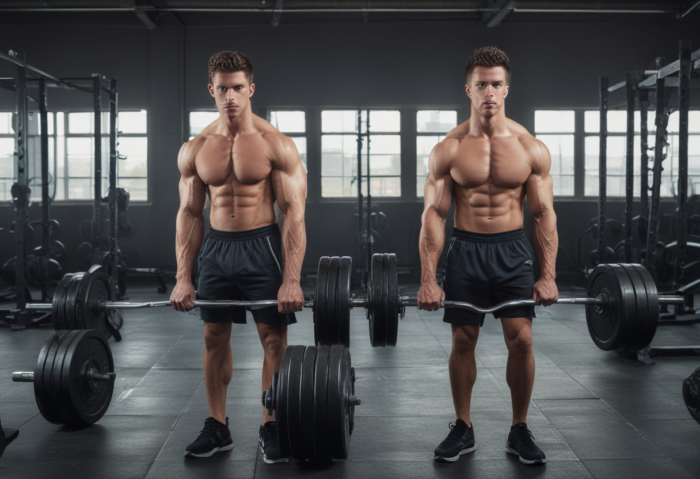
Your body type alone doesn’t determine your strength results
Body type affects how the bar moves in your hands and on your back, but it doesn’t write your progress in advance. Long arms, a short torso or long legs may help in one lift and get in the way in another, but in the end work, technique and consistency count for more.
Why does body type come up in strength training at all?
Excuses are easy to find in the gym. Bad genetics. No time. I’m too old. Another old favorite is “I have the wrong build.” Someone says their arms are too long for pressing. Another thinks their legs ruin the squat. A third looks at the deadlift and thinks this discipline is only for people with long arms.
Honestly, there’s a grain of truth in that claim. Limb length changes the mechanics of a lift. The bar has to travel a different path, the joints end up at different angles, and for some people the same exercise feels more natural than for others.
But here’s a simple truth: a feeling of poor fit doesn’t mean your progress is stuck. It means you need to get to know your body better.
How does body type affect the main exercises?
In general, some relationships are quite logical. In presses, shorter arms give a small advantage because the bar path is shorter. In squats, a shorter torso and/or shorter legs can help because the position is easier to keep under control. In the deadlift, a short torso and/or long arms or legs can be an advantage because reaching the bar is easier.
These are not rules carved in stone. Some people are short but have very long arms or legs relative to their body. Some tall people squat very well. Some short-armed lifters pull huge weights. Training is not just a tape measure.
The original author of the article gave their own example: they were 173 cm tall, with relatively long limbs and a short torso. That build gave them an advantage in the deadlift but did not particularly favor the squat or the press. Even so, at a body weight of 77 kg they squatted 182.5 kg, and did it without equipment.
This example says more than any excuse. If you want to progress, you need to find a technique that suits your proportions. Don’t give up just because someone else’s squat looks prettier.
What can Lamar Gant teach us about this?
When the talk turns to the “wrong” build, many powerlifters think of Lamar Gant. He was a man whose build didn’t fit the usual ideal. Long arms, an unusual posture and very serious scoliosis, i.e. a sideways curvature of the spine or an S-shape.
Yet Lamar Gant was the first man to deadlift five times his own body weight: weighing 60 kg, he pulled 300 kg. Later he also pulled 303 kg and held the world record in both the up to 58 kg and up to 60 kg weight classes. He was a 15-time champion in the IPF, an 18-time national champion, and was even mentioned in the Guinness Book of Records.
It would be easy to say that long arms made the deadlift easier for him. But that would be too convenient an explanation. Gant wasn’t just a good deadlifter. His squat was 280 kg and his bench press 160 kg. These numbers show that his work wasn’t limited to one suitable lift.
Perhaps it was the back problem itself that kept his motivation up. Strong muscles around the spine, better control and constant work with heavy weights may have been more than sport for him. They were a way to keep the body active and toned.
Your body type doesn’t excuse you from learning technique
So what actually happens if you have long arms or legs? You need a slightly different setup. In the squat, foot position, grip width or bar placement can make the exercise much more comfortable. In the deadlift, the starting position may need more patience. In the press, you need to learn shoulder blade work and a stable position.
Don’t compare only how the exercise looks. Check whether the bar moves under control. Does the position hold? Does the weight increase over time? Is pain and discomfort a question of technique, training load or recovery?
If one lift doesn’t suit you right away, it doesn’t mean you aren’t made for it. Sometimes it means you need a simpler variation, a calmer tempo or more repetitions with a lighter weight. The main exercises are tools, not a test of your worth.
Practical thoughts before your next workout
Start by filming a few working sets from the side. Not for social media, but for yourself. You’ll often see right away whether your hips move too fast, your back loses position or the bar drifts away from your body.
Second, don’t change everything at once. If the squat feels bad, try a different foot position for one week. The following week, look at bar placement. If the deadlift strains your back, start with your position and the distance of the bar. Small changes give a clearer answer.
Third, stop arguing with your own body. You can’t swap your limb length, but you can change your technique, training plan and attitude. Body type is a starting point, not a final verdict.
FAQ
Are long arms always an advantage in the deadlift?
Long arms often help in the deadlift because the bar path can be shorter. But that doesn’t automatically guarantee a good result. Position, back strength and practice still count.
Can a bad body type ruin the squat?
Not necessarily. With some builds the squat is technically harder, but a suitable foot position, bar placement and mobility work can change a lot.
When should I change an exercise?
If an exercise causes pain, your technique keeps breaking down or the weight doesn’t move despite consistent work, it’s worth adapting the variation. The goal isn’t to lift the same way at any cost, but to get stronger in a smarter way.
Author: Janar Rückenberg (translation)
Source:Turg.Fitness.ee
Come and train! ArtGym




