
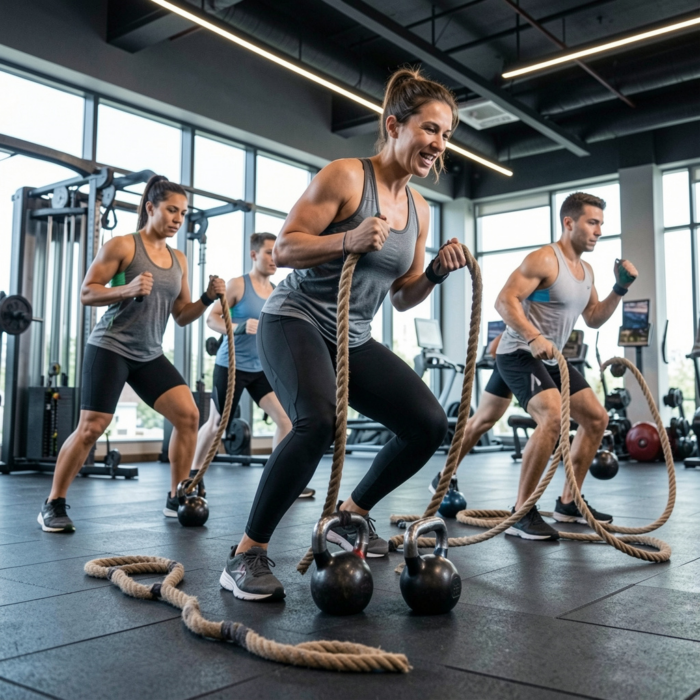
Circuit training: exercises and effects on the body
Circuit training exercises are a good fit for beginners and recreational exercisers who want to improve fitness, tone their muscles and keep their heart rate up in a single session. What matters most is how the circuit is built: the exercises, rests, weights and tempo determine whether you get a strength, aerobic or anaerobic training load.
Why does circuit training work?
The idea behind circuit training is simple: you move from one station to the next, do a short work interval, rest briefly and start the next exercise right away. It is used by the army, the navy, sports teams, physical culture and swimming teams, and health and fitness clubs. The reason is clear: in a single session you can load both the muscles and the heart.
The circuit used in the classic study included 10-12 standard exercises for both the lower and upper body. Each exercise was done for 15 repetitions or 30 seconds. Rests between exercises lasted 15-30 seconds, and three rounds were done in total. A session like this takes about 30 minutes.
The weights were usually 40-50% of RM. RM stands for repetition maximum, the heaviest weight a person can lift in a given exercise. Training was done three times per week for 8-12 weeks. Because everyone used a relatively similar training load, the results were easier to compare.
Circuit training and endurance
So what actually happens? Studies have shown that continuous running, cycling or rowing at about 75% of maximum heart rate for 20-30 minutes, three times per week for 8-12 weeks, raises VO2max by about 20%.
In circuit strength training, heart rate can climb to about 80% of maximum, yet oxygen uptake often stays at only 40% of VO2max. That is close to the minimum at which aerobic capacity can still improve. Energy expenditure in this kind of circuit training is 6-9 kcal/min, depending on body weight.
So circuit strength training is not automatically as effective for aerobic work as running or cycling. When the rest period stretches to 60 seconds, improvements in VO2max have not always been observed. Short rests are the key here. A good trick is to alternate lower-body and upper-body exercises: while your arms recover, your legs work and your heart rate stays up.
The women studied had a VO2max of 35.5 ml/kg/min and the men 47 ml/kg/min. This suggests that a fitter person needs a harder aerobic effort to keep progressing. A moderate gain, a VO2max improvement of about 5%, may not show up as clearly in a more highly trained person.
Circuit strength training also raises lactate levels. This means the training load has a strong anaerobic side. The simple truth: circuit training exercises can be very useful for improving lactate tolerance and buffering, even if pure aerobic development remains modest.
Circuit training exercises and strength results
Circuit training exercises give strength a solid boost when the training load is sufficient. With weights of 40-50% of RM, upper-body and lower-body test results improved by 10-30%. That is a good result, especially for a beginner or someone training for general health.
That said, circuit training should not be confused with maximal strength training. Traditional strength training often uses 60-90% of RM and 1-4 minute rests. This lets you lift heavier weights and build more pure strength. That is why athletes in strength sports mostly stick to traditional methods in the preparation and competition phases.
For endurance and team-sport athletes, though, circuit training can be a good fit. It helps them build or maintain moderate strength while providing an interval-style anaerobic training load. For a beginner it may feel tough at first, not only because of the breathing but especially because of the burning sensation building up in the muscles.
What does circuit training do to body composition?
Studies show that circuit training can increase the proportion of lean muscle mass. Lean muscle mass can grow by 1-3.2 kg and relative fat mass drop by 1-3%, even if body weight stays the same. This matters to those who are not chasing just a number on the scale but want better fitness and a stronger body.
Regular aerobic training can lower body weight, but muscle mass often changes little. Circuit strength training adds muscle work on top of that. When part of the fat mass is replaced by muscle mass, the mirror can change more than the scale shows. Frankly, for many recreational exercisers this is a better measure than the number on the scale alone.
Aerobic circuit training: how to increase the training load?
One study compared two variants. Workout A was circuit strength training in which 30-second work periods at 40% of RM alternated with 15-second rests. Workout B was also circuit strength training, but 30 seconds of running was added between each 30-second work interval at 40% of RM.
The result was clear: group A improved VO2max by 12%, while group B improved it by 18%. In both cases body fat decreased and strength measures increased to a similar degree. This shows that adding an aerobic component can strengthen the effect of circuit training on the cardiovascular system.
The second program started with 3 minutes of aerobic activity at 75% HRmax, followed by a circuit of five exercises at 40-50% RM. This was repeated five times, and the whole session lasted 45 minutes. After 12 weeks, VO2max had improved by 18%, body fat had dropped by 3% and strength had increased by 20%.
The practical takeaway: the effect of circuit training doesn’t depend only on which exercises you pick. Work intensity, volume and rest length are what count. Strength exercises done for 30 seconds with short rests give a moderate strength and fitness effect. If your goal is stronger aerobic development, add controlled aerobic work between rounds or between stations.
FAQ: circuit training
Is circuit training suitable for beginners?
Yes, but start gently. Choose exercises you can perform with good technique, and keep rests short, but not frantically so. If the lactic burn gets too sharp, slow down or reduce the number of rounds.
Does circuit training build muscle?
Strength circuit training can increase lean muscle mass, especially in beginners and recreational lifters. If your goal is maximum muscle or strength, though, traditional strength training is still the better main method.
How many times a week should you do circuit training?
In the studies described here, it was done three times a week for 8-12 weeks. For recreational lifters, this is a good starting point, as long as recovery, sleep and overall training load are in order.
Author: Greta
Come and train! ArtGym




