Squat: how deep to go and how to do it right
Squats are the most debated exercise in the gym. One coach says “all the way down, no exceptions”, another warns about your knees. In reality, the right depth depends on what you’re after in the gym — the needs of a bodybuilder, a powerlifter and an Olympic weightlifter are different. Let’s look at four squat variations, the real injury risks and practical technique rules that will help you make better decisions in the gym.
Four squat variations: squat, deep squat, half squat, quarter squat
Before we start arguing about how low to go, let’s agree on what we’re actually talking about. For me there are four practical squat variations, and they differ precisely in where the top of the hip sits at the bottom of the squat.
Deep squat
Known as the ass to grass squat. Your butt almost touches the floor, and the backs of your thighs and your calves practically meet. Plenty of serious lifters recommend it to everyone — but honestly, if you watch how people actually squat, essentially only the Olympic weightlifting crowd uses the deep squat. Even those who recommend it most fervently don’t go that deep themselves. For a bodybuilder, the deep squat makes the butt too big; a powerlifter doesn’t need to go that deep under competition rules. So why push it on everyone?
Squat
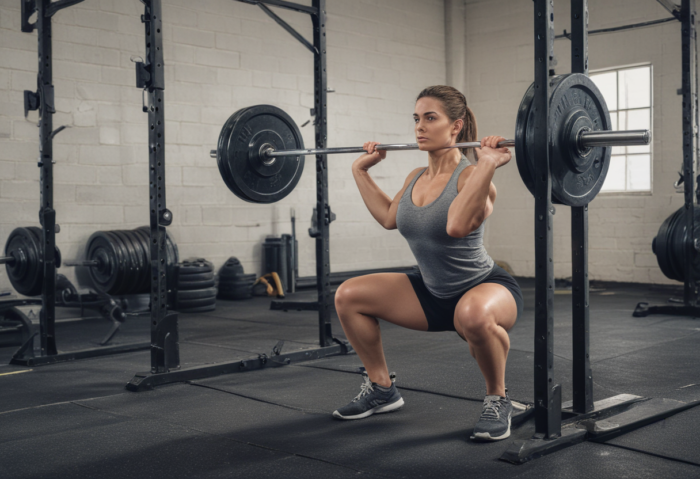
By a squat I mean the top of the hip sitting slightly below the plane of the knee. Most gym-goers consider this a “deep squat”, although in reality it’s simply a proper squat. This is the depth a bodybuilder should reach, and powerlifters squat to the same criterion both in competition and in training.
Half squat
Almost the same as a squat, except the hips stay level with the knees or slightly above that plane. Seen from the side, the thighs are a little above parallel. The difference between a squat and a half squat is actually very small.
Quarter squat
Squats that fall between the starting position and the half squat. The thighs are at about 45 degrees. Quarter squats have their place in occasional training phases — for example, to practice handling heavy weights — but they aren’t suitable for your main work.
How deep should a squat go
Short answer: for both bodybuilders and powerlifters, the range from quarter squat through half squat to deep squat is perfectly sufficient. Only a very small share of people who train need the deep squat. A serious lifter could do the lion’s share of their working sets of squats to a depth that can be called a squat (by the definition above).
You can never completely rule out glute involvement in squats — it comes with lower-body work. But by avoiding deep squats and staying in the squat category, you’ve done your best to minimize glute involvement. Coming up out of a deep squat, the glutes work very hard; coming up from a half squat, less so.
Injury risk: where the load lands
Squats get blamed for knee injuries more than they deserve. Studies have long shown that the squat is considerably less injury-prone than, for example, the leg extension machine (4, 5, 6). Any exercise is risky if you do it wrong — and squatting is no exception, especially in the case of the deep squat.
If you throw yourself to the very bottom with momentum on every repetition of a set of ten with 100 kg, you can hear the cruciate ligaments connecting the femur and tibia creaking. But a normal person doesn’t squat that way — at least not anyone who’s heard the first thing about technique.
What is true is that squat depth directly increases the risk of knee injuries. The deeper the deep squat, the greater the strain on both the anterior and posterior cruciate ligaments (ACL and PCL) (7, 8, 9, 10). The ligaments holding the knee joint together are under unnaturally high strain even when you squat with your heels off the floor (9).
If you wanted to injure a knee as fast as possible, the recipe would look something like this: take a heavy weight, drop fast into the bottom, let your knees travel far past your toes, let your heels come off the floor — and on the way up your knees collapse either inward or outward. That’s a joke, of course. When you actually squat, keep your heels down, especially when training with heavy weights and short sets.
Squat technique: back, bar, foot placement
For the sake of developing the front of the thigh, bodybuilders should occasionally squat with their heels raised 2–3 cm on a block and press through the ball of the foot. For quadriceps development, you can occasionally let your knees travel past your toes more than usual, although this technique puts extra load on the ligaments holding the knee joint together. In that case, use light weights, do longer sets and aim for progress through constant tension. The key word here is extra caution.
Squat heavier weights with more emphasis on the hips — that way the quadriceps still do their work, but your back and knees cope more safely. As for squat depth, you’ve squatted well if you reach the “squat” depth defined above. I don’t recommend the deep squat — and quite honestly, it isn’t even very functional.
Your gaze during the squat should be straight ahead or slightly upward. Don’t look down: the body tends to move in the direction you’re looking, and this is amplified especially when the weight is on your back and you tend to tip forward on the way up. Keep your back straight or slightly arched throughout the entire squat.
Stance width: for a bodybuilder, a stance wider than hip width is definitely not recommended. A narrower stance is fine, and a slightly wider one too — but a very wide stance makes you squat from the hip extensors again, and the quadriceps get less training load. Of course, how wide you can go at all depends on your body and leg length. People with a long torso and short legs squat better technically than those with a short torso and long legs — the latter achieve better technique with a wider stance.

For the average lifter, I recommend squatting more from the hips and sparing the knees, since the hip joints tolerate heavy loads far better. If you want to develop the front and back of your lower body equally, find the golden middle: let your knees travel slightly past your toes, but not all the time. And don’t pile on working sets of squats — if the front of your legs needs more work, use other exercises too (hack squats, leg extensions, leg press).
Bar position and balance in the squat
One important rule: when you view a squatter from the side, the bar on the upper back should travel roughly over the midfoot. The weight has to stay above the base of support. Try it for yourself — if you lean forward so far that the bar moves away from the midfoot, you’ll topple forward. The same goes for falling backward.
Here’s an interesting fact about bar placement on the back: the higher the bar sits, the smaller the distance between the bar and the lower back — and the more the glutes take part in the squat. A high bar position lets you keep your body more upright during the squat, so the squat becomes deeper and more quad-dominant. But since the distance between the bar and the body’s center is greater in that case, the stress on the lower back increases.
There are trade-offs everywhere — there’s no good without the bad. What’s clear is that 200 kg on your upper back loads the back regardless of bar position. Still, logic says that with the bar held low, the shear force on the vertebrae of the spine is smaller, because the weight is closer to the body’s center of gravity. On the other hand, a lower bar means you have to push your hips and butt back noticeably during the squat (so you don’t fall over), and that in turn brings the glutes into play more. A closed circle.
Hamstrings need separate work
Don’t count on the hamstrings getting enough load from squatting alone (7, 11, 12, 13). They don’t take part in the squat that much. That’s why you should do separate exercises for the back of the thigh: Good Morning, leg curls and stiff-leg deadlifts. Balanced development of the hamstrings relative to the quads reduces excess strain on the anterior cruciate ligament (ACL) during squatting.
Squat FAQ
Is the squat bad for your knees?
A deep squat done with proper technique is safer for the knees than many people think — studies show it loads the knee less than even the machine leg extension. Problems come from faulty technique: dropping to the bottom with momentum, heels coming off the floor, knees traveling far past the toes, or collapsing.
How deep should I squat?
For the average lifter, it’s perfectly enough if the top of the hip reaches slightly below knee level. The deep squat, or the “all the way down” variation, is needed in practice only by Olympic weightlifters — bodybuilders and powerlifters have no functional need for it.
Where should the bar sit on my upper back?
A lower bar position (mid-back) reduces shear force on the spine and suits squatting heavy weights better. A high bar (on the traps, near the neck) allows a more upright body and a deeper squat, but adds load to the lower back. Choose depending on your goal and the weight.
References
1. Fry, A.C., C. Smith, and B.K. Schilling. Effects of knee position on hip and knee torques during the barbell squat. J. Strength Cond. Res. 17:629-633. 2003.
2. Caterisano, A., R.F. Moss, T.K. Pellinger, K. Woodruff, V.C. Lewis, W. Booth, and T. Khadra. The effect of back squat depth on the EMG activity of 4 superficial hip and thigh muscles. J. Strength Cond. Res. 16:428-432. 2002.
3. Ninos, J.C., J.J. Irrgang, R. Burdett, and J.R. Weiss. Electromyographic analysis of the squat performed in self-selected lower extremity neutral rotation and 30° of lower extremity turn-out from the self-selected neutral position. J. Orthop. Sports Phys. Ther. 25:307-315. 1997.
4. Beynnon, B.D., R.J. Johnson, B.C. Fleming, C.J. Stankewich, P.A. Renstrom, and C.E. Nichols. The strain behavior of the anterior cruciate ligament during squatting and active flexion-extension. Am. J. Sports Med. 25:823-829. 1997.
5. Escamilla, R.F., G.S. Fleisig, N. Zheng, S.W. Barrentine, K.E. Wilke, and J.R. Andrews. Biomechanics of the knee during closed kinetic chain and open kinetic chain exercises. Med. Sci. Sports Exerc. 30:556-569. 1998.
6. Jenkins, W.L., S. Munns, G. Jayaraman, K.L. Wertzberger, and K. Neely. A measurement of anterior tibial displacement in the closed and open kinetic chain. J. Orthop. Sports Phys. Ther. 25:49-56. 1997.
7. Escamilla, R.F., G.S. Fleisig, N. Zheng, J.E. Lander, S.W. Barrentine, J.R. Andrews, B.W. Bergemann, and C.T. Moorman. Effects of technique variations on knee biomechanics during the squat and leg press. Med. Sci. Sports Exerc. 33:1552-1566. 2001.
8. Spanu, C.E., and M.S. Hefzy. Biomechanics of the knee joint in deep flexion: A prelude to a total knee replacement that allows for maximum flexion. Technol. Health Care. 11:161-181. 2003.
9. Toutoungi, D.E., T.W. Lu, A. Leardini, F. Catini, and J.J. O’Connor. Cruciate ligament forces in the human knee during rehabilitation exercises. Clin. Biomech. 15:176-87. 2000.
10. Zheng, N., G.S. Fleisig, R.F. Escamilla, and S.W. Barrentine. An analytical model of the knee for estimation of internal forces during exercise. J. Biomech. 31:963-967. 1998.
11. Andersen, L.L., S.P. Magnussun, M. Nielson, J. Haleem, K. Poulsen, and P. Aagaard. Neuromuscular activation in conventional therapeutic exercises and heavy resistance exercises: Implications for rehabilitation. Phys. Ther. 86:683-697. 2006.
12. Augustsson, J., A. Esko, R. Thomee, and U. Svantesson. Weight training of the thigh muscles using closed vs. open kinetic chain exercises: A comparison of performance enhancement. J. Orthop. Sports. Phys. Ther. 27:3-8. 1998.
13. Escamilla, R.F., G.S. Fleisig, N. Zheng, S.W. Barrentine, K.E. Wilke, and J.R. Andrews. Biomechanics of the knee during closed kinetic chain and open kinetic chain exercises. Med. Sci. Sports Exerc. 30:556-569. 1998.
Author: Janar Rückenberg
Source: Turg.Fitness.ee
Come and train! ArtGym