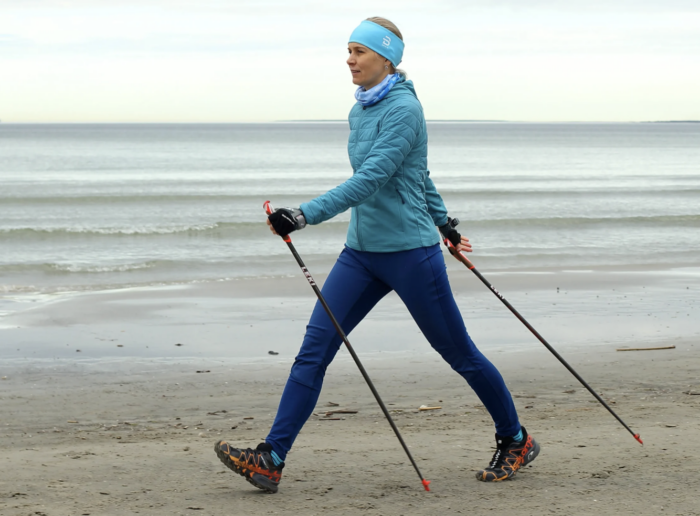
Nordic walking: a simple workout for your health
Nordic walking is an easy way to move more, burn more energy and keep your joints moving gently. If a regular walk feels too easy but running seems too hard on your body, walking with poles is a sensible middle ground.
Why is Nordic walking good for your health?
Nordic walking has one major advantage: it engages your whole body, not just your legs. Your arms, shoulders, back, abdomen, hips, glutes and legs all move together. This makes walking a rhythmic, fairly natural workout.
The original article stated that Nordic walking increases energy expenditure by 20 % compared with regular walking. It also noted that your heart rate rises by 10-15 beats per minute (bpm) more than during regular walking, even though the activity may not feel much harder.
That is the strength of Nordic walking. You get a bigger workload without having to push yourself hard straight away. It is, quite honestly, a good fit if you want to ease into exercise but still feel that your workout is doing something.
- Has a positive effect on your mood.
- Increases energy expenditure by 20 % compared with regular walking.
- Raises your heart rate by 10-15 bpm more than regular walking.
- Reduces the load on your knee joints.
- Regular pole exercise helps improve your physical capacity.
Nordic walking works your whole body
During regular walking, your legs take most of the training load. Nordic walking brings your upper body into play as well. When you move the poles correctly, your arms, back, abdomen, obliques and shoulder girdle all get involved.
So what actually happens? Your stride remains a walking stride, but you push off more actively. A pole is more than just a stick you carry. It helps propel you forward with each step and slightly increases the training load on your body.
Nordic walking also improves respiratory and circulatory function. Your lungs, heart and circulatory system experience a moderate but sustained training load. This is particularly good if longer, gentler activity suits you better than a short, intense workout.
How do you Nordic walk correctly?
The simple truth is that Nordic walking involves more than just taking a stroll with poles. Your arms need to move rhythmically, your body should stay upright and your stride should feel natural. As your right foot steps forward, your left arm moves forward, and vice versa.
Keep your body relaxed
Your shoulders should not be raised or tense. Look ahead rather than constantly looking down. If you hunch over, you lose some of the benefits of Nordic walking and your back may start to tire.
Use the pole to help you push off
The pole should touch the ground roughly alongside your body or slightly behind it. Push through your arm, not just your wrist. The movement should be smooth, without forcefully jabbing the pole into the ground.
Choose somewhere comfortable to walk
You can Nordic walk on asphalt, in a park, on a forest trail, on a sandy beach or on a shared walking and cycling path. In Estonia, it is especially practical in spring and autumn, when running trails may be wet but walking is still possible.
Nordic walking and the old FATBURNER campaign
The original article was linked to a FATBURNER SMS competition. The campaign was a typical promotion for its time in 2006: you had to send a text to 1210 in the format FATBURNER(space)receipt date.
The example was: Fatburner 01.06. The SMS cost 10 kr. The prize system was simple: every 10th sender won FAT BURNER products, every 20th sender won a FAT BURNER DVD and every 30th sender won FAT BURNER walking poles.
Prizes could be collected from Tallinn, Narva mnt. 7D / Viljandi, Piiri2. Information by phone: 612 9000. The campaign ran until 01.09.2006. The old web reference http://www.liiwi.ee/ has been left unlinked here because it no longer works reliably.
What should you keep in mind when Nordic walking?
Consistency matters most. One long walk once a month does not achieve the same results as moderate activity several times a week. Start gently and only pick up the pace once your body has adjusted to the rhythm.
Make sure your poles are the right length, too. Poles that are too long force your shoulders up and make movement awkward. Poles that are too short do not provide enough push-off. A good health walk feels easy, but not sluggish.
Nordic walking FAQ
Is Nordic walking suitable for beginners?
Yes. Nordic walking is well suited to beginners because you can keep the training load light and the movement is based on regular walking.
Does Nordic walking help you burn more calories?
According to the original article, Nordic walking increases energy expenditure by 20 % compared with regular walking. The reason is simple: your upper body gets involved too.
Does Nordic walking put strain on your knees?
With the right technique, Nordic walking may reduce the load on your knee joints because some of the work shifts to your arms and poles.
Come and walk with us: https://www.kepikond.ee/