
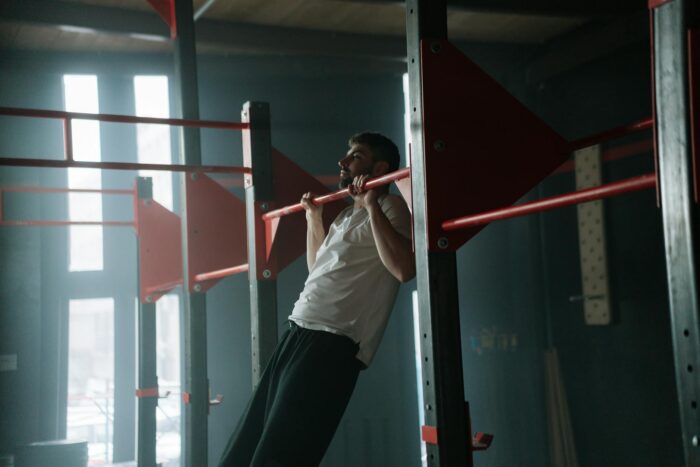
Pull-ups: better technique and a strong grip
Pull-ups only look simple: you hang from a bar and pull yourself up. In reality, success depends on whether you can get your lats working, maintain a firm grip and choose your rep ranges wisely.
Why you need to feel your muscles working during pull-ups
Many beginners do pull-ups mainly with their biceps. That is understandable, because you immediately feel your arms working during the movement. Your back, particularly your lats, can be harder to feel at first. If you cannot feel your lats working, the exercise quickly turns into a tug with your arms.
A good pull-up starts with pulling your shoulders down before you move upward and thinking about your elbows rather than your chin. Your elbows should move down and slightly back. This small shift in focus often changes how the entire exercise feels.
If you still cannot feel your lats working, a training partner can help. The original recommendation was simple: have your partner give your lats a few slaps before the set or keep their hands on your back over your lats during the set. It may look odd to an observer, but sometimes this kind of touch helps your body understand which muscle needs to work.
Pull-ups: how to pull yourself up
5. Initiate the movement with your lats
Before you start pulling yourself up, create tension in your back. Imagine pulling the bar toward you using the strength of your lats. Your arms are working too, but they should not be the main driving force.
If you cannot do this, slow down. Perform one clean rep at a time. The start of every pull-up set does not need to be a race to see who can get up fastest.
6. Drive your elbows down and back
This is especially important for underhand pull-ups. Moving your elbows down and back with control keeps your back more engaged. If your elbows move forward and your body starts swinging, your biceps take on much of the training load again.
7. Pull your chin up to the bar
Traditional advice often says that your chest must touch the bar. This is a useful cue for beginners because it makes you pull yourself high. In practice, getting your chin to the bar or slightly above it is usually enough.
The last inch or two does not add much work for your lats. The smaller muscles of your upper and middle back do work in that part of the movement, but pull-ups are primarily an exercise for your lats. If you want to target those smaller muscles separately, rowing variations are a better choice.
It is simple: pull your chin above the bar, keep your back in a strong position, feel the tension at the top and lower yourself with control.
Improve your pull-ups with grip and rep variations
8. Use different grips
One grip does not have to do all the work. You can use an underhand or overhand grip, go narrower or wider, or have your palms facing each other. You can use a bar, rings, a thick bar, a rope, towels or chains.
Changing your grip is not just a gimmick. It helps distribute the training load, puts your joints at a slightly different angle and keeps your training fresh. If one variation irritates your elbow or shoulder, choose another for a while.
9. Vary your rep ranges
To do plenty of pull-ups, you need both strength and endurance. Strength comes from shorter sets. For these, you can add weight, for example by attaching a weight to a belt.
Endurance comes from longer sets. If completing a full set is still too difficult, resistance bands can help. Bands with different resistance levels allow you to perform longer sets without your technique immediately breaking down.
A practical approach is to use a range of 1 – 5 reps in some workouts and 6 – 12 in others. Occasionally, try a very long set too, such as 15 – 30 reps per set. This develops both strength and your ability to sustain the effort for longer.
10. Strengthen your grip
The stronger your grip, the more securely you can hold on to the bar. This also means a steadier body position and a better feel for your back muscles working. Your grip should not be the reason a set ends before your lats really get to work.
Hand grippers, hangs and heavy dumbbell holds are all suitable ways to strengthen your grip. Do these in addition to pull-ups, rather than instead of them. After a few weeks, you will usually notice that the bar no longer slips out of your hands as quickly.
There you have it: 10 ways to get even better at pull-ups. Initiate the movement with your lats, keep your elbows moving in the right direction, pull your chin up to the bar, vary your grips, experiment with rep ranges and give your grip the attention it needs.
FAQ: making better progress with pull-ups
Does your chest always have to reach the bar during a pull-up?
No. A good goal is to pull your chin up to the bar or slightly above it. If you can bring your chest to the bar with good technique, that is great, but it is not a requirement for every set.
Why do I feel pull-ups more in my arms than in my back?
You are usually initiating the movement with your biceps or letting your elbows move in the wrong direction. Before each rep, focus on your lats, bring your shoulders down and pull your elbows down and back.
Do band pull-ups count as real training?
Yes. A resistance band helps you accumulate quality reps, especially during longer sets. The key is to keep the movement controlled and avoid letting the band do all the work.
Article source: http://jasonferruggia.com/top-10-ways-to-improve-your-pull-ups/
Translated by Janar Rückenberg
Come work out! ArtGym




