The quadriceps muscle and squat biomechanics
The quadriceps is the main worker extending the knee in the squat, but it doesn’t do the job alone. If you want to squat stronger and keep your knees and lower back in better positions, you also need to look at the mobility of your hips, hamstrings and lower legs.
Why is the quadriceps so important in the squat?
From the side, the squat looks simple: you lower your body down and come back up. In reality, several large muscle groups work at the same time. At the front, the quadriceps does the work; it consists of vastus lateralis, vastus medialis, vastus intermedius and rectus femoris. At the back, the hamstrings help: biceps femoris, semitendinosus and semimembranosus. Gluteus maximus is also in play.
There is a small but practical nuance here. Rectus femoris and all the hamstring muscles are two-joint muscles. They cross both the knee joint and the hip joint. In a sense, gluteus maximus can be viewed similarly, since it affects the hip, the pelvis and, indirectly, the lumbar region.
A simple truth: in the squat, you can’t train only the front of the thigh in isolation. When you rise from the bottom of the squat, the hip has to extend. The quadriceps doesn’t do this work alone. The glutes and hamstrings are major helpers in hip extension.
How does the quadriceps control knee movement?
At the start and end of the squat, the same muscle group plays the central role in knee joint movement: the front of the thigh extends the knee. The hamstrings and gluteus maximus take care of the hip joint more. That’s why, when we talk about squats, we always talk about the front of the thigh, the hamstrings and the glutes together.
Honestly, training programs often contain one confusing spot. One day the quads are trained, the next day the hamstrings. But where does the squat fit in? If you do heavy squats right after training one large muscle group, it can interfere with recovery and your next workout. The squat is too big an exercise to treat as the work of a single muscle.
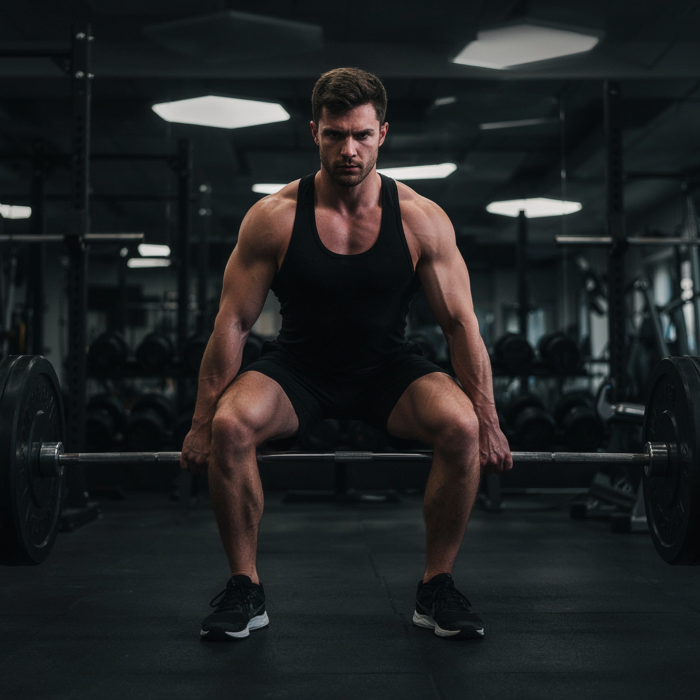
Back position is just as important here as knee position. Keep your spine in a gentle, natural curve. That doesn’t mean an exaggerated arch, but a controlled position where your abs are active and your chest doesn’t collapse. The abdominal muscles help stabilize the body, but you shouldn’t brace them so hard that your back rounds.
Squat depth, mobility and knee loading
Squat depth is not a question of ego. It depends on what your body can do under control. The first limit is the position of your back and feet. If your lower back starts to round at the bottom or your heels lift off the floor, that’s a sign that going deeper isn’t sensible right now.
The second limit is the angle of knee flexion. The original text stressed that bending the leg beyond 90 degrees becomes risky. It’s worth taking this as a practical warning: you need to stimulate the muscle, but not at the expense of the joints. If your technique falls apart before you reach depth, a deeper squat is not a better squat.
The soleus muscle at the back of the lower leg also plays a big role. If the soleus doesn’t let the shin move far enough forward, the body tends to look for movement elsewhere. Usually this means more hip flexion and a more forward-leaning upper body. That shifts more of the load onto the lower back.
Another spot you shouldn’t ignore is the adductors. If the hip adductors lack flexibility, forcefully pushing the knees outward can increase the risk of knee injury. The knees move mainly through flexion and extension. If the position of the thigh can’t naturally follow the movement of the shin, harmful tension develops in the joint.
Practical signs that your squat needs fixing
A good squat doesn’t have to look exactly the same for everyone. People’s hips, ankles and body structures differ. Still, there are a few signs worth watching in every gym and every workout.
- Your heels stay on the floor throughout the movement.
- Your back holds its natural position and doesn’t round at the bottom.
- Your knees move in the direction of your toes, not randomly in or out.
- Your abs are braced, but your breathing doesn’t disappear completely.
- The weight doesn’t force your technique to break down before the end of the repetition.
If any of these points isn’t working, start simpler. Reduce the weight, shorten the range of motion or work on your ankle and hip mobility. This is not a step back. It’s the way to squat stronger later.
FAQ: the quadriceps and the squat
Can you train only the quadriceps with the squat?
Not quite. The quadriceps does a lot of the work in knee extension, but hip extension also needs the hamstrings and glutes. The squat is a whole-lower-body exercise.
Is squatting below 90 degrees always bad?
Not always, but it demands good mobility and control. If your back rounds, your heels lift or something feels wrong in your knee, don’t force the depth.
What should you do if your lower back takes over the load in the squat?
Check your ankle mobility, hip mobility and core muscle work. Often it helps to reduce the weight and use a controlled depth where your spine position stays stable.
Source: www.ifbb.com
Professor Mauricio de Arruda Campos
IFBB Educational Commission
Translated by Jupp, Author Professor Mauricio de Arruda Campos
Come and work out! ArtGym