
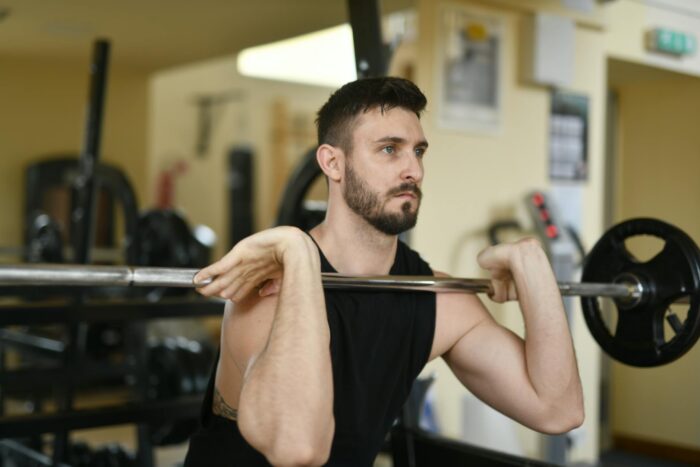
Squats are the king of strength training, but only if you work your back correctly. Poor technique turns the exercise into back pain; good technique keeps the spine protected and builds the entire leg chain. We’ll go through why squatting isn’t “bad for your back”, how to set the barbell on your upper back and what to do about breathing.
Why the squat sparks debate
Spine position is the most important detail. If your back rounds during the squat — especially on the way up — the load shifts onto the discs of the neck and lower back. An arched back keeps the center of gravity in place and spreads the load more evenly between the spinal erectors and the abdominal muscles. If you lean forward, the diagonal forces on the spine grow and the risk of injury shoots up immediately.
The research speaks with one voice: powerlifters who squat with correct technique experience less back pain than other athletes (3, 4). Keeping the upper body upright reduces both the shear and the compressive forces on the spine (2). “Squatting is bad for your back” is mostly the talk of people who haven’t learned the technique.
Squatting below parallel — why it matters
There is no debate on depth. If you squat only to parallel, the sacroiliac joint stays in its starting position. That prevents the spinal erectors and the gluteus maximus and minimus from switching on. When you descend below parallel, the joint goes through its maximal movement and all the assisting muscles are properly engaged.
Barbell on the upper back: how the squat works
Where the barbell sits on your upper back determines how the load is distributed. A high position — on the upper trapezius, close to the neck but never right on the neck — puts more emphasis on the quadriceps. A low position, on the lower trapezius, recruits more of the lower back and the hamstrings. With the low position you have to lean forward more to keep the center of gravity in place.
For powerlifters, the barbell shouldn’t sit lower than about 3 cm below the top of the front deltoid. For an ordinary squatter who does the exercise for a couple of sets a week, it’s best to focus on comfort — the right position comes with time.
Bring your hands in as close to your body as possible rather than spreading them wide. A narrower grip keeps tension and stability in the upper back, and the barbell doesn’t slip as easily. General rule: the lower the barbell sits on your back, the wider your hands go.
Don’t put pads or towels under the barbell. They reduce friction, raise the center of gravity and make balancing harder — which is why they are banned in competitions too.
The squat step by step
The movement starts from the hips, not the knees. Push your butt back, not down — that keeps your shins as vertical as possible. Look ahead and slightly up; this keeps your upper back straight. Your knees travel outward, in the same direction your toes point. Letting the knees cave inward is a classic mistake that you have to consciously avoid.
Once you’ve reached depth, start the ascent. Press your head back and keep pushing your knees outward. How well you performed the eccentric phase largely determines how cleanly you come back up.
Breathing during the squat
The basic rule: breathe in on the way down, breathe out on the way up. Experienced squatters take a couple of deep breaths before descending and hold their breath on the way down. On the way up, from roughly the sticking point onward, they exhale forcefully. This technique is called a partial Valsalva, and it takes time to learn — don’t try it with heavy loads until you can do it cleanly with a light barbell.
The front squat and other variations
Next to the basic squat, most variations are secondary, but the front squat deserves a separate mention. The difference is that the barbell is in front — it runs across the chest and the front deltoids, not across the collarbones. Your hands are on the barbell slightly wider than shoulder-width, and you need to keep your elbows as high as possible. This keeps the barbell stable and forces the upper body to stay vertical.
A more vertical torso puts more training load on the glutes and less on the lower back. The front squat helps develop the mobility and reach the depth that a regular deep squat demands but that many people can’t manage because of limited mobility. The front squat isolates the quadriceps better and recruits less of the hamstrings (5, 7).
For comparison: the squat loads the knee joint considerably less than the leg press or the leg extension, while recruiting significantly more of the hamstrings (6).
Squat FAQ
Is the squat bad for your back?
With incorrect technique, yes; with correct technique, no. An arched back, an upright torso and proper abdominal tension keep the spine protected. Studies show that powerlifters experience less back pain than many other athletes.
How deep should you squat?
Below parallel. That’s exactly where the sacroiliac joint goes through its full range of motion and the glutes engage maximally. Half squats leave half the work undone.
Front squat or back squat?
The back squat is the king of exercises for building overall strength. The front squat is better for isolating the quadriceps and is useful for those whose flexibility is still developing.
References
1. McLaughlin, T.M., Lardner, T.J., and Dillman, C.J. 1978. Kinetics of the parallel squat. Research Quarterly. 49(2):175-189.
2. Garhammer, J. 1989. Weight lifting and Weight Training. In: Biomechanics of Sport, chapter 5, C.L. Vaughan, ed. Boca Raton FL: CRC Press. Pp. 169-211.
3. Granhed, H. and Morelli, B. 1988. Low back pain among retired wrestlers and heavyweight lifters. American Journal of Sports Medicine. 16(5):530-533.
4. Kulund, D.N., Dewey, J.B., Brubaker, C.E., and Roberts, J.R. 1978. Olympic Weightlifting Injuries. Physician and Sports Medicine. 6(11):111-119.
5. Russell PJ, Phillips SJ. A preliminary comparison of front and back squat exercises. Res Q Exerc Sport. 60(3):201-8, 1989 Sep.
6. Zheng N, Fleisig GS, Escamilla RF, Barrentine SW. An analytical model of the knee for estimation of internal forces during exercise. J Biomech 1998 Oct;31(10):963-7.
7. Chandler TJ, Stone MH. The squat exercise in athletic conditioning: a review of the literature. NSCA Journal. 13(5): 58-60, 1991.
Translated by: Janar Rückenberg
Source: Turg.Fitness.ee
Come and train! ArtGym




