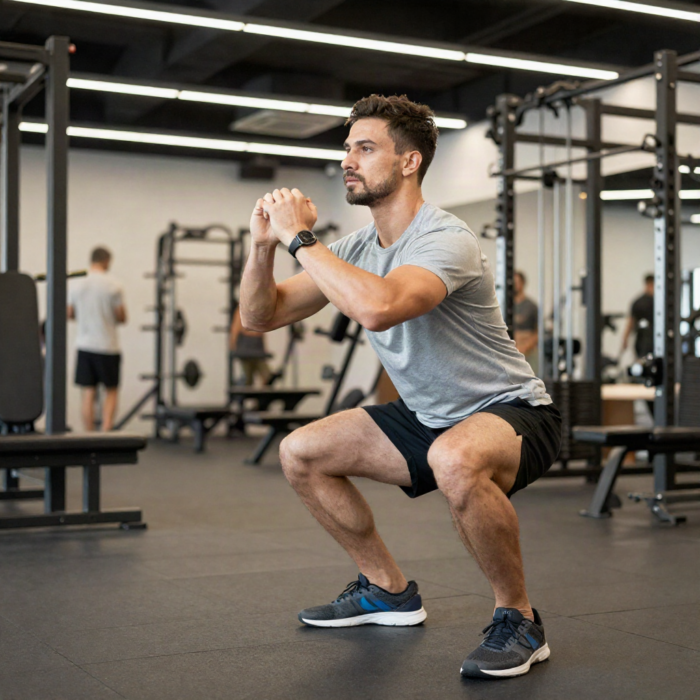
Squat: technique, depth and knee health
The squat is one of those exercises that quickly shows whether your body works as a whole or each part pulls in its own direction. Proper technique helps build strength, muscle mass, speed and jumping ability, but a poor starting position makes the same exercise uncomfortable and sometimes risky.
Why does the squat matter?
The squat should be a staple exercise in every gym-goer’s program. It isn’t just a thigh exercise. Your leg muscles, hip muscles, abs and lower back all do the work. A heavier squat gives your whole body a strong training effect, because it has to stay stable and tight as one unit under the bar.
The basic idea is simple: the bar goes on your shoulders, your knees and hips bend, your body lowers into the squat, or the hole, and you stand back up from there. It sounds easy. In reality, it’s the small details that decide whether the movement is strong, controlled and sensible for your knees.
Squat: starting position and leg work
Squat posture differs from person to person. Long legs, a short torso, hip mobility and ankles all change the movement. One rule stays the same, though: your whole foot must stay flat on the floor throughout the squat. No rising onto your heels. No falling forward onto the balls of your feet.
In general, the center of gravity of your body and the bar should fall in the middle of your foot. In practice, many people benefit from feeling slightly more pressure on the heels. This helps keep the bar path under better control and reduces excessive forward lean. You can learn this feeling with a light weight by briefly lifting your toes and keeping the pressure on your heels.
Your stance should be at least shoulder-width. Some squatters even use a stance twice as wide. A narrower stance loads the quadriceps more, and the bar travels a longer path. A wider stance, sometimes called a sumo-style stance, is common among powerlifters because it can be mechanically shorter and more efficient.
That said, you can’t claim one stance is always better than the other. Records have been set with both. With a wider stance, the adductors, biceps femoris and glutes work more. Squatters with longer legs often use a wider stance, but there are always exceptions (1).
Depth, knees and common mistakes
Your shins should stay as vertical as possible during the squat, or at least close to it. Think of sitting back and down, rather than simply pushing your knees forward. This reduces the load on the knee joint and shifts more of the work to the big muscles around the hips.
So what actually happens when you squat deep? There are plenty of opinions on this. Many people warn against squatting below parallel and call it the death of the knees. Nothing could be further from the truth (2).
Stopping at parallel or above it can put more load specifically on the knees. The deep squat shifts the load more onto the hips (3), which tolerate large forces better. Various studies have shown that the squat loads the knee joint with lower compressive forces than the leg press and leg extension (4).
When you’re building functional strength, it’s worth squatting as deep as you can with control. Control is the key word here. Dropping ballistically into a deep squat is not sensible. Explosive training is a topic of its own, but the main goal of the average lifter should be clean movement, not bouncing off the bottom.
The deeper you squat, the more the biceps femoris muscles come into play. With correct squat technique, the biceps femoris is actually twice as active as during the leg press or leg extension (5, 6). This matters because the biceps femoris helps protect the patellar tendon, which bears the load when we extend the leg.
Knee injuries are often linked to squatting. Frankly, the problem is mostly that people don’t know how to squat with correct technique. A properly performed squat loads the knee adequately (8, 9). This means knee joint stability can improve, and the joint adapts to progressively heavier loads.
Squatting as a long-term part of a training program can improve collagen turnover. This means your joints and ligaments adapt to the load. At least one study has confirmed that international-caliber weightlifters and powerlifters suffered little from symptomatic arthritis (12). Studies have also found that the squat can reduce knee joint laxity and instability (13, 14). In fact, squatting has been used as a rehabilitation exercise for many injuries (15).
FAQ: squat and knees
Does a deep squat ruin your knees?
Not necessarily, as long as you use proper technique and a controlled tempo. Problems arise more often when the movement goes beyond your mobility, your weight shifts onto the balls of your feet, or your body drops to the bottom without braking.
How wide should your stance be?
Start with a stance of at least shoulder-width. If your legs are longer or your hips move better in a wider stance, a wider position may be more comfortable. What matters is that your whole foot stays on the floor and your knees track in the direction of your toes.
Is the squat suitable for recovery too?
It depends on the injury and the training load. A light, controlled squat can be part of recovery training, but if there is pain or instability, the load must be chosen with care.
To be continued…
References
1. Stance width and bar load effects on leg muscle activity during the parallel squat. McCaw ST; Melrose DR Med Sci Sports Exerc, 31(3):428-36 1999 Mar
2. Ariel, B.G., 1974. Biomechanical analysis of the knee joint during deep knee bends with a heavy load. Biomechanics. IV(1):44-52.
3. High- and low-bar squatting techniques during weight-training. Wretenberg P; Feng Y; Arborelius UP, Med Sci Sports Exerc, 28(2):218-24 1996 Feb
4. An analytical model of the knee for estimation of internal forces during exercise. Zheng N; Fleisig GS; Escamilla RF; Barrentine SW, J Biomech, 31(10):963-7 1998 Oct
5. Biomechanics of the knee during closed kinetic chain and open kinetic chain exercises. Escamilla RF; Fleisig GS; Zheng N; Barrentine SW; Wilk KE; Andrews JR Med Sci Sports Exerc, 30(4):556-69 1998 Apr
6. A comparison of tibiofemoral joint forces and electromyographic activity during open and closed kinetic chain exercises. Wilk KE; Escamilla RF; Fleisig GS; Barrentine SW; Andrews JR; Boyd ML Am J Sports Med, 24(4):518-27 1996 Jul-Aug
7. Chandler TJ and Stone MH. (1991) The squat exercise in athletic conditioning: a review of the literature. NSCA Journal. 13(5): 58-60.
8. Hsieh, H. and P.S. Walker. 1976. Stabilizing mechanisms of the loaded and unloaded knee joint. Journal of Bone and Joint Surgery. 58A(1):87-93.
9. Uhl, T.L. and P.V. Loubert. 1990. Axial compression effect on anterior displacement of the in vivo tibeofemoral joint. Master’s thesis, University of Michigan, Ann Arbor, MI.
10. Herrick, R.T., Stone, M.H. and Herrick, S. 1983. Injuries in strength-power activities. Powerlifting USA. 7(5):7-9.
11. Panariello, R.A., Backus, S.I., and Parker, J.W. 1994. The effect of the squat exercise on anterior-posterior knee translation in professional football players. American Journal of Sports Medicine. 22(6):768-773.
12. Steiner, M.E., Grana, W.A., Chillag, K., and Schelberg-Karnes, E. The effect of exercise on anterior-posterior knee laxity. 1986. American Journal of Sports Medicine. 14(1): 24-29.
13. Palmitier, R.A., Kai-Deca-Durabolin – nandrolone decanoate – , A., Scott, S.G., and Chao, E.Y.S. 1991. Kinetic chain exercise in knee rehabilitation. Sports Medicine. 11(6):402-413.
http://www.elitefitness.com/forum/power-lifting/squat-332299.html
Translated by: Janar Rückenberg
Come and train! ArtGym