Strength training is one of the most effective ways for older adults to maintain muscle strength, improve mobility and prevent falls
Age-related muscle loss is not inevitable if you train regularly
Muscle mass and strength naturally decline with age (sarcopenia). Without training, this can lead to:
- balance problems,
- joint pain,
- more frequent falls,
- dependence on others for help.
International organizations such as the American College of Sports Medicine and the World Health Organization recommend that older adults do strength training regularly, at least 2× a week.
➡ The question is not whether to train, but how to train wisely.
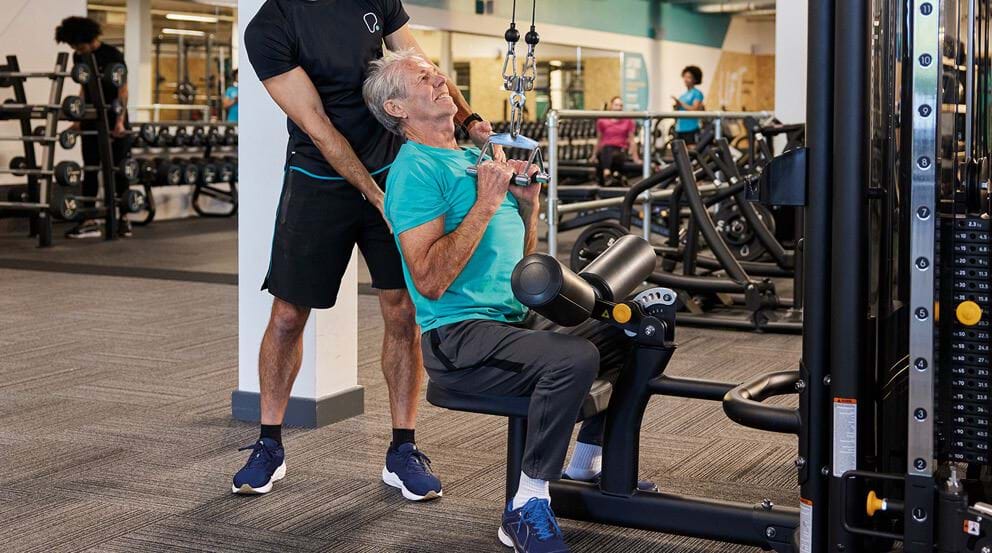
HIT for older adults: is “low volume and very heavy weights” safe?
Benefits of HIT for older adults
✔ short workouts (30–40 min)
✔ easy to fit into your schedule
✔ provides a strong stimulus for your muscles
✔ suits you if you tire quickly
Drawbacks of HIT
❌ an excessive training load can increase the risk of injury
❌ training to muscular failure is not suitable for everyone
❌ your technique needs to be very good
When is HIT suitable for older adults?
HIT can work if:
- you already have training experience,
- you have a trainer,
- your training load is controlled (RIR 1–2).
➡ “Gentle HIT” is suitable for older adults, rather than the all-out effort used in bodybuilding.
High-volume training for older adults: is more better?
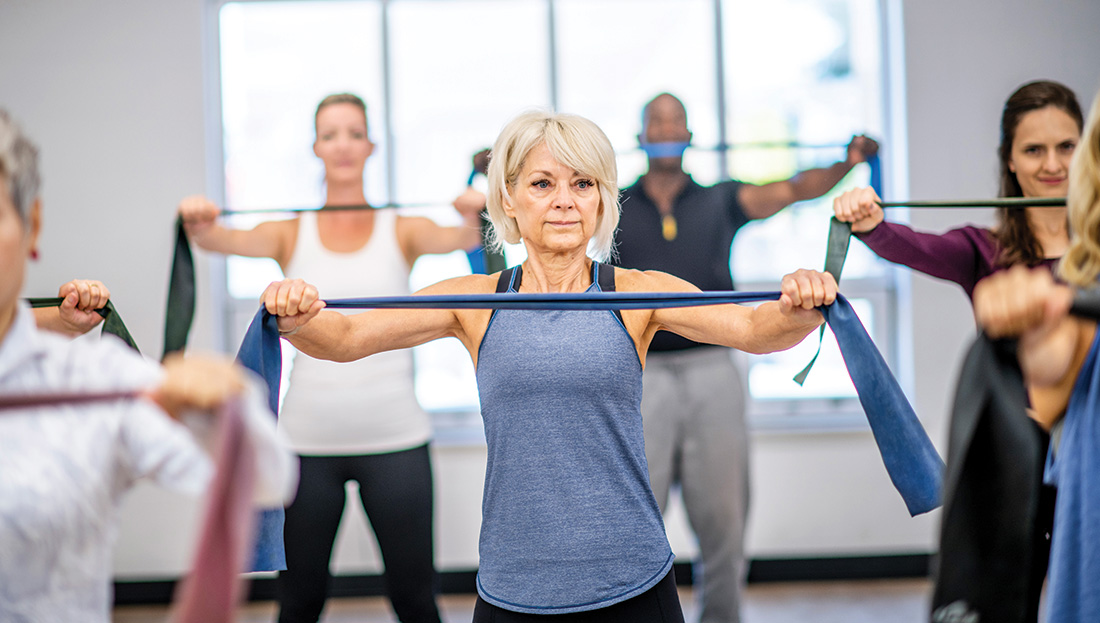
Benefits of high-volume training
✔ improves endurance
✔ develops movement skills
✔ works well in group workouts
✔ maintains joint mobility
Drawbacks of high-volume training
❌ too many sets = excessive fatigue
❌ slower recovery
❌ motivation may drop
When is it suitable?
High-volume training is suitable for:
- active retirees,
- people who enjoy group workouts,
- those whose goal is mobility + overall fitness.
➡ The problem with focusing solely on training volume: strength gains are often modest.
The best option for older adults: a hybrid approach

5
Hybrid = strength + volume + safety
A hybrid approach combines:
✅ the intensity of HIT
✅ moderate training volume
✅ functional movement
In practice, this is the safest and most effective training model for older adults.
What does ideal hybrid training for older adults look like?
Frequency
2–3× a week
Rest days between workouts
Sample workout (60+)
1. Legs and balance
- Leg press / chair sit-to-stand – 2×8–10
- Box step-ups – 2×8
- Calves – 2×12
2. Upper body
- Machine chest press – 2×8–10
- Lat pulldown – 2×10
- Light shoulder press – 2×8
3. Core and mobility
- Abs – 2×12
- Back – 2×12
- Stretches
Training load guidelines
- RIR: 2–3 (2–3 reps in reserve)
- Do not train “through pain”
- Weight ↑ every 2–3 weeks
Comparison: which approach suits older adults?
| Approach | Suitability for older adults | Risk | Results |
|---|---|---|---|
| HIT | Moderate | Moderate–high | Good with supervision |
| Volume | Moderate | Low | Moderate |
| Hybrid | ⭐⭐⭐⭐⭐ | Low | Best in the long term |
➡ Winner: the hybrid approach
Why does the hybrid approach work best for older adults?
1️⃣ Preserves muscle mass
Combats sarcopenia.
2️⃣ Improves balance
Reduces the risk of falls.
3️⃣ Supports your joints
Does not “wear them out”.
4️⃣ Keeps you motivated
Neither too hard nor boring.
Common training mistakes among older adults
❌ Starting with weights that are too heavy
❌ Training too infrequently
❌ Only walking (without strength training)
❌ Ignoring pain
❌ Having no training program
FAQ
Can older adults lift weights?
Yes. Done correctly, strength training is one of the best “medicines” for aging.
How often should you train?
Optimal frequency: 2–3× per week.
Are machines better than free weights?
At first, yes. Later, you can also use barbells and dumbbells.
When should you stop a workout?
If you experience sharp pain, dizziness or unusual fatigue.
🎯 ArtGym
In later life, you shouldn’t train haphazardly.
At ArtGym’s private gym, we offer:
✔ hybrid programs tailored to older adults
✔ safe exercise technique
✔ personalized coaching
✔ progress tracking
If you or a loved one wants to:
👉 stay independent, strong and mobile at 70+, 80+,
then ask your personal trainer for a training plan.
📚 References
American College of Sports Medicine. (2009). Exercise and physical activity for older adults. Medicine & Science in Sports & Exercise, 41(7), 1510–1530. https://doi.org/10.1249/MSS.0b013e3181a0c95c
Borde, R., Hortobágyi, T., & Granacher, U. (2015). Dose–response relationships of resistance training in healthy old adults: A systematic review and meta-analysis. Sports Medicine, 45(12), 1693–1720. https://doi.org/10.1007/s40279-015-0385-9
Fragala, M. S., Cadore, E. L., Dorgo, S., Izquierdo, M., Kraemer, W. J., Peterson, M. D., & Ryan, E. D. (2019). Resistance training for older adults: Position statement. Journal of Strength and Conditioning Research, 33(8), 2019–2052. https://doi.org/10.1519/JSC.0000000000003230
Liu, C. J., & Latham, N. K. (2009). Progressive resistance strength training for improving physical function in older adults. Cochrane Database of Systematic Reviews, 2009(3), CD002759. https://doi.org/10.1002/14651858.CD002759.pub2
Peterson, M. D., Rhea, M. R., Sen, A., & Gordon, P. M. (2010). Resistance exercise for muscular strength in older adults: A meta-analysis. Ageing Research Reviews, 9(3), 226–237. https://doi.org/10.1016/j.arr.2010.03.004
Schoenfeld, B. J., Grgic, J., Ogborn, D., & Krieger, J. W. (2017). Strength and hypertrophy adaptations between low- vs. high-load resistance training: A systematic review and meta-analysis. Journal of Strength and Conditioning Research, 31(12), 3508–3523. https://doi.org/10.1519/JSC.0000000000002200
Steib, S., Schoene, D., & Pfeifer, K. (2010). Dose–response relationship of resistance training in older adults. Journal of Sports Sciences, 28(9), 929–939. https://doi.org/10.1080/02640411003797309
World Health Organization. (2020). WHO guidelines on physical activity and sedentary behaviour. World Health Organization. https://www.who.int/publications/i/item/9789240015128
Fiatarone, M. A., Marks, E. C., Ryan, N. D., Meredith, C. N., Lipsitz, L. A., & Evans, W. J. (1990). High-intensity strength training in nonagenarians. JAMA, 263(22), 3029–3034. https://doi.org/10.1001/jama.1990.03440220053029
PS These studies show that:
✔ strength training improves muscle strength and function in older adults
✔ moderate to high training loads are safe under supervision
✔ training 2–3× a week is optimal
✔ a hybrid approach supports long-term physical capacity
✔ even very old adults (80–90+) can gain strength
Idea: ArtGym; produced by Ai